The Good Man of Albuquerque

It took me a while to warm to Breaking Bad – and the main reason for this is that it took me more than a season to understand what the series is doing. I’m fairly late to the game, only just having started watching season 3, and one of the main reasons for this is that I’d heard so much hyperbolic praise for the series: “Best thing currently on TV!” I’d heard that sort of thing before – but it rarely held up in any way. Seriously, Dexter? Heroes? Entertaining TV, perhaps, at least initially, but neither of those series was anywhere close to the Pantheon of The Sopranos, Deadwood, The Wire and their HBO brethren.

So anyway, Breaking Bad. The premise intrigued me – it’s one of those stories that appeals to my pinko liberal, borderline socialist self: only in America…! Healthcare, shmealthcare, right? If the healthcare system barely deserves that name, cooking meth is a perfectly sane alternative, isn’t it? To my mind, Walter White was a fundamentally decent human being driven to doing something downright insane because of The System, Man, and everything followed from that. Crime, murder, secrets and lies, matrimonial crisis.

Thing is: Walter White is not a fundamentally decent human being. Yes, life has screwed him over – lung cancer when he doesn’t even smoke? – and he doesn’t deserve the hand he’s been dealt. Yes, for much of the first season he doesn’t have time to stop and think about what he’s doing; he’s reacting to the fallout of his first, fateful decision. But once we see Walter make decisions that don’t happen under intense pressure, and we realise: it isn’t cruel fate that makes him do what he does. It’s his own self-pity, self-centredness, and his downright monstrous sense of pride. In fact, in the way he rationalises his increasingly dubious actions, he is a brother in spirit to that greatest of all TV villains believing themselves to be anti-heroes: Tony Soprano.

Note: If you haven’t seen the series at least to the end of the second season, this video won’t make much sense to you – but it will spoil a fairly big plot point. In other words, do not watch unless you know what I’m talking about!

Having said all this, the series does take roughly an entire season to become great. Much of the first season doesn’t exactly know what it wants to be: comedy, drama, bit of both? Are the characters realistic, caricatures or something else altogether? I’m also somewhat doubtful whether the series creators were right to have Walt commit a major crime (no, I’m not talking about some piddly meth cooking) within a couple of episodes of its beginning. Season 1 was entertaining and showed more promise already than, say, the Dexters and Heroes of TV Land, but it’s only in the series’ sophomore season that Breaking Bad fully comes into its own. And now I’m hooked, more so than on any current-gen HBO series – the series is my blue meth.

And as far as poor, decent, selfish, evil, monstrous Walter White is concerned, I’m sorry, Walt, you can’t blame the US healthcare system at this point. I believe Novalis said it best: Character is fate.
Oh, how the ghost of you clings…

Is there another medium as nostalgically in love with itself as film? You don’t really see many paintings about the painters of yesteryear, or novels about novelists from the 19th century. Hollywood, on the other hand, loves looking at itself back when it was younger, had fewer wrinkles, and Michael Bay wasn’t even a twinkle in ILM’s eye.

In the run-up to the last Oscars, there were two major examples of cinema yearning for its heydays: Martin Scorsese’s Hugo and The Artist, a French film whose point of reference is nevertheless the American movie scene of the early 20th century. Both received a fair share of accolades and both put a lot of emphasis on charming their audiences. Both movies are accomplished in many ways, but I’m somewhat torn on them: while I loved Hugo more, I have to say I appreciate The Artist more as a film.

Scorsese’s obviously one of the greats of cinema, and deservedly so. Taxi Driver, Raging Bull, Goodfellas, but also The Last Temptation of Christ, Kundun or the concert film Shine a Light – the man has a strong style, but he doesn’t remake the same film over and over again. Hugo is strange for him in some ways, as Scorsese’s never shied away from gritty, violent themes; trying his hand at a family movie is decidedly new for him. Having said that, there are definite stylistic links between some of his more recent period pieces, especially Gangs of New York and The Aviator, and Hugo, in that a lot of emphasis is put on creating a world. And what a world it is – the Paris of the film is not real in any way, but the train station in which most of Hugo takes place is a beautifully imagined, intricate world.

At the same time, Scorsese’s latest feels like it’s at least two different films, one for children who enjoy Little Rascals-style capers and broad characterisation, and one for people who love the cinema. Narratively these two are bridged by the sadness at the heart of the film, embodied by the titular character who has lost his father, but the result is a work that doesn’t always feel coherent. After seeing the film I walked out of the cinema feeling a warm glow for the love letter to the movies that I’d just seen, but I also sat in the dark feeling impatient for the slapstick, the scenes of Hugo running away from a panto-style villain and the “gosh, it’s an adventure, isn’t it?” enthusiasm of Chloë Grace Moretz’s character to end and for the film to get back to Méliès. The scenes that are primarily about the magic of movies are beautiful and poignant – much of the rest of the film first and foremost made me think that it’s been decades since I was twelve years old. Perhaps I’m not the ideal audience – but I honestly wonder whether a twelve-year old would be all that likely to respond to the scenes focused almost entirely on Méliès and on film history. How many twelve-year old film buffs are there?

While I share Hugo‘s love for cinema, I’m by and large indifferent to silent movies, to the extent where I don’t even remember if I’ve ever seen an entire one. (Yes, I do feel a bit guilty about never having seen Metropolis. Happy now?) I’m not sure The Artist‘s makers are nostalgic to the era where films were silent, either, or that they wanted to start a new wave of dialogue-free films. (Our cinema showed a Swiss short beforehand, also silent and fashioned as a pastiche of the original films of the ’20s. It was unbearable, smug and shallow, having nothing going for it other than wanting to emulate the style.) Take away the self-conscious, meta-cinematic elements and The Artist doesn’t work; but it’s this (dare we say postmodern?) playfulness that is as central to the film as the considerable charms of its two leads, Jean Dujardin and Bérénice Bejo. The film’s a meringue, as I would put it: sweet, delicious and so light the slightest puff of air could blow it away. It doesn’t have much substance in any conventional sense – but charm, style and wit can have a substance all of their own.

What The Artist finally does better than Hugo is this: it’s perfectly formed, it comes together into a whole. It is a complete film rather than two half-films patched together, with considerable skill that nevertheless cannot hide the join. And for all of Scorsese’s talent, The Artist works better because it has made a decision what sort of film it wants to be, and then it’s about the best such film it can be. As far as meringues go, it’s just about one of the best I’ve had.

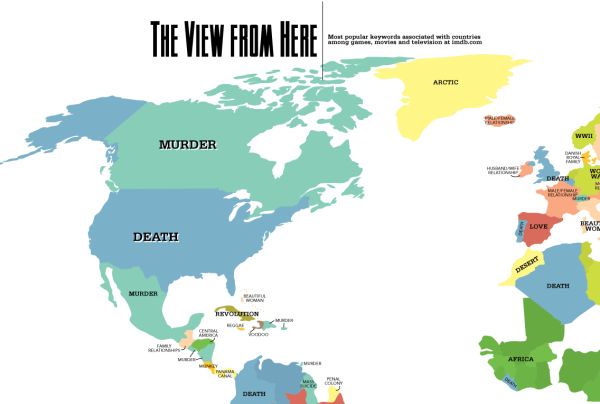
Looking for Murder, Love and Death in all the wrong places…

Yeah, I still owe you a genuine blog update, don’t I? Planning to write one on films in love with cinema (is that incestuous or masturbatory? or both?) this weekend, but in the meantime here’s a fascinating infographic from a site called Very Small Array: Popular IMDb Keywords Associated With Countries. Sounds boring, I know, but do check it out, and make sure to check out the map at the maximum available size.

March Variety Pack

Another month, another variety pack. I’m planning to write longer posts on Hugo and Breaking Bad – and possibly Being Human, depending on my mood – but in the meantime here are some shorter takes on a few of the films I’ve seen recently. Everything from teenage killing machines to Bostonian remakes of Heat and tragicomic Irish policemen – oh, the humanity!

Hanna

Joe Wright’s film about a teenage assassin and her odyssey is an odd ‘un. It’s definitely strikingly different from what you might expect reading the blurb on the back of the DVD, and it’s got a lot going for it – but in the end I don’t think it works all that well. Hanna, starring the unpronounceable Saoirse Ronan, is basically three different films: a gender-swapped Bourne Identity, a modernised L’Enfant Sauvage and a stylised, symbolist-bordering-on-the-surreal fairytale. It pulls off the first two, but it is both most interesting and least successful in the latter: there are elements reminiscent of Little Red Riding Hood, with the weirdest variation of the Big Bad Wolf ever (played by Tom Hollander as an artsy, flamingly camp psychopath, which should give you an idea), but these more stylised elements stand out like sore thumbs compared to the almost-realism of the more Bourne-inspired parts. It’s a shame – there’s a lot to admire about the film, from Ronan’s acting to the cinematography, but there are bits that feel half-baked or even outright ridiculous. And if Cate Blanchett’s accent even comes close to resembling the way any real human being talks, I’ll buy a 40-gallon hat and eat it.

The Guard

I am a big fan of Brendan Gleeson. I like black humour. Don Cheadle is one of the most criminally underused actors in Hollywood. And In Bruges was one of my favourite films the year it came out, making me laugh and cry in equal measure.

The Guard feels like like it’s trying to go for an In Bruges feeling in some ways, and Gleeson’s character has the same sort of laconic, melancholy humour going – but it doesn’t even come close to the earlier film’s… integrity, for want of a better word. The Guard is funny, undoubtedly, but its tentative attempts to be more than a pleasantly diverting, dark comedy don’t lead anywhere. Worse perhaps, The Guard is lazy in how it seems to think that it’s enough to have Gleeson play his usual part (or even a reduced version thereof) and have some jokes, and the rest will take care of itself. It isn’t, and especially if you’ve got Don Cheadle in the film it’s a massive waste to give him the most underwritten part in the film. If The Guard, whose author is the brother of In Bruges’ writer director Martin McDonagh, had come first, it might have been less of a disappointment – as it is, it’s difficult not to think that the time it takes to watch the film would be better spent on the earlier, better movie.

One thing, though: it’s great fun to watch the scenes shared by Liam Cunningham and Mark Strong. If there were ever a prequel spinoff focusing on their two characters, I’d watch it at the drop of a hat.

The Town

Talk about films that would play better if you hadn’t seen earlier film X… I’ve never been a big fan of Ben Affleck as an actor – I don’t dislike him, but I find him fairly bland, perhaps 0.47 McConaugheys – but I very much enjoyed his directorial debut, Gone Baby Gone (starring his kid brother Casey). The Town shows the former wasn’t a fluke – Affleck definitely has a talent for directing, and I was surprised to enjoy his acting in the film more than in most other things I’ve seen him in, even though I’m usually suspicious of actor-directors who put themselves in the main part. The film is also well written, acted and filmed – but it is practically impossible to watch it without thinking Heat… and more specifically, that Heat does everything better than Affleck’s film. There are too many echoes in The Town to Mann’s masterpiece, so that halfway into the movie it was difficult to focus fully on what was happening and not sit there thinking, “Yeah, this is just like that scene with Ashley Judd, and that’s very much like that bit with Tom Sizemore…” I liked The Town quite a bit – and am definitely planning to keep my eyes open for Rebecca Hall – but it brings too little to the table compared to Heat not to suffer from the comparison. In a world without Mann’s movie it might be different, but as it is I have to wonder: was there ever a moment when someone on the crew, the Director of Photography or one of the producers, said, “Listen guys, great work’n’all… but I’ve seen this film before, it was called Heat, and why exactly are we doing a Boston-based reskin of that movie?”