We left off last time with a cinematic version of what the Great Beyond might be: Hirokazu Kore-eda’s After Life, in which the newly deceased have a few days in a threadbare but friendly waystation to decide on the one memory that would be made into a film, and that film would then be all that remains of them for eternity.
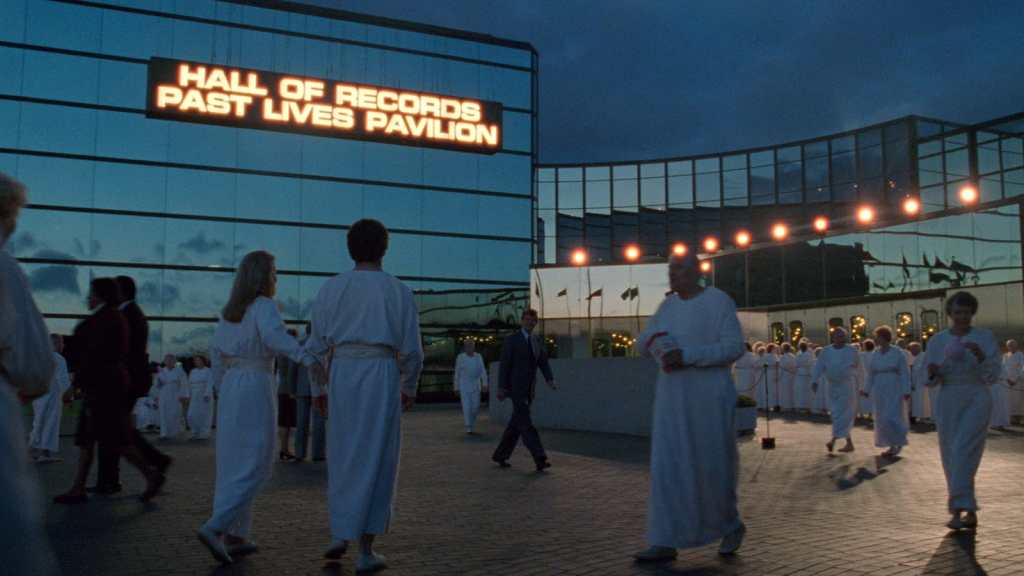
Defending Your Life, Albert Brooks’ 1991 romantic comedy with a satirical slant, shares some surprising qualities with Kore-eda’s film. Its afterlife is also entirely mundane, though in a decidedly more American way, and it is likewise staffed with people who are there to determine what happens with you next. Like in After Life, none of the people who have just died question their fate, nor do they seem overly concerned with metaphysical questions. No one brings up God or religious belief, though in Brooks’ version of the hereafter people are somewhat concerned with heaven and hell – where will they go to next? But first there are more important questions – where will they go for dinner? This afterlife is a place of all-you-can-eat restaurants that will pack you nine pies to take back to your anonymous hotel room. Judgment City is the American hereafter, after all.

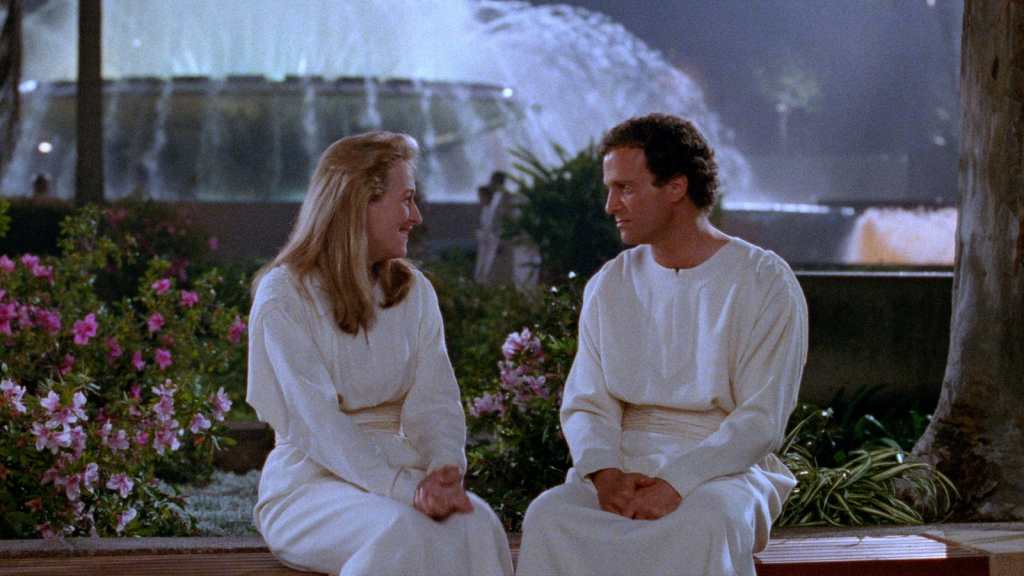
I first saw Defending Your Life a couple of years after it originally came out. In my late teens, I had a phase during which I suffered from pretty bad insomnia. I was relatively lucky in that I was still living at home and my parents had satellite TV and a subscription to early pay TV channels, which meant that I spent more nights than I care to remember zapping through the movie channels and stopping when something caught my attention. One of the films that did so was Brook’s comedy of the afterlife. I can’t remember exactly what it was that would have made me stop and watch: it wouldn’t have been Albert Brooks, who I didn’t know at the time, but it may have been Meryl Streep, in her early 40s but looking younger. More likely, though, it was the incongruous images of what looked like present-day America, anonymous, urban and corporate, and people walking through it dazed and looking goofy in these white robes.
By now, it’s been thirty years, so I didn’t remember much about the film. What I did remember was that I enjoyed it: there were plenty of movies I watched at 2am simply to pass the time until I’d go back to bed and try to get one or two hours of sleep after all – and there were films that I remembered because there was something about them that resonated with me. Defending Your Life was an example of the latter. I remember finding it funny but also surprisingly poignant, even if the only concrete thing I remembered was the film’s denouement and Brooks clinging to a bus with Meryl Streep inside it.
Being the Criterion addict that I am and having just rewatched After Life, I remembered that Defending Your Life had had a Criterion release a couple of years ago and thought: why not revisit a film that I enjoyed a lot during a time when films were one of the few things that kept me from despairing, after many, many nights of getting little more than three or four hours of sleep? It might be fun to look at these films side by side, seeing how they both feature a world in between life and death where the newly dead watch video footage of key moments in their lives in a process designed to determine what will happen to them next.
Reader: it backfired. Don’t get me wrong: Defending Your Life isn’t outright bad, and there are things I found I still liked about it. For one thing, while I must confess that I’m not exactly a big fan of Meryl Streep, she is both fun and funny in this one. Her performance as Julia, the woman Daniel (played by writer-director Brooks himself) finds himself falling for during the few days before moving on to his next life, is winning and very different from her many more dramatic roles. Arguably she’s something of an early example of the Manic Pixie Dream Girl trope, but she lends her part a warmth and a spark that make her come across as a real person even when the role remains somewhat underwritten. The satire that Brooks’ bureaucratic afterlife is infused with is also mostly amusing, even if it is too mild to be particularly critical of anything. And Brooks and his creative team have fun with a lot of ideas and especially how they’re translated into the overall look and feel of Judgment city.
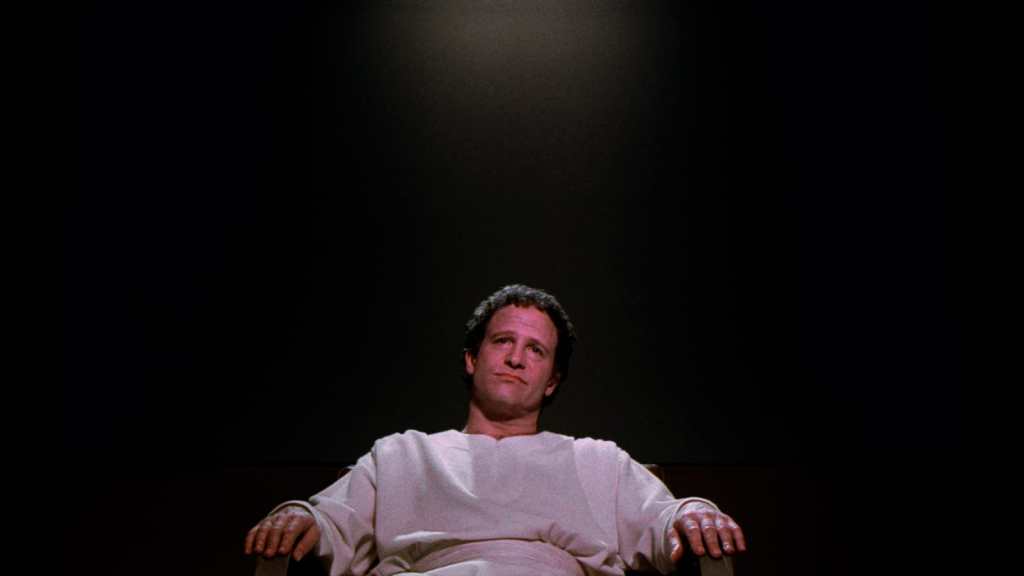
But one aspect of the film doesn’t work for me at all. Perhaps it didn’t much register with the much younger insomniac me, or perhaps I just didn’t remember the things I didn’t like about Defending Your Life – but on rewatching it thirty years later it stood out like a sore thumb. Even though the legal staff in Judgment City keep stressing that the recently dead aren’t put on trial, Daniel has to defend his life, as the movie’s title puts it. He has to justify key choices he has made during his life. And most of all, he is accused of being unable, after many, many lives on earth, to move past his fears: fears of failure, of not measuring up. While Brooks’ film plays the trial itself mostly for laughs, it nonetheless seems to take this notion – that human beings are held back first and foremost by their fears – seriously enough to have it drive the plot. But when it shows Daniel in situations where he didn’t act because he was supposedly afraid, little of this makes sense in the grander scheme. As a kid Daniel didn’t dare fight a bully. As a young man he didn’t enter into an investment with a friend that would have made him a lot of money. He pulled out of a public speaking engagement because he suffered from stage fright. These choices supposedly define Daniel more than anything else, and they all build up to the film’s shallow, facile concept of fear and its effect on our lives. The idea might work better if it was less spelled out, or if Daniel’s fears were developed into something more rounded, more three-dimensional, or alternatively the movie could lean more into the trial’s arbitrariness, developing its mild satire of the US justice system into something more interesting – but Defending Your Life ends up being surprisingly po-faced about the notion. There’s not a trace of perceptiveness, ambiguity or poetry about how the film handles this theme, so that it ends up with little more substance than a self-help tape or a motivational poster. And yes, obviously I don’t go to early ’90s romantic comedies for life lessons, but this thematic strand is too much foregrounded, too central to the film’s plot, to ignore.
Verdict: Sadly, sometimes it’s better to remember things fondly at a distance of decades than to revisit them. There is always a risk of disappointment – and more, there is the awkwardness of asking yourself just why you liked something in the first place. Defending Your Life is certainly not in that league of disappointment, but it is difficult for me at this point to recapture why the movie resonated with me more than half a life ago. However, it does illustrate the risk inherent in returning to something you once enjoyed this much later, urged on by so many enthusiastic mentions over the years, and then – most decisively – the Criterion release of the film. But then, who knows? Perhaps I need to revisit Defending Your Life in another thirty years. Though I suspect I’m more likely to return to Kore-eda’s version of the hereafter. Which the tribunal in Defending Your Life may well interpret as an instance of me being afraid… but I think I can live (and die) with that.
 A Damn Fine Cup of Culture
2 thoughts on “Criterion Corner: Defending Your Life (#1071)”