She’s in her 30s. She’s smart, savvy – and perhaps a little too proud of her critical abilities. She’s an atheist, and when she enters a church and sees the confessionals, what she thinks of isn’t faith or confession, she thinks of how she can challenge the curates. So she talks to the young, sexy priest, seeing if she can shake his faith – and the conversation that develops with them, over several meetings, is as much about belief and ethics as it is an extended flirtation. She is drawn to him, and while he doesn’t say so, his actions suggest that the attraction isn’t one-sided. What exactly is he trying to convert her to – and what is she trying to convert him to? And where can this ongoing, and increasingly erotic, duel of wits lead?
The young woman is Barny (played by Emmanuelle Riva, icon of French arthouse cinema), and the sexy priest (Jean-Paul Belmondo, just one year after Breathless) is the title character Léon Morin. But even considering how much of a cliché the constellation is – a sexy priest, an attractive young woman -, it is difficult not to think of Phoebe Waller-Bridge’s modern classic Fleabag.
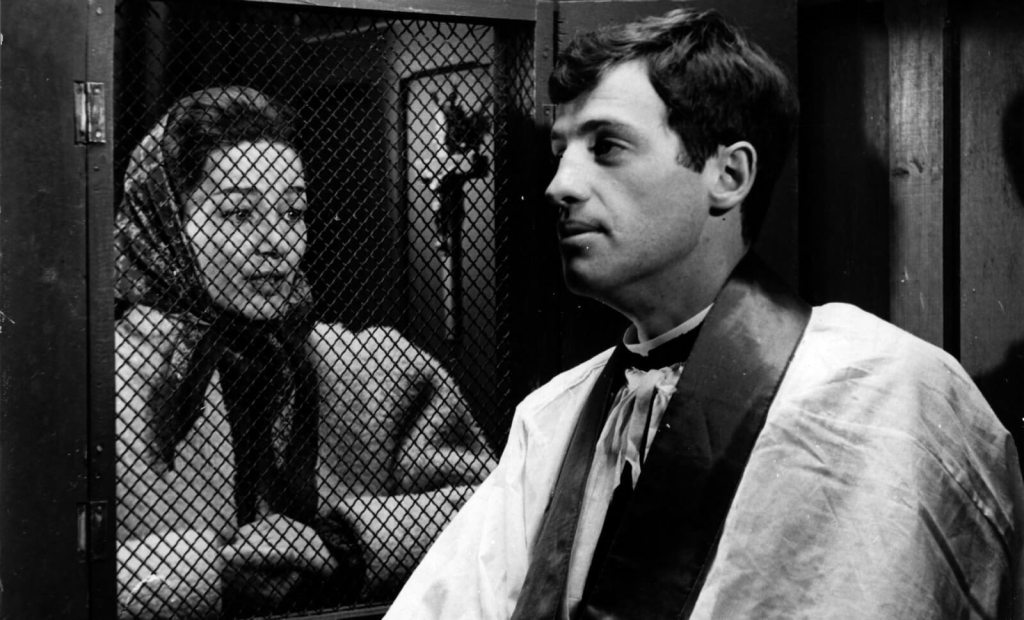
I’d not even heard of Léon Morin, Priest until the best little cinema in the world started a series of films by French director Jean-Pierre Melville. Our own viewing of the films started with Le silence de la mer and Army of Shadows, two very different films about wartime resistance that I’ll return to at a later time. Both of these were dark, brooding, intense, albeit in very internalised ways. Neither prepared me for the very different beast that is Léon Morin – a film that is witty, even funny, and sexy, adjectives that are unlikely to come up at the top of the list when talking about Le silence de la mer or Army of Shadows.
Léon Morin may have as its title the name (and occupation) of the priest in a small town in rural France who during the occupation of the country, first by the Italians and later by the Germans, comes to be the centre of all the women’s erotic interests while the men are away. But as well as Belmondo plays him, he remains something of a cipher onto which others project their longings and resentments. The film is very much Riva’s, whose Barny is witty and frank, not least in sexual matters. She is aware of her own needs and desires, but at the same time there are limits to her self-awareness. Early in the film she waxes rhapsodic about an attractive female co-worker, but she seems in denial about the extent to which her appreciation of the woman is erotic in nature, while after she’s begun her ongoing conversations with Morin she renounces her atheism and returns to the church, it is not clear to what extent she understands that this may be less about belief and God than about the attractive instrument God has put in front of her as a way of seducing her back into the fold.

Melville’s film is fascinating, but it is also frustrating at times. Its wartime setting is intriguing and provides additional moral ambiguity to Barny’s conversation with the priest, for instance when she learns that an acquaintance of hers is on the Résistance’s kill list for working with the Germans and she is in a position to save a life or to let the woman be killed. At the same time, the romantic storyline and the overall tone of the film can seem at odds with the gravity of the situation, and Barny’s world, even under German occupation, is a very different one from the wartime reality of Army of Shadows, Melville’s later film about occupied France. While Léon Morin never succumbs fully to a rom-com feel, it can be sensed around the edges in a handful of scenes.
What makes the film more frustrating, though, is the title character: Léon Morin himself. It is clear why the women of the little town are fascinated with him, seeing how most of the men are away and the priest is young, smart and played by Belmondo. But I found myself thinking, repeatedly: why doesn’t Barny challenge him and his thinking more? This is where the Fleabag comparison definitely falls down: Barny has the potential to be as sharp with her comebacks as Waller-Bridge’s character, and differently from Andrew Scott’s sexy priest the arguments that Morin lobs at the young woman rarely go far beyond Converting an Atheist 101. His theology is appealing on the surface, especially to a communist like Barny, but they don’t hold up to much scrutiny, and I wanted her to throw them back in his face, rather than submit to his smugness. Intellectually and theologically, he shouldn’t be as much of a challenge to her as the film seems to presume he is.

But perhaps that’s the point: both for Barny and for the priest, their conversation is about God and belief on the surface, but underneath the surface there are entirely other things being negotiated: sex, love, power. Their talk of faith and of religion is safe, because it allows them not to say the things that are really on their minds. And when Barny does speak these things out loud, Morin eventually leaves, to bring God to the remote, rural areas of France. He can deal with her desire when it is boxed inside theological talk, and once it no longer is, he cannot deal, because this would require him to face up to his own desire. In that sense, his feelings for Barny may not be altogether different from her feelings for her colleague at work: they’re only safe, acceptable and manageable if everyone can pretend the conversation is about something altogether different. Sublimation as a means of self-denial.
Melville’s filmmaking isn’t entirely helpful in the matter: at times the mis-en-scène gives the impression that the film is as infatuated with Morin as Barny herself becomes, creating a power imbalance between the two. I found myself wanting a film that’s more overtly critical of the priest, when the film develops in the opposite direction: Barny is a more worthy sparring partner early on, and over time she succumbs to Morin’s charms. But the more she falls for him, the less she hides her desire for him, and perhaps this is Morin’s Achilles’ heel, more so than a perfectly honed counterargument to his theological talking points: a woman who plainly states her desire for him, forcing him to reckon with his own desire.
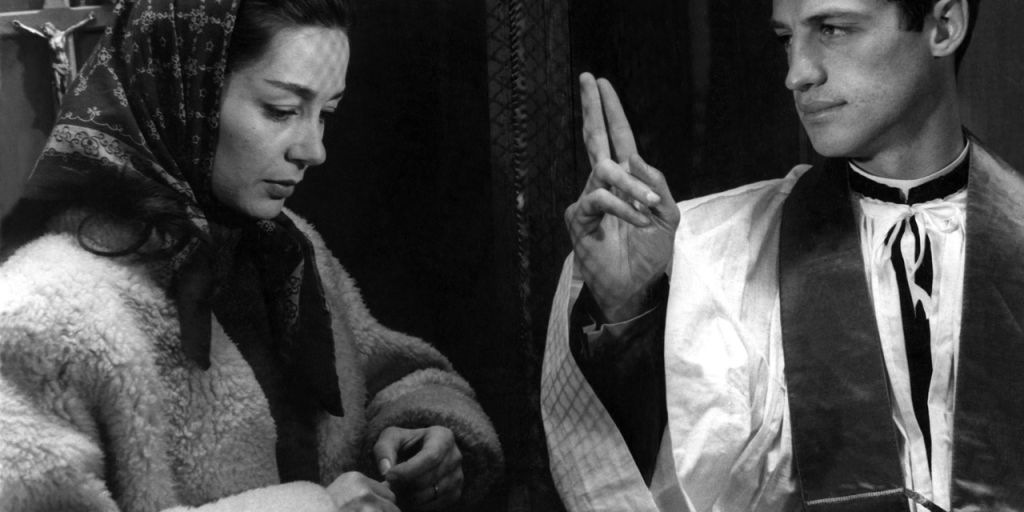
Léon Morin, Priest isn’t the iconic classic that Le samouraï is. It lacks the singularity of vision, the style, it has too many things, too many characters, too many themes that it is interested in. But in that lack of focus there lies a richness that is as appealing as Emmanuelle Riva’s Barny. And, let’s be honest, it’s nice to watch a film by Jean-Pierre Melville that is at least as interested in its female characters as it is in its male characters. It may be frustrating to find out that desire eventually trumps intellect – especially when the latter is one of the elements that both of the main characters find attractive in the other – but finally, the film slyly hints that it is not only the young, widowed woman who is ruled by her erotic needs. And while priests have needs too, especially if they live in a village where they are practically alone in being young, male and Belmondo-shaped, it says a lot that Morin’s way of dealing with this is finally to run away.
 A Damn Fine Cup of Culture
One thought on “In France, they call it le Fleabag: Léon Morin, Priest (1961)”