There are many kinds of resistance. The one that’s perhaps most familiar to us – more so from the cinema screen than from personal experience, most likely – is that of taking up arms against the oppressor. The French filmmaker Jean-Pierre Melville made a number of films in which the French Résistance and its fight against the occupying German army featured, most famously perhaps Army of Shadows (which may come up more prominently in a future post), and as one might expect, the film depicts a heroic (if bleak) armed struggle.
While the setting is a similar one – the Second World War, occupied France -, the resistance of Le silence de la mer (The Silence of the Sea) is of a very different kind; as is, arguably, the characters’ struggle with each other and with themselves.
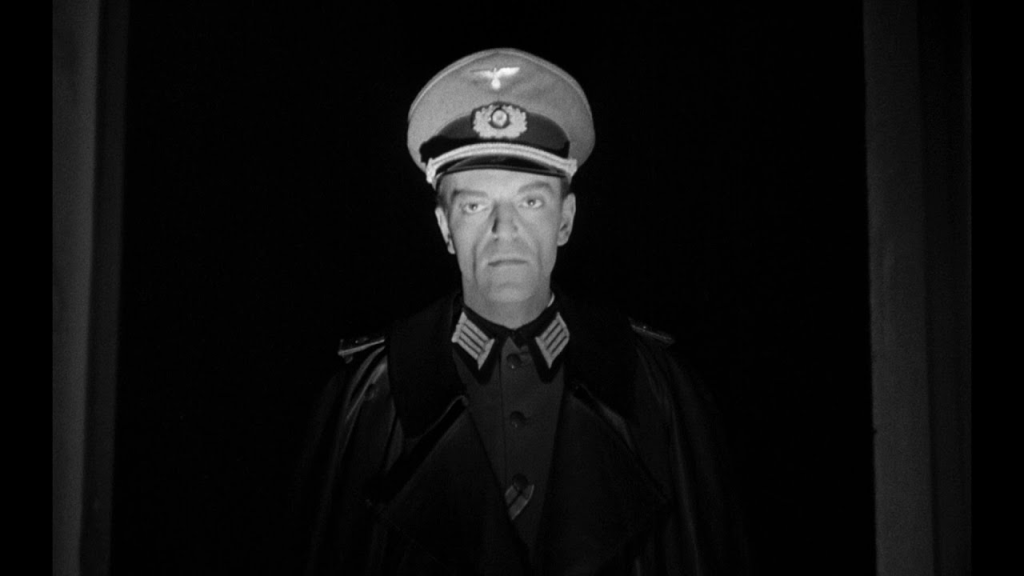
One day, an old man (Jean-Marie Robain) and his niece (Nicole Stéphane, in a very different part and performance from her other film with Melville, Les enfants terribles) receive an unwanted guest. Werner von Ebrennac (Howard Vernon), a German lieutenant, is billetted in the house in a small village that the two of them share. Differently from what one might expect, von Ebrennac is not the typical movie Nazi: von Ebrennac is a cultured, polite man who shows the two of them respect, seeking to impose himself as little as possible on them. During the day he is away, and when he returns in the evening he attempts to engage them in conversation, but when they do not respond or even acknowledge him in any way he bids them a good night and leaves. And so a routine develops: as the old man and his niece sit by the fire, von Ebrennac enters the living room, speaks to them, finds himself faced with their silence, retires to his room. Day after day, the German takes up his one-sided conversation, and day after day, the man and his niece act as if von Ebrennac wasn’t even there.
The lieutenant, an unmarried composer who clearly sees himself as a cultured man first and foremost, is not the Nazi officer one might expect, especially in a film by a French director who himself was a member of the Résistance: von Ebrennac is courteous and clearly wishes to earn the respect of his involuntary hosts. His monologue at them, which is taken up again each evening and then interrupted as they continue to ignore him, is really an extended attempt at wooing them, and through them, France. The man speaks of the grande nation‘s virtue, its culture and beauty. The monologue reveals that while the lieutenant may not be a fascist thug, he is an ideologue: he justifies the war and the invasion of France for himself because, as he believes, France and Germany need one another. He describes the relationship between the two countries as a romantic one, and the eventual goal of the invasion should be a lasting “marriage” between Germany and France. von Ebrennac draws on French literature in his comparison: Germany is the Beast of the classic fairy tale, while France is the Beauty with the power to turn her suitor into the prince he really is. He does not approve of the violence that Germany is making use of, but he does see it as sadly necessary for this marriage of cultures to be brought about, for the betterment of both countries.

As von Ebrennac continues his ongoing campaign of cultural courtship – which over time is hinted at being an attempt to court the niece herself, not just as the representative of a female-coded France – he increasingly reveals himself to be a man who is at denial about who he his and what he represents. He clearly believes everything he says: France needs to be wooed, if necessary with a touch of violence, and Germany needs to be tamed. War is the horrible but necessary means of achieving this. He is not unmoved by the cruelty of war and of the occupation, but for him the solution to the current situation is one in which France yields herself to Germany and in doing so both countries are saved. And it is increasingly his self-image as an aesthete, a man of culture, and his framing of Germany’s war on Europe as a necessity for the betterment of all, that is revealed to be as offensive as out-and-out fascism. It could be seen as akin to gaslighting – if von Ebrennac wasn’t himself entirely convinced of everything he says. He is a believer, and as a result he is blind to the reality of what he represents and what he defends to his unwilling hosts.
And through all of this, the old man and his niece remain silent, treating von Ebrennac as if he was air. The lieutenant is like a ghost, he sees them and can talk to them, but unable to make himself heard… or so he thinks. Because, over time, his insistence seems to wear both of them down – and perhaps there is a measure of pity in them, for a man who is blind to the crimes of the regime he not only represents but defends. But likewise, as time goes on, the lieutenant finds himself less and less able to ignore what his Germany is doing to his France, and to the world at large. The Holocaust is not addressed head-on in most of Le silence de la mer, but its horrors are revealed to the true believer von Ebrennac on a visit to Paris and in conversations with old friends who have embraced the Nazi ideology with a blunt honesty that shatters his illusions. The war is not courtship, fascism isn’t a husband hoping to be domesticated by a wifely culture. He has made himself a willing, if deluded, instrument to a murderous cult.
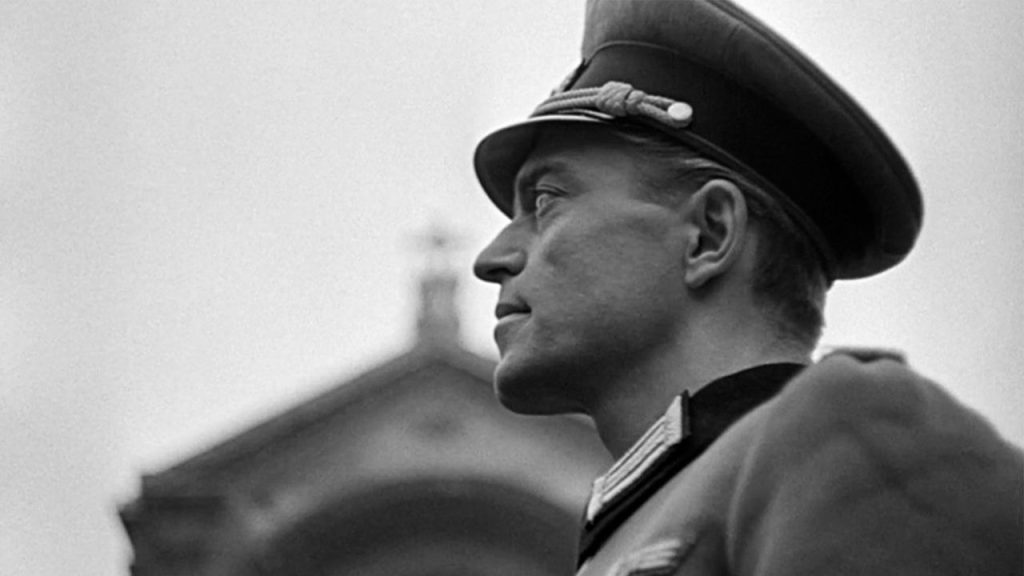
Le silence de la mer, adapted from the novel by Jean Bruller (under the pseudonym “Vercors”), was one of the first Melville films I’d seen, perhaps even the very first one. There is a difference in style between his earlier films and the iconic gangster films later in his career, and Le silence especially has an austerity that some have compared to Bresson. This is amplified by the minimalist plot: in effect, very little happens in the film, at least if one considers plot to be about people doing things. von Ebrennac speaks, repeatedly and at great length, while the old man smokes and the young woman knits and both remain silent. What is happening is entirely internal, manifesting itself to the audience through the lieutenant’s voice or through small movements and gestures. It is this minimalism that makes it all the more momentous when the uncle leaves a note for the German officer (a quote from Anatole France: “It is a fine thing when a soldier disobeys a criminal order.”) or when the niece turns to look at von Ebrennac at the very end and whispers a single, final word.
Verdict: Le silence de la mer is not the ultra-stylish existentialist thriller that many of Melville’s later films are, nor does it have the adolescent energy and high-strung drama of his next film, the Cocteau adaptation Les enfants terribles. It is a muted, internalised affair, and it is this quality that the film draws its effectiveness from, because it makes the later moments of realisation and their emotional impact stand out all the more. At the same time, these qualities can also make Le silence difficult to engage with: for some the tension created by the silence the uncle and his niece sustain until it almost manifests physically may be too much to bear, while others might find this tension to be too ephemeral in the first place. So much of the film is about what is absent, what is not said, about looks and gestures withheld – which puts Le silence de la mer on a frequency that not everyone will be able or willing to receive. In that sense, it is definitely not a Melville I would recommend to a newcomer, unless they were specifically looking for a film by the director that isn’t about gangsters and cops, heists and betrayals, and handsome, doomed men looking good while smoking one cigarette after another. Together with most of its action (if it can be called that) being limited to a single room, Le silence de la mer might be the Melville for people drawn by words such as ‘theatrical’, ‘austere’ and ‘minimalist’ – but for those who have the patience and are receptive to what Melville is doing with this story, Le silence is a striking counterpoint to the director’s stories about the kind of resistance we’re more used to seeing on the screen.

 A Damn Fine Cup of Culture
2 thoughts on “Criterion Corner: Le silence de la mer (#755)”