Ladies and gentlemen, step right up! The time of drily ironic Swedes grappling with existentialist despair and God’s extended silence, indeed His existence, came to an end earlier this year. It’s taken us a while to move forward, but we have finally arrived at our destination: Essential Fellini, Criterion’s gorgeous box set including fourteen of the Italian director’s most important films.

While it is a shame that the box set is less complete than Criterion’s Ingmar Bergman’s Cinema (though even that one had the occasional gap), it’s still a great occasion for me to get to know Fellini better. I’ve seen some of his films: La Strada, obviously, although it’s been a few years, and La Dolce Vita, the former on TV, the latter at the cinema. I’ve also seen, oh, perhaps a third of Amarcord, which they were showing at a hotel where we were staying, but I was too tired to watch the entire film and wimped out. So, in sum, I cannot really say that I know Fellini – though I know the iconography and the clichés, the gaudy, circus-like spectacle, the carnivalesque style, and it’s very well possible that I applied the adjective “Felliniesque” to things before I’d even seen La Strada (which, ironically, ignorant me might not have labelled “Felliniesque”). Which is to say: I have an idea of what Fellini and his films are about, but it’s time that I test this idea against the actual thing, starting with the first film in the collection: Variety Lights.
Already within the first few minutes I can tick some boxes on my Fellini Tropes checkbox. Giulietta Masina, Fellini’s wife and frequent collaborator? Check! A gaudy, tacky, yet lovable, troupe of performers? Check! The contradictions of post-war Italy? Check! Late Italian neorealism giving way to something more baroque? Check, check and check! Of course, these are fairly superficial criteria, and I’m applying them even more superficially due to my relative lack of knowledge of Fellini the director, as opposed to Fellini the stereotype. Nonetheless, even to a relative neophyte there are elements that are recognisable – though the film was co-written and co-directed by Fellini and Alberto Lattuada, about whom I sadly know next to nothing.

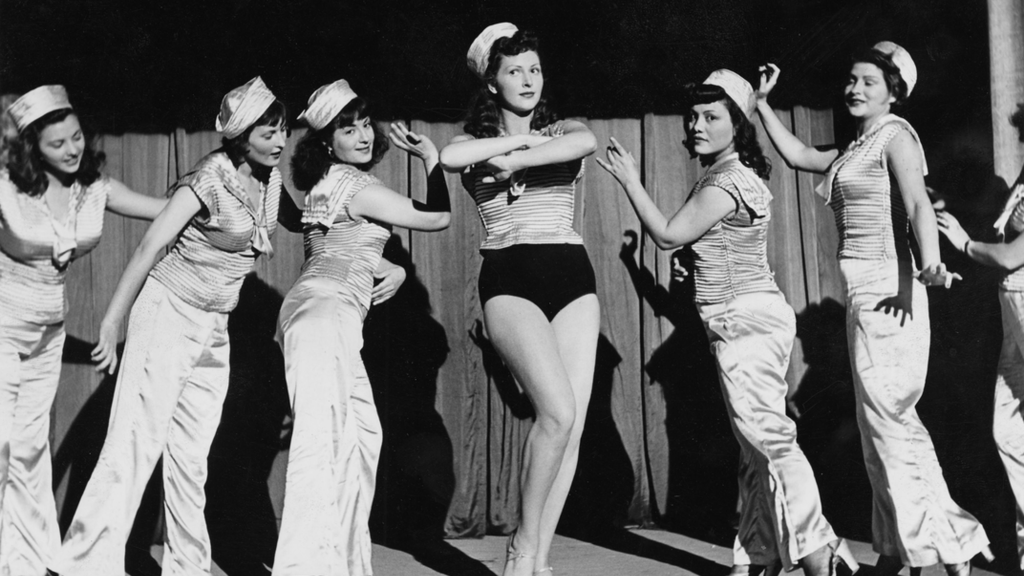
In its best moments, Variety Lights is a charming if slight film, telling the story of a travelling troupe of second-rate variety artists and focusing on Checco (Peppino De Filippo), the middle-aged manager of the troupe, his mistress Melina (Giulietta Masina), and Liliana (Carla Del Poggio), a young, beautiful woman who dreams of being one of the performers. There is a definite affection in Variety Lights‘ depiction of the troupe, though the film doesn’t idealise the world of the stage in any way: these people are poor and barely make enough to feed themselves – and they’re not even particularly talented. And yet, the audiences in the small towns they tour keep coming, albeit in decreasing numbers: mostly to jeer at the people on stage, the fake fakir with his goose, the singer, the vaudeville comedian, and to ogle the scantily-clad dancers, but still they come. Italy was caught between the desolation of the post-war years and the miracolo economico, an economic boom, but not much of the latter is seen in the rural towns, and even bad vaudeville gives these audiences something to forget their woes for a couple of hours.
In its main plot, Variety Lights has some striking parallels to All About Eve: Liliana quickly becomes central to the troupe’s with her fresh face and her seeming innocence, but she knows exactly what she is doing – and she knows exactly how to press Checco’s buttons. Not that he is a man whose buttons are particularly well hidden or difficult to access, and it doesn’t take much for Liliana to wrap him around her little finger. Eventually he drops Melina and the troupe, promising Liliana that he will use his (vastly exaggerated) contacts in showbiz to make a star of her.

Honestly, Variety Lights‘ story isn’t what appeals about the film. Nor is it the movie’s male protagonist: Checco is a pathetic loser who dumps the woman he’s with the moment a younger woman bats her eyelashes at him. He thinks he’s both an impressario and a lady’s man, but really he’s neither: he’s paunchy and prone to self-aggrandisement, and the moment Liliana drops him he does the predictable thing, slinking back to the troupe and to Melina, only to repeat the exact same behaviour in the film’s final scene, when the next pretty young face materialises in front of him. Variety Lights makes it clear that the story we’ve just seen was neither the first time nor the last that all of this would happen. It wants us to feel some sympathy for Checco, loser that he is, but this is very much what kept me from liking Fellini’s first film. The trope of the bumbling middle-aged man who feels entitled to the favours of younger women because he lies to them, and to himself, that he can make them famous, is tired, and for me he doesn’t gain pathos by being toyed with and then dropped by Liliana. In a sharper film that doesn’t pull its punches, I might even end up feeling some sympathy for Checco, but Variety Lights doesn’t go far beyond suggesting that there but for the grace of God go we – and sorry, Federico, but that doesn’t fly with me in 2023.
However, ignoring the film’s protagonist for a moment: there are wonderful scenes in Variety Lights. Checco trying to convince a theatre manager that he didn’t lie about the 17 acts his troupe performs (admittedly, most of these acts are the same people in slightly different costumes or singing a different song); the troupe being invited to the mansion of a wealthy lawyer and enjoying a proper meal for the first time in weeks; Checco in Rome, coming upon a group of homeless musicians and performers at night, and recruiting them into his latest pipe dream. It is these individual incidents that appeal, rather than the predictable plot of a middle-aged schmuck leaving his life running after a pretty young woman and slinking back with his tail between his legs. Most of all it’s Variety Lights‘ love for its performers that shines through, as well as its satire of showbiz. While Liliana moves on from fleabitten theatres to more glitzy venues and the shows she appears in have better production values, what appeals most to the audiences is still the same: young women showing lots of skin. The scenes that show Liliana’s supposed success prefigure the scantily-clad showgirls that were a mainstay of Italian TV, to be leched over by older men as short and pudgy as Checco. In the end, what brings in the crowds isn’t vaudeville: it’s commodified sex, or at least the illusion of it – and as much as Checco may think he’s an artist at heart, he is really a pimp with a bottomless capacity for self-delusion, and accordingly, what hurts his ego most is when Liliana pierces the bubble of his lies. She may be willing to put out, but she’s not going to pretend it is desire or even love. Sex is just a transaction, it’s giving the punters what they want. Really, that sharper, more honest version of Variety Lights? It’s there in the film – you just need to look past the bumbling amicability.
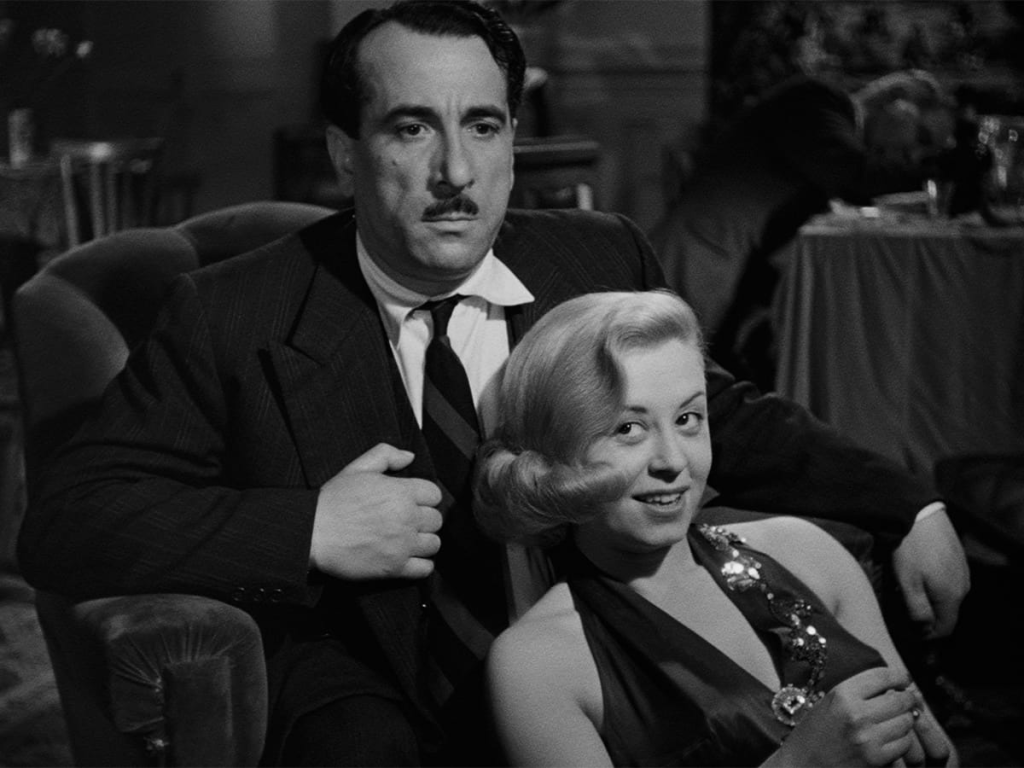
P.S.: Talking of where and how to look at the film, the stills I found reminded me that Variety Lights is often beautifully shot. Its cinematographer, Otello Martelli, collaborated with Fellini on some of his most famous films, including La Strada and La Dolce Vita (both to follow later in this series), as well as with directors such as Vittorio De Sica and Pier Paolo Pasolini.
 A Damn Fine Cup of Culture
5 thoughts on “Forever Fellini: Variety Lights (1951)”