Seeing how we’re usually at our local cinema several times a week, we tend to end up watching certain trailers half a dozen times or more before the films are ever shown. In some cases, I might find a trailer appealing the first two or three times I see it, but by the time I’ve seen it so often that I could lip-sync along to the dialogue I feel I’ve seen enough and don’t even want to watch the whole film. Perhaps in a year or two, once it’s appeared on Film Four or on one of the streaming services we’re subscribed to, but I’m just glad to have seen the last of it for now.
Some trailers are different, though, and each time I watch them I find myself more intrigued. Often, these are the trailers that don’t much focus on plot or dialogues, they’re more about the aesthetic and the vibe of a film. The trailer for Disco Boy by the Italian director Giacomo Abbruzzese is a case in point: obviously the film stars Franz Rogowski, an actor I’ve come to appreciate a lot in recent years, but more than that it was the images and the soundscape of the trailer. It was also the hints at the film’s themes: soldiers, colonialism, identity and doubling, intertwined in ways that felt poetic rather than literal. And yes, I’d also heard good things from film festivals, suggesting that Disco Boy was something to look out for.

Sadly, there are films that feel like a step down from the trailer, where the considerably longer running time simply serves to dilute what was most effective about the brief glimpse the trailer affords. For me, Disco Boy is one of those films: the material may have been better served by a short film – or by a script that puts more thought into its own implications.
Disco Boy is a film of two uneven halves. One is about Aleksei (played by Rogowski), a Belarusian fleeing his country in order to join the French Foreign Legion, in the hope of getting French citizenship. Where some of his fellow recruits are loud and brash, performing a crude masculinity, there is something more pensive, even gentle, and internalised about Rogowski’s soldier. The other part of the film is about Jomo (Morr Ndiaye), the leader of a group of rebel fighters, engaged in an anti-colonial struggle in West Africa. When the rebels capture a group of French civilians, Aleksei and his fellow soldiers are sent to Nigeria to rescue the hostages, which puts him and Jomo on a collision course.
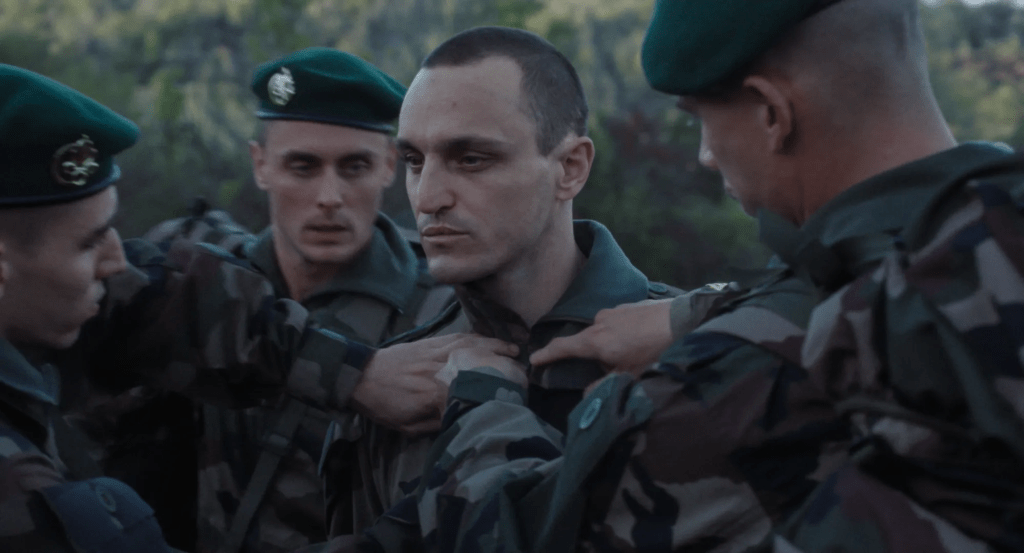
To some extent, Disco Boy could be described as a ghost story or as magic realism. The lives of Aleksei, Jomo, and Jomo’s sister Udoka (Laetitia Ky), are intertwined in uncanny ways that cannot be rationally explained. This is emphasised by the film’s direction and its aesthetic, which works on a poetic, sensual level rather than an intellectual one. Disco Boy has a strong vibe, and this is what comes through most strongly in the trailer. The problem is, the more the film adds story to this, the more its effect is diminished. Disco Boy becomes more concrete in some respects, and this concreteness is at odds with the vibe, as this is clearly not where the story’s, or the director’s, strengths lie. There are undoubtedly scenes that expand on what the trailer does and that make the film into more than just a mood piece, in particular the encounter between Aleksei and Jomo, but Disco Boy nonetheless has the feel of a like a short film extended to feature length at times.

There is a bigger problem, however. The film suggests that Aleksei and Lomo are doubles of one another, but the former gets considerably more screen time than the latter. We don’t much get a sense of Lomo, he is a cipher, a symbol; it is clearly the former that Disco Boy is interested in, and as a result it feels like Lomo is primarily there to serve Aleksei’s story. Obviously he has thematic and symbolic import, but he is barely a character. The same is true for Udoka. Aleksei is by no means spelled out in every respect, he too remains somewhat oblique, but the film is still about him in a way that it isn’t about the African characters. Ultimately, while Aleksei is not exactly an illustration of privilege as a Belarusian refugee, Disco Boy still ends up feeling like its black characters are there to serve a white protagonist’s story. The impression that Lomo matters less than Aleksei is reinforced by an oddly othering use of the African characters: there is a hint of the magical to Lomo and Udoka that, in conjunction with their overall lack of prominence and agency, feels lazy and clichéd.
All of these elements could have worked, but I’m not sure they do in the version of Disco Boy we got. The film is arguably both too much and not enough: the effectiveness of its tone and aesthetic diminishes over the film’s short running time of 91 minutes, yet it uses little of this time to develop characters that structurally and thematically ought to be as important as Aleksei. Again, I return to the impression made by the trailer: it was poetic and hypnotic, hinting at the film’s themes and vibe. As a full feature film, Disco Boy only develops these to a limited extent. Even if there are things to like a lot – the actors, first and foremost Rogowski, the visuals (Hélène Louvart’s cinematography is arguably the film’s greatest asset), the music – the Disco Boy I imagined as I watched the trailer may be the richer film than the Disco Boy we got in the end.

 A Damn Fine Cup of Culture
One thought on “I’m shooting at the man in the mirror: Disco Boy (2023)”