In the last couple of years, AI has become one of the trending topics, generating excitement and dread in equal measure. It is therefore no surprise that more and more artificial intelligences are popping up as antagonists in pop culture. They’re not what they used to be, however: the action franchise heroes that defeat evildoers by running, running, and running some more are not up against WarGames‘ WOPR or Terminator‘s Skynet. No, what we get these days is basically ChatGPT with an evil goatee: modern AI antagonists are all about the algorithm.
Mrs. Davis, which Wikipedia describes as a “science fiction comedy drama limited series”, is about the fight against such an all-seeing, all-knowing, all-powerful algorithm. It is also, in no particular order, about vengeful nuns, secret orders, exploding heads, crazed whales, chicken wings, magicians, sneakers, Jesus, hypermasculinity, falafel with pineapple, and mummy issues. Oh, and the Holy Grail. Obviously.

Mrs. Davis was created by Tara Hernandez and Damon Lindelof. I don’t know Hernandez or her work particularly well, as I only know The Big Bang Theory from the occasional still or YouTube clip. Lindelof I know somewhat better: he was one of the creative minds behind the wildly uneven early 2000s phenomenon Lost, and he co-wrote Prometheus, Star Trek Into Darkness, World War Z, and The Hunt, all of which were… flawed, to put it kindly. However, he also created HBO’s The Leftovers, the series that replaced Six Feet Under as my favourite TV series ever, as well as Watchmen, a smart, funny, poignant, deeply weird continuation of Alan Moore’s seminal comic. The quality of his work isn’t consistent, and when he’s bad he’s often horrid – but when he’s good… well, let’s say that Lindelof is thematically ambitious like few others writing for TV, and can be one of the best writers for the medium when it comes to creating nuanced, engaging characters coming up against the fundamental unfairness and incomprehensibility of the world.
When I saw the first previews for Mrs. Davis, I couldn’t really reconcile what I saw with Lindelof’s best work, or indeed with any of his work. The trailers made the series look comedic, first and foremost, and like loud, in-your-face comedy at that. Still, I thought: I’ve loved much of Lindelof’s recent work, and there’s also that cast, including Betty Gilpin, who was one of GLOW‘s greatest assets, Margo Martindale (fantastic in so much of her work, such as The Americans and Mrs. America), Katja Herbers (who has been very enjoyable even in relatively middling material like the immensely foul-mouthed The Columnist). I thought, let’s check this one out, and at worst I’ll just leave it at one or two episodes.

Whatever I was expecting from the previews, Mrs. Davis wasn’t that. It was a comedy, but not only. It was loud and in-your-face… at times. It’s difficult to describe what the series is, because a description could make it sound random, when in practice Mrs. Davis comes together much, much better than it has any right to. In some ways, I would call it an inventive but goofy, and possibly troubled, sibling to the novel Good Omens by Neil Gaiman and Terry Pratchett, made with the comic and dramatic sensitivities of a James Gunn. It’s not afraid to be puerile and gross, but it never stops at this. Even when it is outrageously dumb, it is so in witty and surprisingly sweet ways.
Mrs. Davis is about a quest: Simone (Betty Gilpin), a young nun, is manipulated by a supposedly maternal, caring algorithm into doing its bidding. Simone, who blames the AI for the death of her magician father (David Arquette), refuses to interact with Mrs. Davis, who otherwise seems to be omnipotent: pretty much every person around the world has invited the algorithm into their lives, delegating decisions to it, and striving to earn their wings – a rewards scheme monitored and enacted by phone app. Instead of accepting the algorithm into her life, Simone embraces a different higher being: she is a Bride of Christ, and she takes this quite literally, hanging out with Jesus (Andy McQueen) at his diner (that may or may not be a real place) and sampling his wares in more than one way. Nonetheless, Mrs. Davis sets things into motion, so that Simone finds herself with no choice but to embark on the quest the algorithm sends her: to find the Holy Grail and destroy it – which also puts her on a collision course with her ex-boyfriend Preston (Jake McDorman), the leader of a men-only, conspiracy-addled group dripping with homoerotic subtext and strangely endearing idiocy from every one of their well-oiled pores.

Mrs. Davis should come across as random. It is bursting with plot points, characters and ideas that should absolutely scuttle the whole endeavour: on paper it’s easy to think that Hernandez and Lindelof stuffed every single thing they could come up with into their eight scripts. There are too many characters, too many plot strands, too many extended jokes; but somehow, miraculously, the series keeps it together. This is due in no small part to Gilpin, whose badass nun could easily have joined the gang of neurotic but highly effective vigilantes in Lindelof’s spin on Watchmen. Gilpin is very funny, but she never plays even the most outlandish jokes in a self-defeatingly self-aware way. She takes the story and characters seriously, and we do alongside her, even when the weirdness escalates.
However, Mrs. Davis also coheres into something bigger than the chaos of its individual parts because the story and its themes are much more considered than is initially apparent, and this only begins to shine through after the first couple of episodes. This is also where Mrs. Davis does reveal itself to be remarkably similar to The Leftovers in striking ways: its world is one that is so chaotic, so irrational, that in order to remain even semi-sane it makes sense to try and come up with explanations: these things happen because of God’s ineffable plan, they happen because the algorithm has calculated that they should. There is some kind of pattern here, some sort of purpose – because otherwise, what is the point of all of this? There is comfort in believing that some intelligence, whether it is artificial or divine, is behind the insanity and sheer boneheadedness we encounter every day. And Mrs. Davis, like The Leftovers, is filled with characters who seek out such explanations, or who despair because those explanations don’t actually help. The world remains what it is, regardless of whether you can say “God decreed it” or “The algorithm did it.”
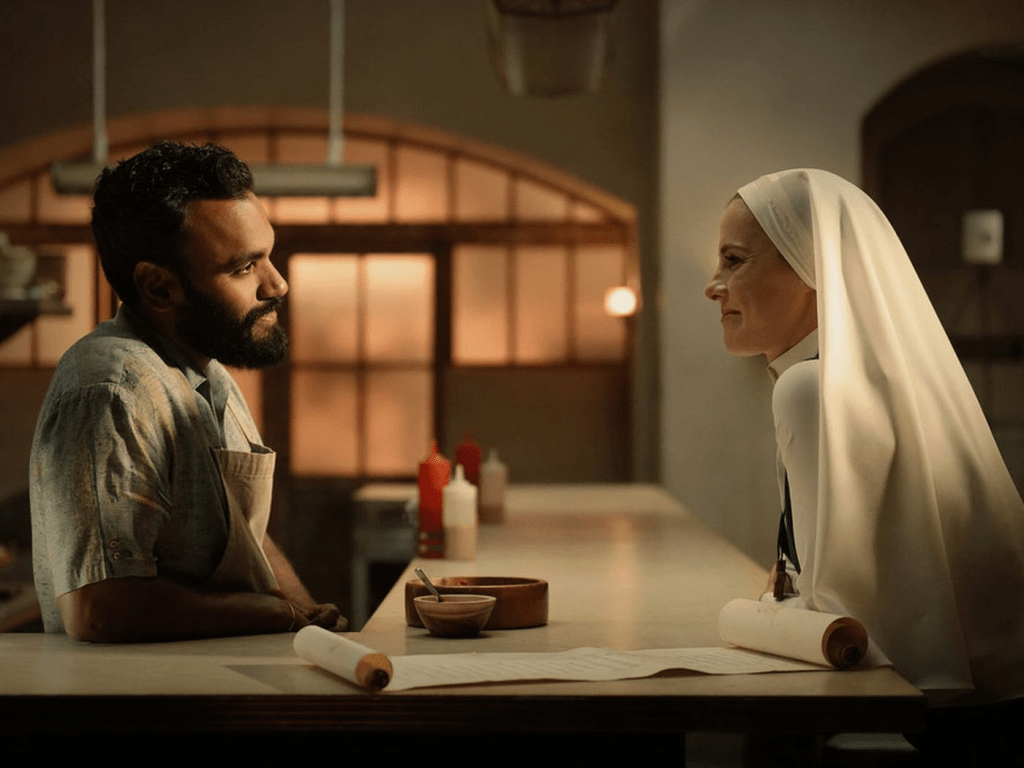
The series isn’t perfect. It couldn’t be, what with the number of plates it keeps spinning at the same time. And some might find its ending too sweet and sentimental, considering everything that has gone before. For me, though, it worked, mainly because of how small-scale and personal it is, fitting the characters. And whatever Damon Lindelof moves on to next, here’s something he needs to consider: after Regina King’s glorious Sister Night in Watchmen and Sister Simone in Mrs. Davis, there’s none better than he to launch the Badass Nun Cinematic Universe. In fact, give King and Gilpin a series together playing these characters, and I’ll be there in a heartbeat – no need to be told by a supreme being or an algorithm.
 A Damn Fine Cup of Culture
One thought on “What Would the Algorithm Do? Mrs. Davis (2023)”