The order in which you watch, read, listen to things matters. It changes how you experience these things. Criterion’s Ingmar Bergman’s Cinema was organised thematically first and foremost. Even if a clear delineation wasn’t always possible, you’d get a set of films about marriage and relationships, followed by some movies about actors and performers, and then you might get a couple of films about crises of faith. Even though many of these themes pop up across all of Bergman’s films, there was still the sense of thematic focuses. And after watching Scenes from a Marriage, other stories about relationships gone sour would always have a certain subtext; Through a Glass Darkly would be lurking in the background when watching, say, Winter Light.
In contrast to this, Criterion’s Essential Fellini box set is ordered chronologically. This comes with pros and cons: you lose the thematic unity (that may be imposed or at least reinforced by the curators to some extent), but it’s easier to concentrate on how Fellini develops as a director if you’re watching the films in the sequence in which they were made – but with Bergman I was glad that we didn’t have to watch a whole slew of his early films first. Crisis and A Ship to India, to mention just two, certainly show some promise, but if Bergman hadn’t turned out pretty okay at this whole directing thing later in his career they’d probably be forgotten by now, and for good reason. And that’s the sense I get of these early Fellini films: that they were made by someone who’s talented, but whose talent isn’t fully in evidence yet. But boy, there’s some stuff here that hasn’t aged well at all, there are comedic bits that would have been lazy and clichéd at the time already, and those things don’t sit well with this idea of a timeless filmmaking genius.

The White Sheik tells the story of two newlyweds from the provinces. Ivan (Leopoldo Trieste, whose face people might remember from The Godfather Part II and Don’t Look Now) and Wanda (Brunella Bovo) are petit bourgeois naifs – so going to the bustling, chaotic Rome on their honeymoon is already asking a lot of them. Ivan’s main hope is to finally introduce his young wife to his family, but Wanda harbours another hope: to find and meet the Fernando Rivoli, who’s become something of a celebrity as the White Sheik, the main character of a fotoromanzo (a sort of soap opera in photo comic format). Wanda, a big fan of Rivoli, wanders off and ends up at the beach with the fotoromanzo crew who’s trying to produce the latest episode in the White Sheik’s adventures. When Ivan realises that his bride is gone, he tries to track her down while also keeping up the pretence to his relatives that Wanda is merely in bed with a headache and will join them before long, honest to god, cross his heart and hope to die.
The setup of The White Sheik is that of broad farce with a decidedly Italian slant, melodrama as comedy, with no interest in nuance or ambiguity. There are definitely things to appreciate about The White Sheik – but as a whole, the film is often gratingly broad and its characters are facile caricatures: blushing brides, cheating husbands and harridan wives. Watching the film, it certainly helped to know that I had classics such as La strada and La dolce vita to look forward to.

Some of the film’s humour is less farcical than satirical, and while the humour is still fairly broad, but the satirical elements benefit from being more specific to the film and to Fellini. Trieste’s Ivan, for instance, is the kind of childlike, naïve husband that’s common to any number of farces across centuries and cultures, from Shakespeare via operetta to the Carry On films, but when the film switches to the fotoromanzo crew, the humour changes, it becomes sharper, as Fellini pokes fun at these photo comics and the massive gap between their outlandish romantic plots and characters and the reality of the entertainment industry. For Wanda and fans like her, these people are there to serve as screens for their own wishes and dreams, of the kind of romance that is impossible in real life, in post-war Italy and with nebbishes such as Ivan; but when Wanda takes a closer look, she ends up realising that the object of her fantasies is as mundane and banal as her actual husband. In fact, Rivoli is even worse: he’s a fake and a fraud, seducing young, impressionable fans even though he is married. While Fellini’s mockery uses the fotoromanzi as their subject, his satire also extends to the film industry, and there is a lot of overlap between those two worlds; the scenes from The White Sheik (the photo comic rather than the film we’re watching) are reminiscent of orientalist silent movie melodrama, and Rivoli is a two-bit Rudolph Valentino. Even the crew looks pretty much indistinguishable from movie crews, including the bearded, white-haired director sitting on his director’s chair as if he was auditioning for the role of Cecil B. DeMille.

There is a touch of The Purple Rose of Cairo to The White Sheik, but while Woody Allen’s film also has fun with the world of cheesy melodrama, it finally ends up on a note of affection for the escapist fantasies produced by Tinseltown. Fellini’s movie mocks both the entertainment industry and its fans – yet his take is also not without affection: with him, the difference is that he appears to love this world exactly because it is fake, tacky and ridiculous, something that could already be felt in Variety Lights. Fellini isn’t one for the suspension of disbelief: it’s the artifice that appeals to him, and its magic isn’t diminished so much as amplified by being revealed. There are other aspects of Italian post-war culture that are satirised in The White Sheik, and there is fun to be had from those scenes; Fellini knows how to mock the operatic self-aggrandisement of authority, and he has an eye for a mis-en-scène that highlights the absurdity of martial displays of power. But it is the scenes with Wanda and the cast and crew of the White Sheik photo comics that are most memorable and that most seem like they depict Fellini’s world. (Though, admittedly, I’m too early into my exploration of the films to say whether this is really where The White Sheik‘s strengths lie or whether I am seeing what I’m expecting to find based on what I’ve heard and read about the director.)
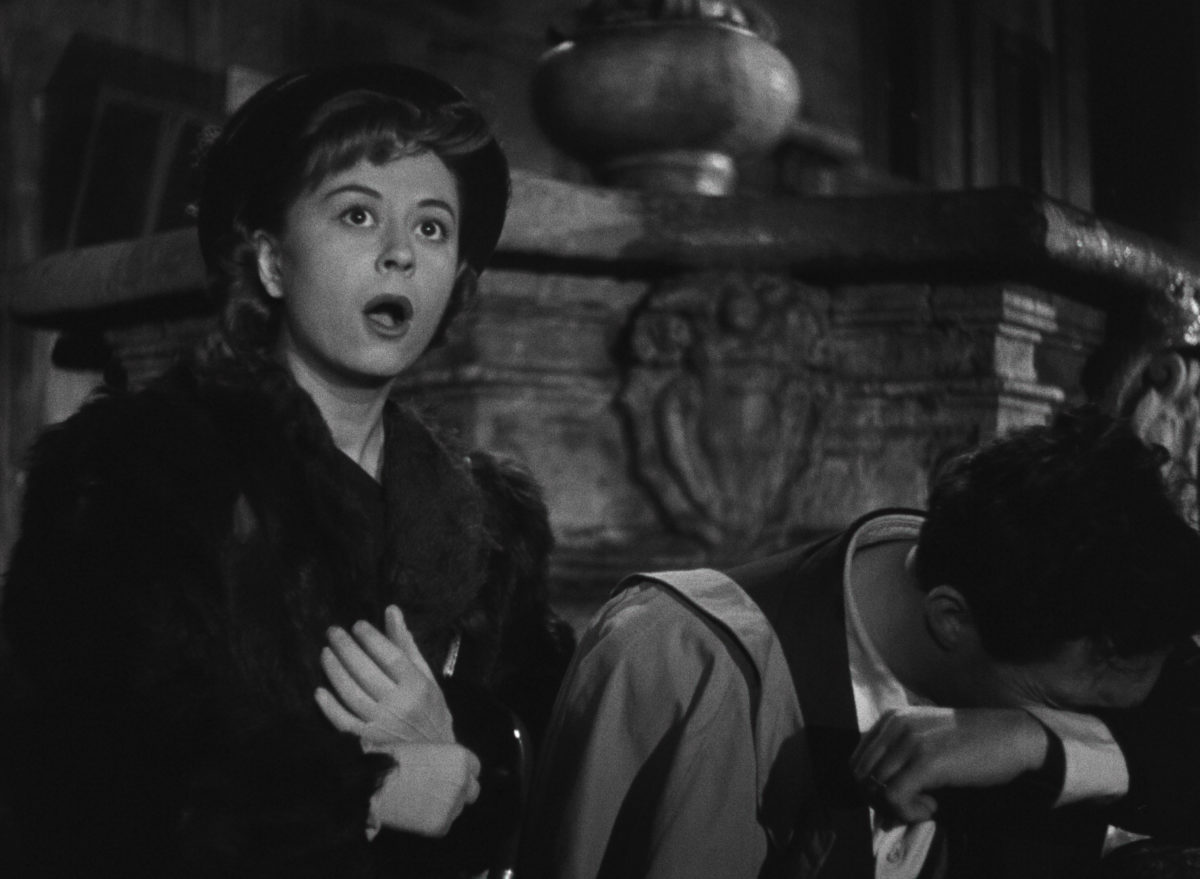
There is one other scene that is memorable, for a very specific reason: heartbroken and despondent, Ivan finds himself lost in nighttime Rome, where he is found by a duo of prostitutes who do their very best to cheer him up. One of these is Cabiria, played by Giulietta Masina; her later film Nights of Cabiria, which revisits the same character but puts her centre-stage, is still a while away in this series, but I suspect we will see more of Masina before long.
 A Damn Fine Cup of Culture
4 thoughts on “Forever Fellini: The White Sheik (1952)”