Welcome to Six Damn Fine Degrees. These instalments will be inspired by the idea of six degrees of separation in the loosest sense. The only rule: it connects – in some way – to the previous instalment. So come join us on our weekly foray into interconnectedness!
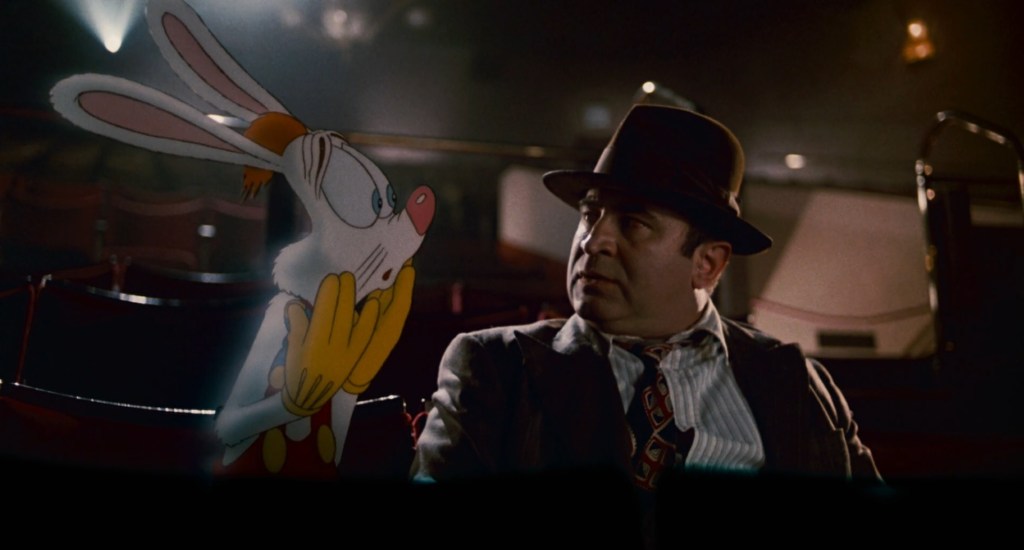
After the nostalgic tune of a bass and saxophone has sounded over opening titles, Who Framed Roger Rabbit, drops us right into the action. Cartoon action, that is, with the slightly hysterical bent of the classics, such as Tom & Jerry, Road Runner, or Bugs Bunny. The comedic star of said cartoon is the hapless Roger Rabbit (voiced by Charles Fleischer), who predictably gets hit by every possible peril a kitchen can hold, to hilarious effect. When he gets a fridge dropped on him, and chirping birds start circling around his head, we hear “CUT!” and the human director steps in, in stark live-action. “They’re supposed to be stars, not chirping birds,” he yells at the cartoon rabbit. And so we enter into a live-action world, as the cartoon baby from the short film (voiced by Lou Hirsch) apologises: “Sorry, Toots!” in a gritty baritone, and storms off the setm fulminating “How the hell many times do we have to do the damn scene?” Roger is clearly in trouble, as he keeps blowing his lines. His head and heart are not on the job. As Roger’s film is now seriously over budget, what with all the takes, producer R.K. Maroon (Alan Tilvern) enlists private detective Eddie Valiant (Bob Hoskins). Eddie, who looks like he’s slept in his coat, steels himself for this meeting by sipping from a whiskey flask, which he appears to keep in his shoulder holster. Maroon tells Eddie that his star Roger’s wife is “poison”, and he just wants some compromising pictures to show Roger, to cure him his adoration of her. Hard-up, Eddie reluctantly agrees. He’s clearly not a fan of “toons” as the animated characters are known in the film.

When Who Framed Roger Rabbit came out in 1988, it was considered to be ground-breaking. The action centres on a 1947 Hollywood, where famous cartoon characters have a place in showbusiness and in every day life, much like any other movie actor. The intermingling of these cartoon characters and the live-action actors is the movie’s particular innovation. It is also worth bearing in mind, that these characters are hand-animated. The scenes were entirely plotted out, so that the animators could painstakingly draw the characters as they fit into the scenes, real-world perspective and all.
The movie, outside of the toons, has the atmosphere of an old Raymond Chandler pastiche. The down on his luck private detective, the tough cookie girlfriend, and the very well endowed femme fatale. To dub her a cartoonish version of a femme fatale can, in this case, be taken quite literally. It always strikes me, and I’ve seen this film countless times, how quickly I am drawn into this world. The cartoon characters blend so seamlessly with the real world, the actors are so convincing, that it never takes me out of the story to think some of our protagonists are, well, drawn. The film, quite early on after showing us some of the toons’ antics (and reeling us in us with some very, very famous characters), points out that having toons in the real world isn’t without its dangers. Dropping a fridge on a cartoon rabbit is one thing. But just imagine what that would do to a human…

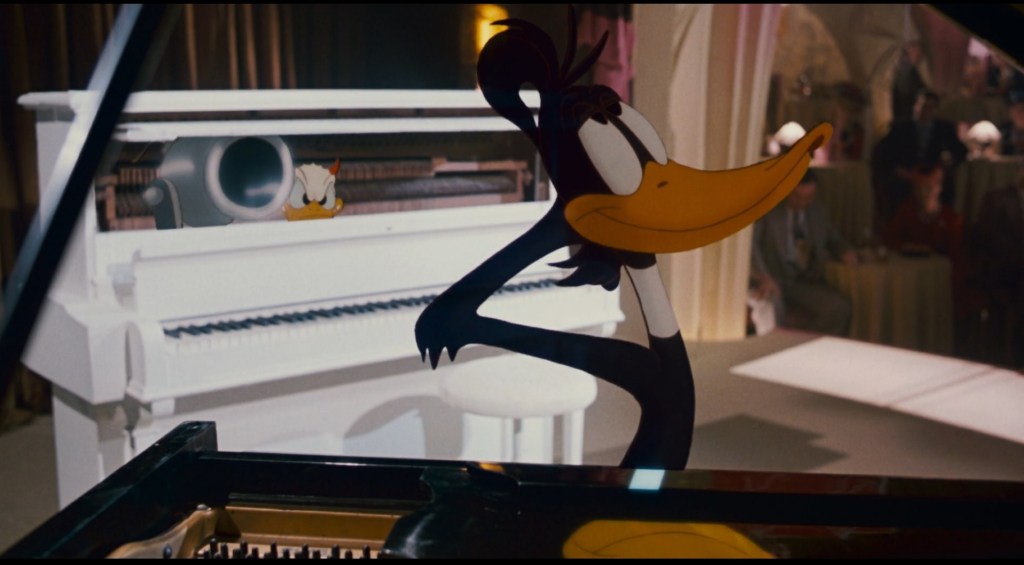
One of my favourite examples of this blended reality is the scene early on, when Eddie enters the Ink and Paint Club, where Mrs Roger Rabbit is set to perform. The waiters are cartoon penguins, who carry real life trays and menus. Performing on two pianos are two of the most famous ducks in living memory. Donald & Daffy (voiced respectively by Tony Anselmo and Mel Blanc) are predictably chaotic and delightful. Eddie, though, surveys this spectacle as if it were the dirtiest dive in Tinseltown. Not a smile, not a laugh. He looks as if he’s smelled something nasty and, inasmuch as that’s possible in such a place, Hoskins plays it all completely straight. When a cannon appears on stage with a demonic Donald aiming to shoot at his rival, Eddie is startled. The cannon-ball rips an actual hole in the very real grand piano, and the act ends, much to Eddie’s relief. Delightful, yes, but also irresponsible, we start to think. The detail in this sequence (and throughout the film) is astonishing. Jessica Rabbit (voiced by Kathleen Turner and Amy Irving), when she finally appears, has musical accompaniment from a band of birds, two of them collaborating to play one double bass. We meet Betty Boop, fallen on hard times since cartoons went to colour, and Eddie treats her with surprising gentleness. She was, after all, once a great star.

For any casual viewer, this scene is a delight. The way the cartoons interact with the human characters is nifty. But for those of us who love our classics, this scene is packed with so much Hollywood history it would put any straight bio-pic to shame. As is true for the entire film: one could write an essay on the references alone. And if some of the effects are slightly awkward – the scene in which Eddie is literally thrown from the bar, manages to make Hoskins look weightless, rather than to suggest the cartoon-bouncer has heft – it’s easily forgiven. We’re in a world we’ve not seen before, in which the cynical private eye has to find some dirt, in film-noir fashion, but the toons continually refuse to follow the rules of the genre.
When Roger is confronted with his wife’s indiscretions, by way of some photos Eddie took, he doesn’t take it very well, to put it mildly. Consider the magnificent gag where he hurls himself out the window, still gibbering, leaving a perfect Roger Rabbit-shaped hole in the blinds… and the window. The timing is flawless, transferring a cartoon-reality upon the unsuspecting real-life set. This thin line between pathos and cartoonish hysteria is played impeccably, and it certainly doesn’t hurt that the film loves both of the genres it pays tribute to. It is a film that rewards revisiting more than once, for all its intricate detail, its many movie-references and its larger-than-life heart.

The mere fact that you have Disney’s Donald and Warner’s Daffy sharing a movie, let alone a stage, must be some sort of miracle. Zemeckis, who directed it, wanted it to have “Disney’s high quality of animation, Warner Bros.’ characterization, and Tex Avery humor.” Perhaps it does. But, more so, for a viewer who was a young girl when this came out, and who has rewatched it countless times, Roger Rabbit is sui generis as a labour of love.

 A Damn Fine Cup of Culture
I was visiting my friend Tiffany in Boulder for a few days that summer, and we went to the cinema to see “Willow”. Five minutes in, we decided it was awful, so we snuck out and into the cinema next door to see “Roger Rabbit” – and it was, of course, magnificent!
Oh, I didn’t see that my comment was going to be anonymous! Signed, Andrew