Of all the tropes in romantic stories that I’m not a big fan of, two people falling instantly in love is probably the most common. I can buy immediate attraction, especially of a sexual kind, and I am also okay with an almost instant sense of sympathy, a sort of mutual resonance that develops into something further – but when we’re supposed to believe in love at first sight, that there is deep, abiding love between two people the moment they meet, I roll my eyes, and they keep rolling if this instant romantic attachment is given a significance that is practically metaphysical. I am no fan of the notion in romances that someone is ‘the one’, that destiny has preordained certain couplings. In fact, I don’t find the idea particularly romantic to begin with.
There is perhaps one film where I buy into such almost instant love, and not just begrudgingly but entirely, 100%. That film is Michael Powell and Emeric Pressburger’s wonderful A Matter of Life and Death (1946).
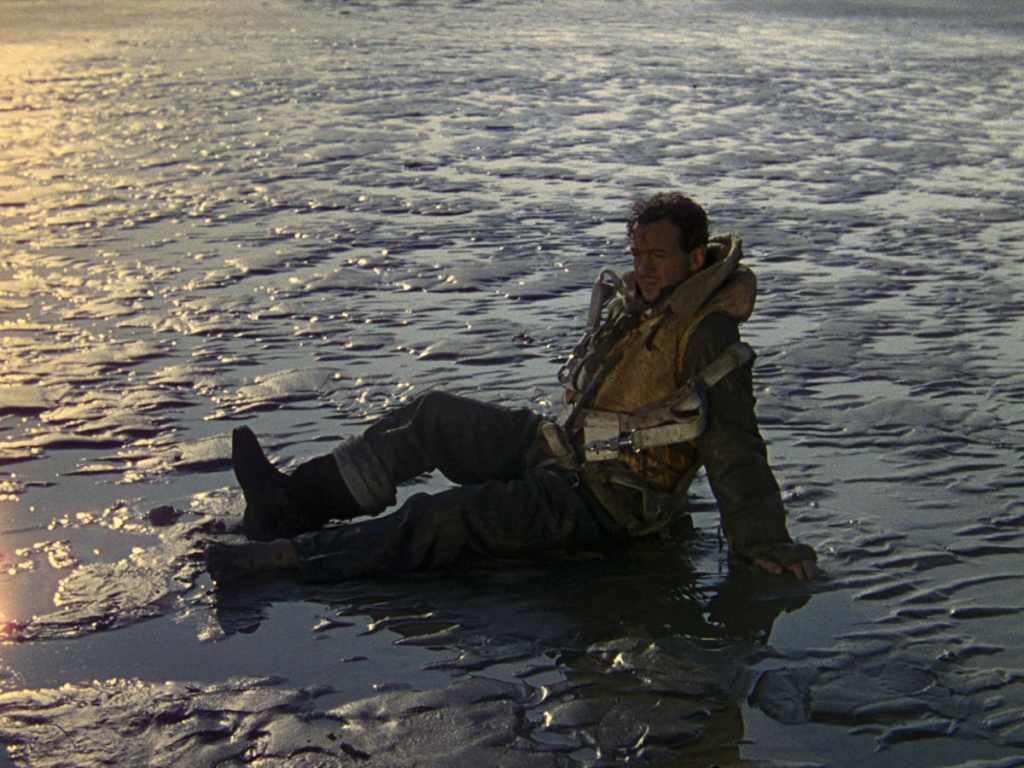
Obviously it’s the context that Powell and Pressburger’s film places this romance in. There’s probably little that lends itself to strong, sudden attraction as much as war and the possibility of death suddenly looming that much more closely. Squadron Leader Peter Carter (David Niven) is on his way back across the English Channel after a mission over Germany, but he knows his plane isn’t going to make it; the woman at the other end of the radio connection is June (Kim Hunter, whose performance makes June feel like a rounded character even if she doesn’t warrant a surname), and I can totally see that these two people who would have found a lot to like about each other under different circumstances connect all that much more quickly and strongly when it’s likely that their first conversation will also be their last.
And, equally obviously, it doesn’t exactly hinder the budding romance that when Peter bails his damaged, burning plane without a working parachute, he doesn’t fall to his death but instead finds himself miraculously alive and unharmed when he wakes up on an English beach. See, in the thick fog over the Channel, Peter’s guide to the afterlife – yes, it’s that one again, after Hirokazu Kore-eda’s After Life and Albert Brooks’ Defending Your Life – completely missed his charge and therefore couldn’t take him to the Great Beyond. (It’s amazing that this doesn’t happen more frequently in a country where pea-soupers are supposedly common.) If such a miracle – or, more accurately, a clerical error compounded by meteorology that nonetheless looks uncannily like a miracle – occurs, even I can believe that two people may fall deeply in love after one brief conversation and an unlikely escape from what should have been certain death.
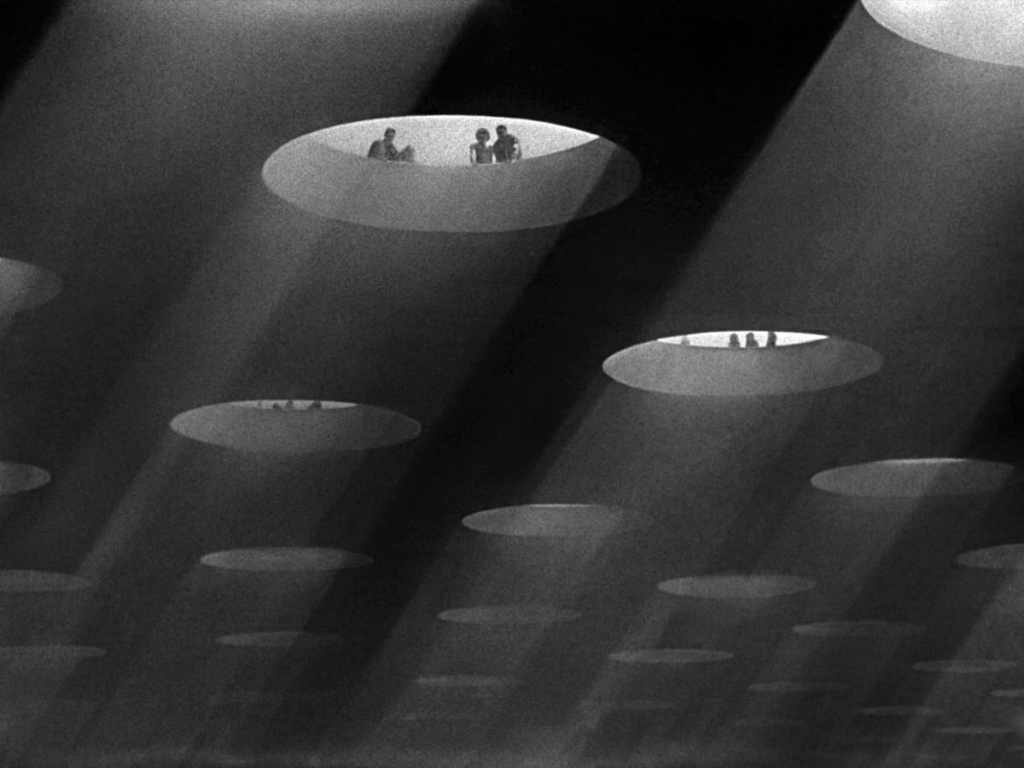
What is striking about A Matter of Life and Death every single time I watch it: this is a tremendously fanciful film, practically a fairy tale, but at the same time there is a terrifically grounded quality to its characters and its central love story – and to me, this is a quality that is common to the films made by “The Archers”, the creative partnership that Powell and Pressburger formed. They deftly blend tones that should be antithetical: their heroes are ridiculous and nonetheless carry genuine pathos, their romances are magical yet their lovers are often grounded and common-sensical. There’s a quietly subversive quality about the stories they tell and the themes they work with. This is equally true about the elements of A Matter of Life and Death that are literally out of this world: its depiction of the hereafter and its denizens, and especially its escalator taking the recently departed to the afterlife. The film’s whimsy is delightful, but at the same time there is a down-to-earth quality to it that only heightens this delight. Heaven isn’t a kitschy fantasy, it is an institution, with logistics and people working hard to make everything run smoothly, and this is suggested in amusing, witty ways: for instance, the many new arrivals we see in the early scenes of the film, largely soldiers who have lost their lives in one of the many battles of WW2, are issued their wings in dry-cleaning bags. Watching the film, one cannot shake the sense that Powell and Pressburger distrust grandeur as much as they are drawn to it – and as much as they enjoy giving their imagination full reign in their vision of what comes after death, it lacks something we have down here on earth. When Conductor 71 (Marius Goring), the French aristocrat that was supposed to guide Peter to the next world, arrives in the hope of undoing his faux pas, he looks around at the flowers in bloom around him and says with a smile: “One is starved for Technicolor up there.”

Verdict: Even at a third or fourth viewing, A Matter of Life and Death is a sweet, witty and beautiful film. While thematically it is a product of its time, it’s the commitment to its stranger aspects and the way it manages to be both lighthearted about its fantastic conceit and entirely earnest that give it a timeless quality. I mean, how often do you get whimsical musings about the afterlife mixed with metafictional play on the conventions of cinema and talk of neurosurgery, and all of these elements add to rather than detract from the central romance? If there’s anything I’m not a big fan of when it comes to A Matter of Life and Death, it’s the final third’s theme of the British-American rivalry and the way it’s reflected in the 25-minute celestial trial the film ends on, determining whether Peter dies or not. There are fun bits to be had in the interaction between Peter’s friend and doctor Frank Reeves (frequent Archers collaborator Roger Livesey) and the anti-British prosecutor Abraham Farlan (Raymond Massey), but the idealisation of modern US multiculturalism feels rather naive in the face of reality (there are more than enough examples around the time the film was made of such ideals being revealed as paper-thin at best), and the sequence’s championing of diversity rings somewhat hollow as we notice that women seem to play no role in the heavenly legal system, other than as an audience to the trial. It’s something of a shame then that A Matter of Life and Death holds up perfectly in its first two thirds and that it is the lengthy third part that feels the most dated – but even then, the Archers’ film remains a classic with a very unique, and often startlingly modern, filmmaking and storytelling sensitivity, and a sense of romance that even this grumpy old man can fall for.

 A Damn Fine Cup of Culture
2 thoughts on “Criterion Corner: A Matter of Life and Death (#939)”