Just like Fellini used to be a big gap in my filmography – something this series, with a little help from Criterion, is supposed to address -, I’ve not seen all that many films by Pier Paolo Pasolini. The ones I have seen are an eclectic bunch: Mamma Roma (starring a magnificent Anna Magnani), The Gospel According to St. Matthew, and the Greek tragedies: Oedipus Rex and Medea. Based on having watched these, it’s difficult for me to get much of a grip of who Pasolini was as a filmmaker – but tonally he definitely seems to be a fairly different, much more overtly political storyteller from Federico Fellini.

Which makes Nights of Cabiria, on which Fellini collaborated with Pasolini, an interesting blend of the two men’s styles and preoccupations. The role of Pasolini, who was one of altogether four co-writers, was to help with the dialogue of the 1950s Roman demimonde of pimps, prostitutes and their tricks, giving it more authenticity. The world of Nights of Cabiria doesn’t actually seem all that far removed from that of Mamma Roma, who, like Cabiria, is a sex worker dreaming of a different life. However, while the director and his writers evoke a believable world that is earthy, that lives and breathes, this world isn’t what defines the film the most, instead providing a background to the central performance. As in La Strada before it, the star of the show is undoubtedly Giulietta Masina – who may be even better as Cabiria than she was as Gelsomina.
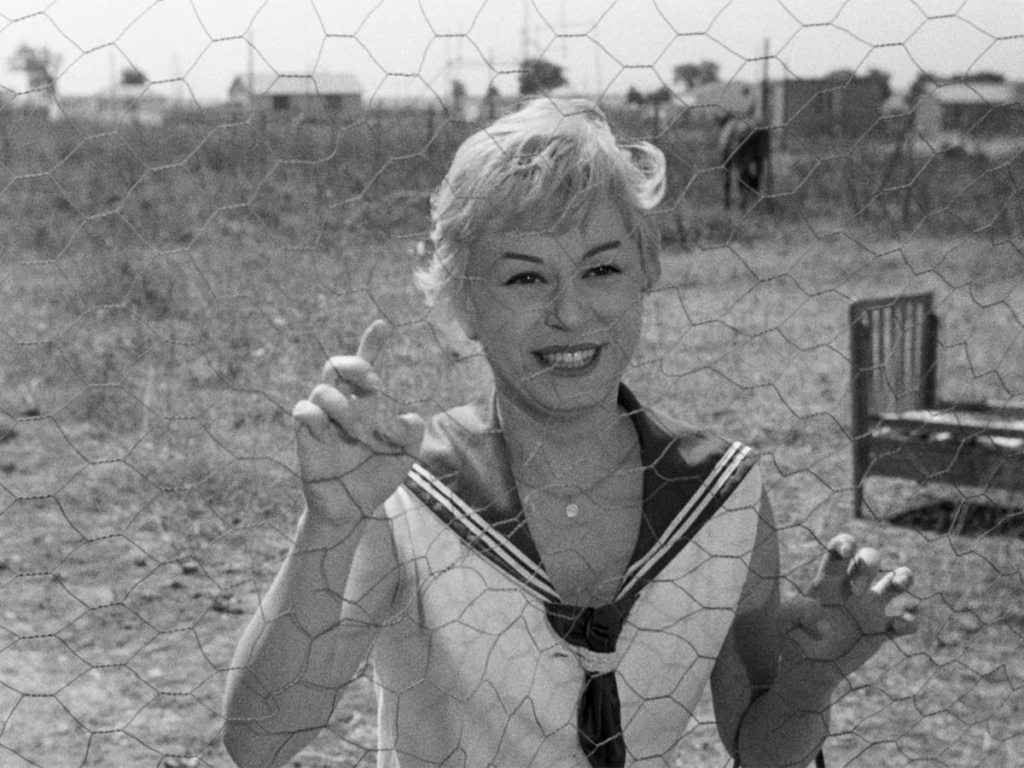
Certainly, those two characters are quite different: where Gelsomina is childlike and innocent, Cabiria has seen it all. She is not the Christ-like sacrificial lamb that Gelsomina was, and when the film starts with Cabiria’s lover Giorgio stealing her purse and pushing her in the river, her reaction is one of understandable fury – as much at the bystanders that save her from drowning as at the treacherous Giorgio. There are nonetheless parallels in Masina’s portrayal of the two characters, and in both films she has both the physical comedy and the pathos of a silent movie comedian. In an early sequence in which Cabiria is picked up by a famous movie star who’s just been dumped (albeit temporarily) of the girlfriend du jour, she is both sweet and hilarious, her face and body as expressive as if she were a living cartoon, though Masina has the great knack of making her character funny and sort of ridiculous without ever exposing her to mockery. Later episodes show other sides of Cabiria, as Fellini’s film shifts its tone and even genre towards melodrama and tragedy, but it’s always Masina’s performance that carries it. We see her interacting with the city’s poor, we go to a church mass where she begs the Virgin Mary for the ability to change her life, we accompany her to a magic show where she’s hypnotised and acts out her desires for a life of normalcy, without the judgment that comes with her profession. The film is clear-eyed when it comes to Cabiria’s foibles, but it never looks down on the character, it doesn’t blame or judge her. And, in the final scene, Cabiria emerges from the latest setback with a moment of grace that, almost 70 years after the film was made, still is startling and fresh.

While Masina is the emotional centre of Nights of Cabiria, Fellini nonetheless also uses his main character to comment on Italian society at the time, and once again he finds a striking balance between poking fun at it and its hypocrisies and expressing affection especially for its outsider characters. There is an affinity between his troupes of performers, his losers and con men, and his pimps and prostitutes: they all play-act characters that are larger than life, they often affect a jaded cynicism while pursuing sentimental dreams of a better life, and they’re generally looked down on by others that make the outsiders into scapegoats for their own failings.
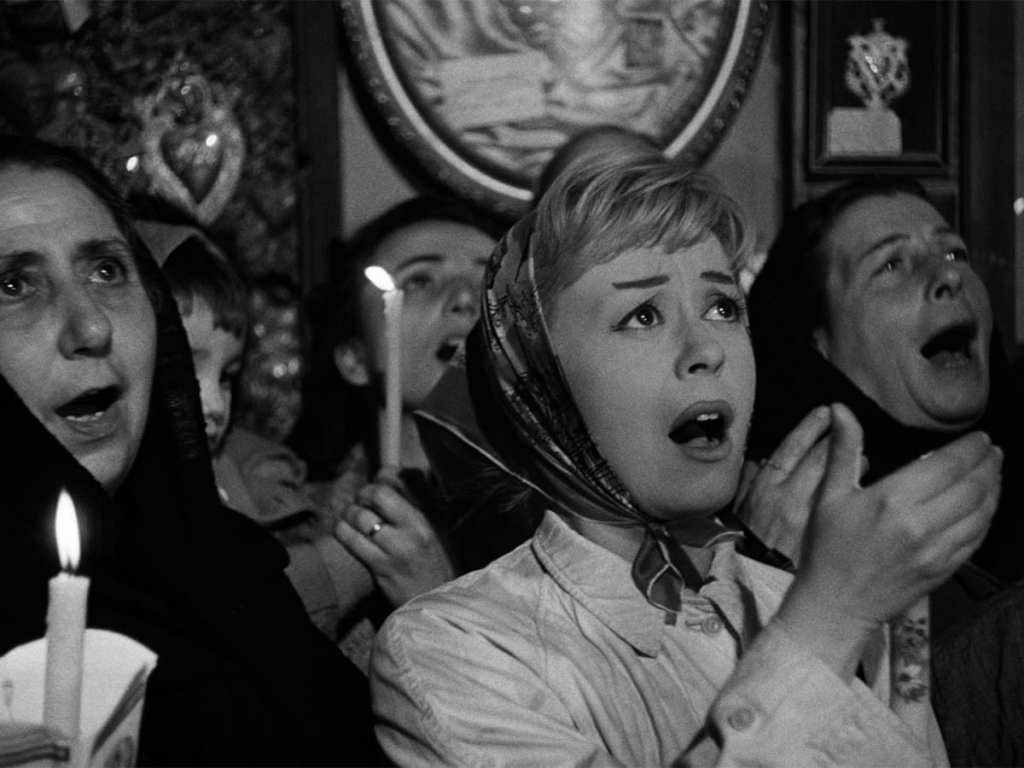
Nights of Cabiria also prefigures La Dolce Vita (which comes next in the Criterion box set), making for an apt counterpiece. Structurally, the two films are quite similar: they’re highly episodic, almost picaresque, telling less one coherent story than showing us different facets of the protagonists – Masina’s Cabiria in this case, Marcello Mastroianni’s tabloid journalist in La Dolce Vita – and, through them, different aspects of Italian society: prostitutes, movie stars, the Church and the believers, the almost rural communities living lives on the outskirts of Rome that could easily have been pre-war. Though, in La Dolce Vita, Fellini’s focus would shift from those at the periphery of Roman society to someone much more firmly middle-class – and where Nights of Cabiria clearly has affection for its central character and the world she inhabits, Fellini’s next film would instead express a profound disaffection and even alienation, encapsuled succinctly in its protagonist. The difference between La Dolce Vita and Nights of Cabiria is largely embodied in the difference between Mastroianni and his character on the one hand and Masina and her performance of Cabiria on the other. Judging from both La Strada and Nights of Cabiria, as well as from her smaller part in Il Bidone, it is difficult not to come away with the impression that Masina, her roles and performances, form the heart of the Fellini films she is in.
 A Damn Fine Cup of Culture
3 thoughts on “Forever Fellini: Nights of Cabiria (1957)”