We all know the iconic images: the statue of Christ flying through Rome, transported by a helicopter; wild nighttime parties in the Baths of Caracalla; believers carrying the sick on stretchers, tabloid journalists and TV people crowding two small children that claim to have seen the Madonna; and, always and especially, Anita Ekberg in the Fontana di Trevi.
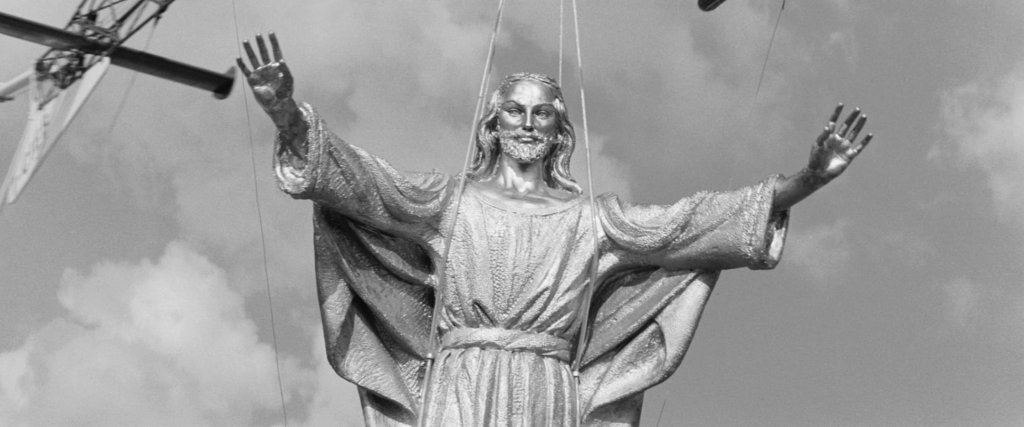
For someone who, like me, is mostly discovering the films directed by Federico Fellini in chronological order, it’s startling to arrive at La Dolce Vita. The film clearly represents a watershed moment in Fellini’s work: it feels modern (and arguably modernist) in a way that the earlier films have only done in isolated moments. There’s none of the sentimentality of La Strada or Nights of Cabiria, and little of the earthy, cheeky humour of Variety Lights or The White Sheik. This is a Fellini who is closer in tone and temperament to Godard, Antonioni or Resnais – and in the episode on the outskirts of Rome that deals with the purported sighting of the Madonna there are even hints of what’s to come in the 1970s, with films such as Robert Altman’s Nashville.

At the same time, rewatching La Dolce Vita confirmed my original sense that the film makes for a fascinating, and depressing, companion piece to Nights of Cabiria, and Marcello Mastroianni’s jaded tabloid journalist and writer manqué is a grim, distorted mirror image to Giulietta Masina’s prostitute Cabiria. Both films follow a similar pattern, focusing on a series of loosely connected episodes rather than telling a clear, coherent plot, and both films depict the city and outskirts of a Rome that still feels decidedly post-war through the eyes of their protagonists, so that it’s no longer clear whether we’re watching a portrait of the person or of a place and a time – or whether the question even makes much sense. Both Cabiria and Marcello (the character shares his first name with the actor who portrays him) have made a home in Rome but they are outsiders and observers. Both interact with those doing the same job as them: Marcello hangs out with journalists and paparazzi (the word was derived from La Dolce Vita, as Paparazzo is the name of Marcello’s photographer colleague), Cabiria with fellow sex workers and pimps, but in the film’s various episodes with partygoers, celebrities and religious masses as well. But Cabiria reacts to being mistreated by life with the hopefulness and warmth that Masina exudes in her performances like no other, while Marcello, as he comes up against the shallowness of the rich and famous and the pretensions of the intellectuals he is friends with, becomes more and more jaded and hollow. Where Cabiria, whose suitor has turned out to be a thief who only just about decides not to kill her for her money, comes out of these trials beaten but unbroken, Marcello seems to loathe both the world he chooses to inhabit and himself. Ironically, where Cabiria is the sex worker, Marcello is the one who has whored himself, his talents and his ideals out to others. For all her sarcasm, Cabiria is vulnerable but finds a touching resilience in her vulnerability; Marcello comes to see vulnerability as weakness and rejects it.

La Dolce Vita is beautiful, but there is a rotten quality to many of its beauties. Marcello is an existentialist trying to numb his pain by affecting to be nihilistically hedonist, but there is no enjoyment to his hedonism. Even when he surrounds himself by others, he pushes them away, sometimes cruelly so, making himself more and more lonely. And while it becomes downright unpleasant towards the end of the film to be in Marcello’s company, Fellini nonetheless achieves a tone of strange, ambiguous, fleeting sadness. Like Nights of Cabiria, La Dolce Vita ends with a character looking straight at the camera, at us – but the effect is entirely different. Cabiria’s look tells us that, against all logic, there is hope that everything will end well. When the young girl that Marcello met earlier in the film looks at us, as she has looked at Marcello only moments before (and a point could be made that we have taken the place of Marcello, as happens repeatedly during La Dolce Vita when characters look straight at the camera), the effect is one of profound pity. Whether Marcello deserves such pity is another question – but, as in La Strada, Fellini isn’t interested in allotting pity on the basis of whether we deserve it or not.

 A Damn Fine Cup of Culture
3 thoughts on “Forever Fellini: La Dolce Vita (1960)”