Would you say that, when you were a child, your parents really knew you? Did they see the person you considered yourself to be? Were there things you wished they’d known about you, but you were afraid of what they would think if indeed they did know? Did you feel that, in so many ways, you and your parents were strangers to one another?

All of Us Strangers, writer-director Andrew Haigh’s latest film, is concerned with these questions – and, even more, with what it does to us when we miss the chance to be known, seen, understood, by the people who are close to us, and to know them in return. Adam (a sublimely sad Andrew Scott) is a TV writer living in London. Even in a city of millions, he is lonely, isolated from others – or perhaps he isolates himself. He is a ghost of his own making. One day Harry (Paul Mescal), one of the very few neighbours of his in a newly built but mostly empty block of impersonal flats, knocks on his door and hits on him, drunk and displaying more than just a hint of despair. Adam sends him away – though not out of a lack of interest. He simply seems hesitant to let others in, literally and figuratively.
And then something happens that prompts me to warn the spoiler-averse: if you’ve not seen the film, come back once you have. Arguably, the thing that happens is part of the premise of All of Us Strangers – but it is disorienting, and that effect is intended. Okay, everyone who doesn’t want to be spoiled gone? Here goes: wanting to write about his parents and his childhood, Adam visits his childhood home in Sussex – and there he encounters a man, younger than him. The scene is filmed ambiguously, and anyone who doesn’t know the film’s basic plot already may think that the man is trying to pick up Adam. Which seems to work: the man says, “Shall we go, then?” And when Adam asks where, he says, “Home, of course.”

So the two men go home – literally. They go to the house where Adam grew up, and, as the man opens the door, he adds, “She’s going to be over the moon to see you.” And here, for the first time since he was 12, since his parents died in a car crash, Adam finds himself face to face with his father and mother, looking like they did when he was a child. Are they ghosts? Figments of Adam’s imagination? The film doesn’t ask that question, at least not yet: much like Céline Sciamma’s Petite Maman, in which eight-year-old Nelly goes to the woods and encounters her mother Marion as a child the same age as herself, the impossible is presented as matter-of-factly as if this happened every day. The mystery is not the point, it’s not even much of a mystery. It just is.
Adam keeps visiting his parents, and they encourage him to do so. All of them want to make up for lost time – though it’s also more complicated than that The parents are aware that they missed their son’s life as an adult, so they ask questions: Where does he live? What does he do? Does he have a girlfriend? At which, Adam does what he was never able to do in reality: he comes out to his parents, which prompts a reaction of concern from his mother: is he happy? Is he lonely? Is he safe from that horrible disease that people were talking about when she was alive? Surprisingly, though, his father’s reaction is an utter lack of surprise, as he tells his son that he’d always known – though, the times having been what they were, he never reached out to his deeply unhappy son, to talk to him, to comfort him.
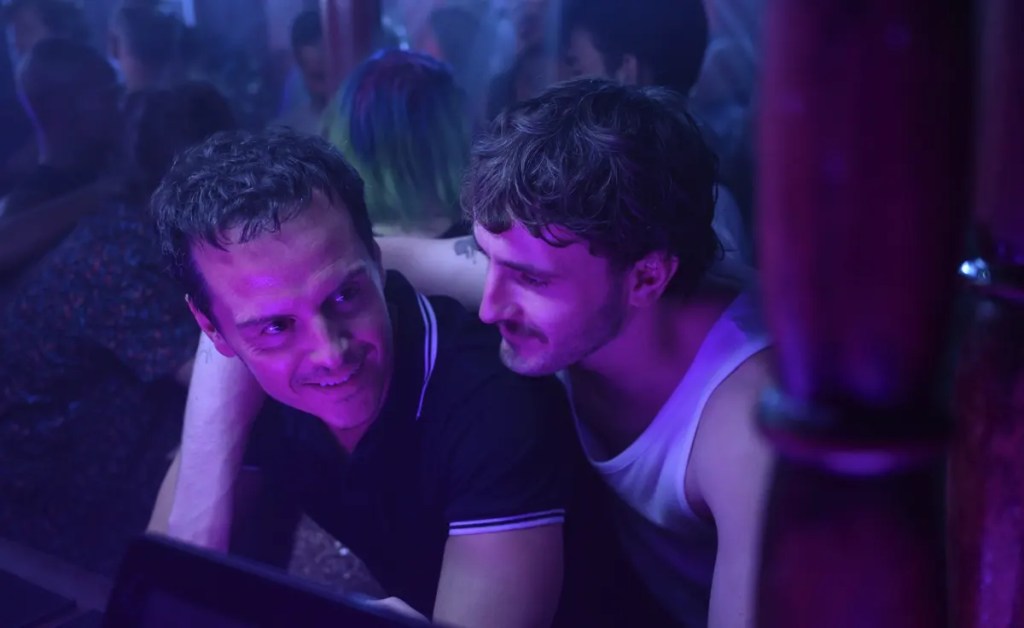
As we see Adam opening up to his parents after having been denied the chance to do so for all of his adult life, he also finds himself able to open up to his neighbour Harry, reciprocating the younger man’s interest – in physical nearness and sex, certainly, but also in more than just a physical relationship. It is as if the death of Adam’s parents killed a part of him as well: never getting the acceptance he longed for, he seemingly never fully accepted himself, his own desires and needs. Talking to his parents is therapeutic – but is it also an escape from his present and from everything that has shaped him, for better and for worse, into the adult he’s become?
The story that All of Us Strangers tells doesn’t undo Adam’s loss in the end: it gives him the means to deal with it. But in telling this story, the film makes a choice towards the end that, the more I think about it, the less I think it works. See, for the longest time Haigh’s film is of exceedingly light touch, which is highly effective: while it doesn’t explain its central mystery, it doesn’t dwell on it either. Have Adam’s parents come back from the dead? Are they ghosts? Are they a figment of his imagination? These questions aren’t answered because they’re not important. They’re not really what the film is about, just like Petite Maman isn’t about how a little girl gets to meet her mother as a child. And then All of Us Strangers throws a twist at us that suddenly draws all too much attention to these unimportant questions. I don’t think that this is Haigh’s intention – but how can it not? A twist makes us reexamine everything that has happened, and here it makes us ask what really happened at a number of key points during the film, which distracts from the characters’ emotional truth up to that point, leaving us instead with a number of possible interpretations that stand at odds with one another.

I’ve seen people read the ending as tentatively hopeful or at least restorative, and I can just about see where they’re coming from – but there are equally credible readings according to which All of Us Strangers ends in despair, and possibly even on a note of emotional sadism: if only this had happened, if only Adam had chosen to do this instead of that. Can a story be too open for interpretation? The choice that All of Us Strangers makes in its final half-hour is so open, it renders the film’s ending vague to the point of shapelessness. This may not be immediately apparent, as Haigh’s direction, the acting by Scott and Mescal and the film’s cinematography and style suggest a coherence and poignancy that the story sorely needs at this point. But this sense that the ending is of one piece in terms of its presentation and tone grates against the various mismatched implications of the ending in terms of the story we’ve just been told. The film doesn’t gain anything from letting us choose from all these possibilities. Certainly, All of Us Strangers does not call to be tied up with a neat bow, but its twist, while it is depicted with a care and even grace that provide the illusion of clarity, is a mistake, making me distrust the film in hindsight: All of Us Strangers‘ ending can be read as hopeful, or resilient, or horrific, or pointless – or all of these, or none.

 A Damn Fine Cup of Culture
One thought on “Love, longing, loss: All of Us Strangers (2023)”