Watching Fellini’s 8 1/2 for the first time in 2024 is a strange experience: it is so clear that this film has inspired many directors who’d go on to make films of their own that are very much inspired by Fellini’s. From Bob Fosse’s All that Jazz via Tom Di Cillo’s Living in Oblivion to Charlie Kaufman’s Synecdoche, New York and Paolo Sorrentino’s Youth – and that’s just some of the movies that, like 8 1/2, focus specifically on artists in a protracted state of crisis, trying to produce a work that, to all extents and purposes, is the film we’re watching.

In the past this sort of thing has resulted in me disliking the O.G. because I liked the derivatives. Give me Rosencrantz and Guildenstern are Dead over Waiting for Godot any day of the week. Let me read Midnight’s Children rather than The Tin Drum. Clearly a lot of what is in the later works stems from the earlier ones, but I enjoy Rushdie more than Grass, and Stoppard more than Beckett. Yes, I really am that kind of philistine. With 8 1/2, though? I totally see its appeal. Even if it left its mark on other artists and later films, some of which I like a lot, it still feels fresh and unique. It has a voice of its own, and even in those cases where Fellini is the obvious point of inspiration, few people are arrogant and/or mad enough to try and out-Fellini Fellini.
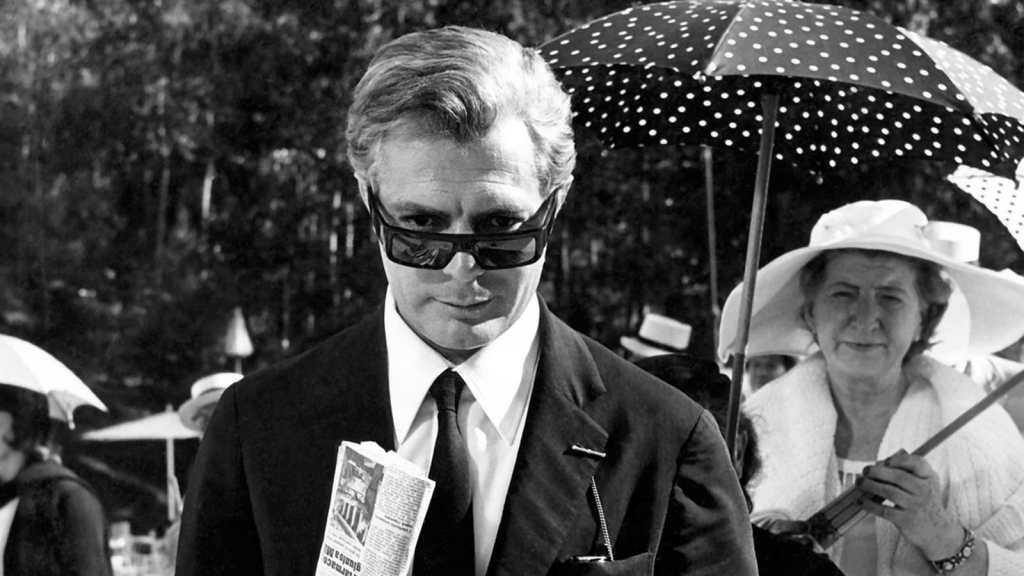
Having said that: I can absolutely see how someone might find 8 1/2 aggravating. For all its inventiveness and exuberance, it is a film about a male artist in crisis, and like most stories of that kind, it is intensely self-involved, which is only partly mitigated by the extent to which is pokes fun at its main character. Guido Anselmi (Marcello Mastroianni) is clearly a version of the film’s director, and his ego is as oversized as his many insecurities, as an artist as well as a husband and lover. For every scene where Guido is flattered and praised, by his friends, collaborators and women, there is another where he is mocked – most of all in an extended fantasy where he heads his own harem of current and former lovers, who have only one rule to keep in mind: once they get too old, they get banished to the first floor of the rustic house where they’re all shacked up, waiting for their lord and master to return home and require their services. But like so much of 8 1/2, there’s a schizophrenic quality to the scene: it is clear that Guido’s fantasy is laughable and that he is a pathetic manchild, but it is nonetheless impossible not to see the sequence, as much as the entire film, as self-indulgent. As Fellini ridicules himself by ridiculing Guido, the director and his fictionalised stand-in are nonetheless always the centre of the film, they’re the ringmaster of the metafictional circus. Even pathetic, ridiculous Guido is still magnificent Guido: when one woman gives him a tongue-lashing, another is at the ready to lavish him with affection, and when he is blocked artistically, his anxiety dreams are wildly imaginative and beautifully shot. 8 1/2 turns the man’s fear of losing it into a monument to his virility, even while showing it to be a sad and laughable virility, and the artist’s fear of failure into, well, 8 1/2.
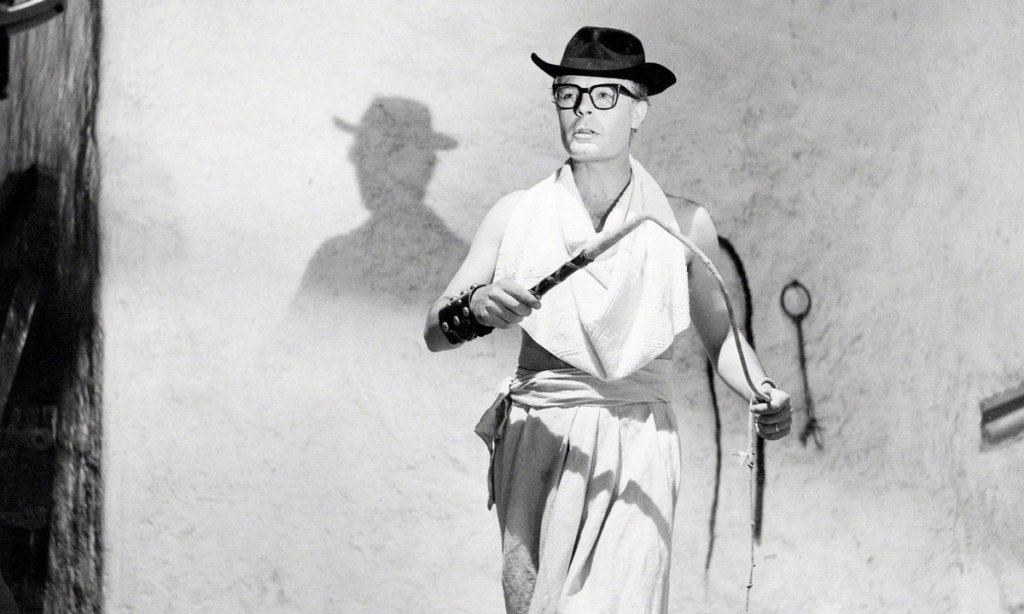
8 1/2 is very much at the other end of the spectrum from La Strada or Nights of Cabiria: it lacks the warm, earthy, deeply humane kindness and longing for connection, offering instead an alienated, self-centred neediness bound in an endless invention that nonetheless reflects exactly that need, for praise, for affirmation, for love that comes without the expectation that it is returned. But, if you can get past the film’s supreme solipsism, there is so much to enjoy here. Obviously the many dreams and dream-like episodes (this is a film where everything may well operate on the level of a dream, and even seemingly naturalistic sequences can veer into something much stranger at a moment’s notice) no longer have quite the same effect at this time and on audiences raised on surrealist cinema from Buñuel via Lynch to the likes of Guy Maddin, Michel Gondry or the Daniels, but they’re still highly effective, mustering a feverish intensity and conviction. Even when it is hard to ignore how self-serving all of this invention seems at times, pleading for the audience’s adoration, there is undoubtedly a generosity to the many riches that 8 1/2 offers. And sometimes it is in the film’s smallest details – an idea here, a stylistic flourish there – that Fellini seems to forget himself most and his showmanship ceases to be about the showman first and foremost. It is at these moments, when the film drops its relentless, Freudian navel-gazing for a moment, that it is at its most purely wondrous and strange and beautiful.
 A Damn Fine Cup of Culture
3 thoughts on “Forever Fellini: 8 1/2 (1963)”