Hirokazu Kore-eda‘s Still Walking was the second or third film by the Japanese director that I watched, after After Life and probably Nobody Knows. In some ways, I now recognise it as a more typical film for Kore-eda than After Life, in terms of its themes and character constellations. Where the earlier film undoubtedly has the feel and emotional heft that I’ve come to recognise as typical of a Kore-eda film, it is much more high-concept in terms of its premise and plot. More than that, though, when I think of Kore-eda, it‘s his families, both biological and found, that come to mind, and where family isn‘t as obviously a theme of After Life, Still Walking is very much about this: the families we find ourselves saddled with, the ones we make for ourselves.
But family isn‘t just about the people we have in our lives, it is also about those we have lost. Still Walking is focused on a theme that is central to many of the director‘s films: considering the kindness and warmth that are perhaps the most apparent characteristic of Kore-eda‘s films at a first glance, it is striking how many of them are in no small part about death.

It took the Kore-eda series at our favourite local cinema and seeing most of the director‘s films over a relatively short period for me to realise how much death figures into practically all of his films. Obviously After Life‘s premise is predicated on the fact that everyone dies. Marobosi, his first feature, is about a woman trying to cope with her husband’s suicide. Then there‘s the brutal killing that The Third Murder begins with, and that drives the film‘s entire plot. But even a film as overtly sunny and gentle as Our Little Sister both begins and ends with a funeral, its plot is put into motion by death, and its emotional themes are inextricable linked to the death of the protagonists‘ father.
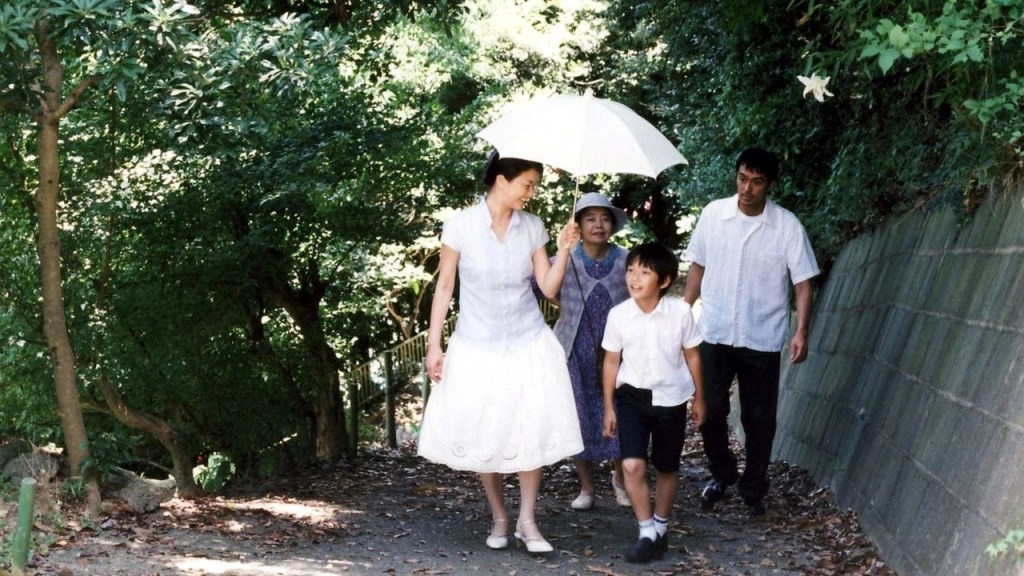
Still Walking is about a family gathering that, at first, isn‘t obviously about death. Once a year the Yokohama family gather at the parents‘ house, they prepare food, eat together, talk about their lives – and about Junpei. It eventually becomes clear that the gathering is a memorial one: Junpei, the older son, drowned 12 years ago in the process of saving the life of a boy. While most of the family‘s conversations are about the usual things families talk about, death makes its presence felt, in other ways as well: Kyohei (Yoshio Harada), who‘s lived all his life as a doctor, has retired and closed his practice, and while he still seems reasonably fit for his age, it is clear that he feels his life is over, and that he resents this, much as he resents his younger son, Ryota (Hiroshi Abe), for not living up to his expectations. Ryota‘s mother, Toshiko (Kirin Kiki, a Kore-eda regular), may seem more amiable at first, but she is a true master of the passive-aggressive, and she never lets Ryota forget that he is not Junpei, and that his having married a widow (death yet again), Yukari (Yui Natsukawa), who already has a son, is not the proper way of ensuring that the Yokoyama family line continues.

Meanwhile, the daughter Chinami (You, in a very different role from her part as the negligent mother in Nobody Knows) seems happily married, but she seems to be treated by her parents as an afterthought: it is the sons that matter, the older, dead one because he was the ideal son, and the younger because he needs to be reminded of the many ways in which he will never live up to Junpei. Family anecdotes are revised to feature Junpei, not Ryota, and Junpei‘s room serves as a shrine to the lost son, filled with things that will never again be used by anyone alive. Junpei may be absent, but it feels as if the Yokohama family is organised around him: as a reminder for what is missing and as an example that cannot be lived up to. And because he is dead, his overbearing presence in the minds and hearts of everyone does not need to be checked against the real person. The idea of Junpei, frozen in impossible perfection, is there in every exchange, in everything the family does and says over the two days they spend together.
While the family as a whole acquiesces (with a fatalistic grumble) to this annual ritual of a loss that is performed but rarely expressed outright, it is especially Toshiko who has perfected her resentment and honed it to a scalpel-sharp edge, even while she hides it behind a façade of maternal and wifely clichés. There is a sequence in Still Walking that is among the saddest and most bitter in all of Kore-eda. Yoshio, the boy that Junpei saved at the cost of his own life, makes his annual visit to express his continued condolences. On the surface, everyone seems to behave kindly to the young man who sees himself as a failure, but this kindness is an act that belies the underlying resentment and judgment of the man who should have died instead of Junpei. After Yoshio leaves, Ryota asks his mother why they keep inviting Yoshio to this annual display of bitterness and regret, and she replies:
– Why?
– I feel sorry for him. It seems painful for him to see us.
– That’s why we invite him. Can’t have him forgetting after just a dozen years. It was his fault Junpei died.
– But Yoshio didn’t –
– It makes no difference. Not to a parent. Not having someone to hate
makes it all the worse for me. So once a year I make him feel awful too. Will the gods punish me for that? So I’ll invite him next year and the year after.
– That’s what you keep inviting him here for? … you’re cruel.
– I’m not cruel. I think it’s normal.

Verdict: Still Walking is perhaps the film by Kore-eda that is the most upfront about the ways in which families seem designed to hurt, and be hurt by, one another. The expectations people have of one another, the extent to which parents and children judge one another, the ways in which resentment and disappointment become the ties that bind family together. But Kore-eda‘s familiar lightness of touch, and the wonderful performances, especially by Kirin Kiki, make Still Walking not only bearable but strangely poignant. On the surface, the family may present a fake façade of geniality underneath which run bitterness, anger and disappointment – but go a layer further, and the Yokohamas are indeed a normal family. Family relationships acquire such layers over time, some more gnarled than others, and affection and kinship are as much a part of the mix as the darker, more sour emotions and memories. A father‘s disappointment in the son who didn‘t follow in his footsteps; a daughter‘s resignation at always coming second to the men in the family; a mother‘s hurt, and a wife‘s acrimony, weaponised into a passive-aggressiveness that would be formidable if it weren‘t so sad; and at the centre of it the gap left behind by the son who, most likely, was never as perfect as the phantom the parents made him into once he was gone.
If Still Walking ended with Ryota, his wife and his stepson leaving the Yokohama family home, happy to leave behind those relationships suffused with bitterness and resentment that are barely ever addressed fully-on, it would be the grim counterpart to Our Little Sister, but Kore-eda instead ends the film on a coda set only a few years later, and those few years make all the difference. Junpei is no longer the only absence in the family, but family relationships don‘t end when a person dies – in particular a parent. The dead may longer be there in person, but they have left a dent in the lives of others, they exert a gravity. For better and for worse, they have shaped, and continue to shape, those left behind. Remembering them isn‘t always consoling, the rituals we have to express all of this aren‘t always healthy, but they are an expression of who we were, and always will be, to one another. And Kore-eda‘s film expresses all this with a subtlety, honesty, wit and sadness that is uniquely his own.
 A Damn Fine Cup of Culture
It dawned on me that this film is one of Kore-eda’s darkest. I didn’t realize it at first, but this is a testament to the scars that families leave on each other. It’s interesting how the currents in Nobody Knows, Still Walking, and finally After the Storm all have similar parental “traps”, but they abate in both drama and intensity.
I can’t remember the specifics, but I think Kore-eda mentioned that this one is a deeply personal film. Perhaps this is the arc of someone who allowed their pain to mature into something poetic, or even transcendent.
Thank you for your comment! I agree with you that there’s an edge to Still Walking, it’s definitely not as feel-good as Our Little Sister, for instance. I like that the underlying scars you’ve mentioned are not resolved, but they emerge as one element of many in this family still suffering from their loss and everything that this prompts. They survive as a family, even if the scars survive with them.