We’re back, several months after 8 1/2 (sorry!), with a film that I find frustrating and confounding – and yet I’m difficult to shake it off: Juliet of the Spirits. Two years after Fellini’s last film, and after two movies in which Marcello Mastroianni played variants (albeit more overtly attractive ones) of the director himself, Fellini cast his wife Giulietta Massina, for the first time in eight years (he’d last directed her in Nights of Cabiria) – and, in a twist on what he’d done with Mastroianni, Masina plays a character not dissimilar from herself: Giulietta Boldrini is an upper-class housewife, married to a philandering, self-centred husband, and while the details are vague but specific enough to show that the Boldrinis aren’t literally Fellini and Masina, the constellation of their marriage isn’t a hundred miles from that of the famous film-making couple.

What makes Juliet of the Spirits frustrating is this: we’ve just had two films about self-serving men whose flaws are revealed, even accused, but at the same time excused. As much as La Dolce Vita and 8 1/2 acknowledge the extent to which their protagonists are shits that use the people around themselves, the self-flagellation is performative and finally at the service of keeping these egotistical men at the centre. Especially 8 1/2 seems to say: this man is an exceptional artist, but at what price? – while whispering, isn’t the price worth paying for art this beautiful? And it’s usually other people, especially the women in the life of the thinly-veiled Fellini stand-in, that pay the price: the wives, the lovers, those lusted after yet dropped when they no longer serve their purpose. 8 1/2 is entirely aware of this – but I’m not sure the awareness goes much further than the shrug Marcello gives at the end of La Dolce Vita: I’m a bad boy, and I’m ridiculous, but, eh, what can you do? The director makes fun of himself, but like the stereotypical Catholic, his celluloid confession serves to let him go on doing exactly what he’s been doing.

With Juliet of the Spirits the director has a chance to do something different, because the protagonist of his film isn’t the fictional Fellini but instead a fictionalised version of his wife – and, more than that, played by his real wife. Undoubtedly, Masina wasn’t a victim devoid of agency in the creative partnership that had her starring in La Strada and Nights of Cabiria and delivering indelible performances, but if her stand-in in 8 1/2 (played by Anouk Aimée) is anything to go by, she may nonetheless not have been altogether happy with the marriage and with a husband who mined his life and the lives of those around him to make films about himself: the tortured, flawed, sinful man who feels bad about the beautiful women he beds, and who turns his feelings of guilt into art that is in equal measure self-accusation and self-exaltation.
So Juliet of the Spirits offers a chance to remedy this: this film isn’t about the flawed genius who’s so good at his art and so honest that he can laugh about himself and be patted on the shoulder by those around him for his many qualities! It gives the long-suffering wife a voice and makes her the protagonist! Never mind the complicated relationship between real life and art: is Juliet of the Spirits the much-needed feminine counterpart to 8 1/2?
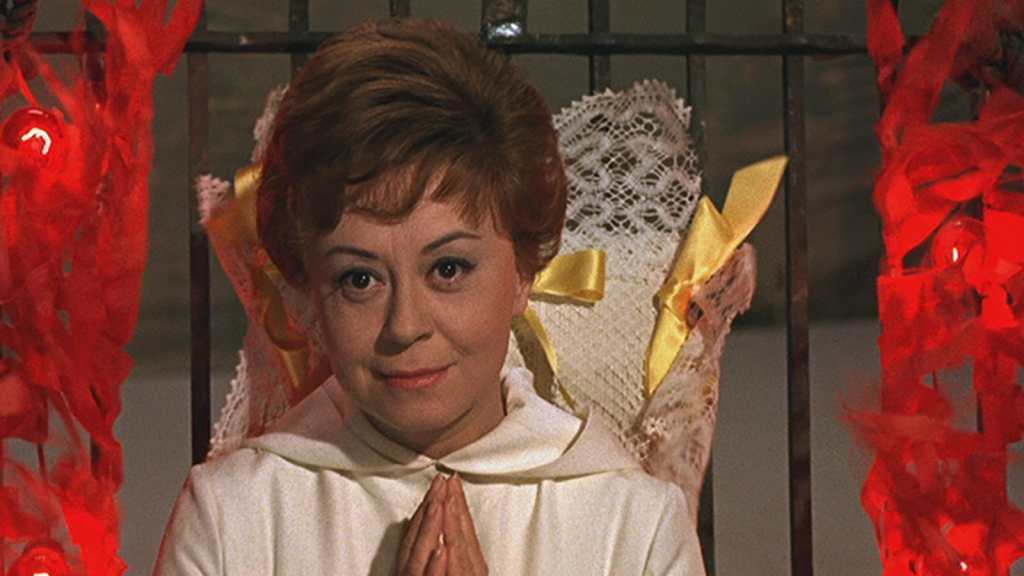
Well, yes and no. It is and it isn’t. It focuses on the wife while making the adulterous husband a side character. It gives Giulietta (is Fellini being earnest or smug by giving her his wife’s name?) a voice and agency – but it does so entirely at Fellini’s terms. The film’s visual and symbolic language is often notably similar to 8 1/2 (Fellini’s style is nothing if not recognisable), so it’s difficult to shake the impression that the director who put prettier versions of himself on screen in his last two films now uses his wife to chastise himself some more, with an equally forked tongue as in his most recent film. Look at me, Juliet of the Spirits seems to say at times: I am a cad, I am a bad husband, and here’s my wife, starring in my film, saying exactly this in the words I’ve written for her!
But it’s not as easy as that. Masina is too strong a presence, too savvy a performer, for Juliet of the Spirits to come across as entirely self-serving – and, frustratingly, Fellini is too good a director to deliver a film that is there only to reveal his sins and tell him to pray ten Hail Marys and go forth and not sin again. There is a tension to Juliet of the Spirits that is not necessarily enjoyable, but it makes the film fascinating. Are we watching Fellini’s film, are we watching him use his wife as a mouthpiece for an inauthentic mea culpa, or are we watching Masina’s film, in which she gets to express her anger, confusion and frustration at her marriage to a man who can’t keep it in his pants and who keeps producing successful, internationally recognised art about this very fact? In the end we’re watching both of these films at the same time, and they don’t cohere into a harmonious whole. They couldn’t, and most likely they shouldn’t.

So be prepared for a film that can be obnoxious, that has Fellini be the Felliniest he can be, for good and for ill. Enjoy the inventiveness, the dreamlike, increasingly surreal images – with added camp gaudiness, thanks to the director making his first feature film in colour -, but also enjoy it for Masina holding it all together better than the film seems to deserve at times. The psychology and metaphysics of Juliet of the Spirits are dated, they’re facile and crude at times, and Fellini has rarely felt more misanthropic than he does in his depiction of the friends and colleagues of Giulietta and Giorgio Boldrini, but there is plenty to enjoy while you’re rolling your eyes at Fellini.
P.S.: One of the extras that Criterion included on the disk is “Toby Dammit”, a short film that forms part of the anthology Spirits of the Dead, which had Fellini together with Roger Vadim and Louis Malle adapting stories by Edgar Allan Poe. The obnoxious qualities of Juliet of the Spirit are very much present in “Toby Dammit”, and amplified by having Terence Stamp play an alcoholic, nihilistic rock star who can’t meet his grisly fate soon enough, but this is an intriguingly moody, dark piece that takes Fellini’s sensitivities in a more phantasmagorical, almost Hammer-like direction that Juliet of the Spirits already hinted at but never fully embraced.
 A Damn Fine Cup of Culture
One thought on “Forever Fellini: Juliet of the Spirits (1965)”