Imagine: a body is found in a London alley in 1890. The man is naked, and it looks like he was killed by a gunshot to the head – or, more accurately, to the left eye. He also has what seems to be a strange tattoo on his left wrist. But that’s not all: the same body is found in the same place… in 1941. And, again, in 2023. In 2053, the man is found, but he isn’t dead yet – he’s clinging on to life. And four detectives from the Metropolitan Police investigate the mystery in four eras.
Sound intriguing, if perhaps in a somewhat mystery-boxy way?
Now imagine: you’ve got an engaging hook, with lots of pulp sci-fi potential – only to squander it away in a story that rehearses the same old tropes of time loop narratives and dystopian fiction, with characters that are either drab or clichéd or both, and a script that could have been written by generative AI. And the cinematography is as dreary and flat as the writing. And, in case you haven’t guessed: yup, it’s a Netflix production.
Time is a flat circle, innit?

Bodies was unlikely to be one for the ages to begin with, but it could have been an enjoyable slice of sci-fi pulp. But it gets something fundamentally wrong right out of the gate: it’s simply not particularly fun. It doesn’t have to be funny, there’s no need for overplayed, sub-Marvel bathos, but Bodies is set up first and foremost as a play on genre, and that should be more enjoyable, and definitely more playful, than what we get. What on the page could’ve been fun shoutouts – the late 1890s murder investigated by a detective with a great 1890s beard, with winks at From Hell and Ripper Street; the sleaze of wartime London, a time when men wore great hats and spoke in hardboiled clichés; even the Nineteen Eighty-Four Lite of the nearish future, where the government is benevolent in an ominous, overbearing way – became derivative and hackneyed in the hands of the series’ makers. Pulp does not need to mock itself for being pulp, but it is self-important at its own risk, and boy, does Bodies drink deeply from the well of self-importance. Even the most outlandish plot developments are delivered with a gravitas that would be hard to pull off if it had conviction, seeing how we’re dealing with time travel murder and century-spanning, conspiratorial cults. But Bodies does worse: it doesn’t have the conviction of its pompousness. A handful of the characters and actors deliver the material they’re given with at least the tip of their tongue placed in their cheek, but most go for monotone mutter in some scenes, shoutiness in others, as if these could signify intensity or make up for a script that loses itself in tired tropes.

We’ve got hints of time travel, see? With key events happening again and again? Anyone who’s watched a handful of genre stories, or even just the first season or two of Dark, will know which way this is going: loops, predestination, bootstrap paradoxes. Tell such a story and you can either try to come up with an internal logic-of-sorts that holds up as long as the audience is willing to suspend their disbelief, or you can do the equivalent of having Bruce Willis mockingly telling Joseph Gordon-Levitt to break out the straws, but for the most part Bodies decides to go for its protagonists with furrowed brows telling other characters that bad things will happen if they don’t believe their ludicrous story. I was no huge fan of Dark past its first season, but that series had a brittle seriousness that rather fit its adolescent protagonists, where everything might mean the end of the world. It also put in the homework and came up with a mythos, even if that mythos was mainly catnip for a certain kind of lore-obsessed audience and suggested that the people who’d come up with it might want to lay off the drugs and the Meaningful Proper Nouns (and, really, the latter more than the former). Bodies, at least in its TV incarnation (the series is based on a graphic novel by Si Spencer, apparently with considerable changes) does little of this, which isn’t necessarily a bad thing: Dark, to my mind, was sunk by its pomposity, its insistence on depth and substance where there was mostly a convoluted mess. But Dark had a personality of its own. Bodies never finds a voice or a vibe that isn’t reminiscent of other, better stories with more conviction and more of a sense of what they wanted to be.

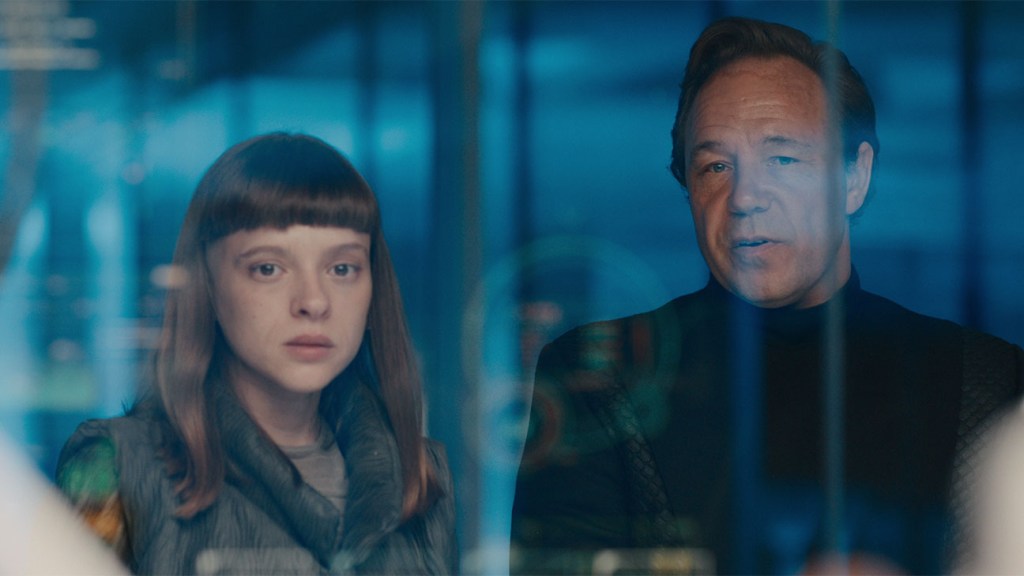
In the end, I don’t think I will remember much of Bodies beyond its premise. It is too formulaic while doing very little with its formula: each of the detectives is a minority in one way or another, and there are some story strands about oppression and discrimination, but what is there goes little beyond the generic, as with DI Alfred Hillinghead (Kyle Soller, who was so good in Andor), a closeted homosexual in a deeply repressed late-Victorian society. Or, worse, it is woefully underdeveloped, as with DS Shahara Hasan (Amaka Okafor), a Muslim, but this finally matters little to nothing to the plot, or DC Iris Maplewood (Shira Haas), whose disability could be written out with little impact on the series (it serves to motivate her loyalty to the oppressive state, but is little more than a perfunctory element of her character, a shorthand so short its absence would hardly be missed). Even Stephen Graham, who’s usually solid and sometimes great, is given little to work with – especially since this is the kind of TV where, the moment a character turns up on screen, you can pretty much tell if he’s a bad ‘un, but his villain isn’t even an enjoyable one. Some predictability needn’t be a bad thing, even for a mystery series, but Bodies tells a story that should thrive on secrets and puzzles, but very few of its plot developments come as much of a surprise.
As I’ve already noted: if anyone were to tell me that Bodies was an early Netflix experiment with AI-written storytelling, I might have believed them. Only its final episode musters some surprising emotional heft, considering how much the series had meandered up to this point and overstayed its welcome, but this is too little, too late – and, as a result, the nonsensical sequel bait at the very end leaves a bad taste. Knowing my streaming services, it will only be a few years before the next well-cast but generic time-loop narrative makes its way onto our small screens, and who knows? Perhaps the writers’ room algorithms will have improved enough by that time to deliver something better than Bodies. This one, like its central, titular mystery, arrives just about alive and soon becomes just that: another body, and another body, and another body, all oddly the same, none particularly interesting. For another time, I hope they will come up with something better – or break the loop before it even begins.
 A Damn Fine Cup of Culture
One thought on “Time keeps on looping: Bodies (2023)”