Welcome to ancient Rome, filtered through Federico Fellini’s sensitivities – which may as well be saying: unfiltered. But this isn’t your parents’ ancient Rome, or perhaps it is exactly your parents’ ancient Rome: one that is filled with corruption, debauchery and cruelty. Expect images, scenes and ideas that go far beyond the strangeness and excess of earlier Fellini films: here’s a beautiful young woman who won’t put out to just anyone, so an old sorcerer curses her so that fire comes out of her vagina (which the villagers use to light their kindling), and there’s a dead poet whose last will was that his belongings go to those who will eat his remains, so they begin to tuck in.

Fellini Satyricon (also known as Satyricon) is a wild ride. Don’t expect coherence or even much of a story, and don’t expect relatable characters. Instead, expect something that feels like a fever dream into a different world, one that is less historical (the film is loosely based on a 1st century AD satire by Petronius) than it is a psychosexual phantasmagoria that Fellini himself described as “science fiction of the past”. It is a film that leaves the director’s earlier works pretty much in the dust when it comes to its depictions of homosexuality, and of sex in all shapes and sizes in general.
It may also be the film by Fellini that most asks you to meet it on its own terms – and I’m not sure I succeeded at this. If you like films that are a parade of scenes, incidents and images that surprise you and confound you, Satyricon may be your thing. There is the frequently made argument that cinema is a visual art form, and that it should be judged on those terms, with ancillary arguments being made that a film does not require plot or characters to succeed as a work of art. I can agree with the latter, although I think there’s an arrogance to dismissing these aspects outright: storytelling, even in its most traditional terms, is a valid tool in the artist’s toolbox, and it shouldn’t be thrown out because some audiences are too narrowly focused on what happens next. Film isn’t just a visual art form: even if plot itself isn’t a requirement, films are structured by time. And Satyricon is the kind of movie that isn’t particularly interested in structure.

It would be wrong to say that the film has no structure, but its structure is minimal: a young man laments the loss of his lover to his friend and rival so he goes after them – and encounters one strange scene after another. Satyricon‘s guiding principle is “And then this happened”, which is part of what defines its dreamlike vibe. None of the characters are developed particularly – again, beyond “And then this happened”, so for Encolpius, the young man, what passes for character development is that he gets captured and imprisoned repeatedly, becomes impotent, fights a gladiator dressed up as a minotaur, has his buttocks whipped (albeit relatively gently) by young women in the hope of curing his impotence. This is stream-of-consciousness narrating – or, more accurately, it’s the kind of storytelling that Bill Waterston’s Calvin favours, that is, if Calvin was a horny Italian using Roman mythology as a jump-off point. This will not bother everyone equally, but I tend to take a dislike to storytelling that feels random, where you could put all the individual scenes in a box, give it a good shake, and pull them out one by one, and it wouldn’t make much of a difference. Encolpius captured by pirates is much like Encolpius captured by soldiers, Encolpius kidnapping a hermaphrodite demi-god could come before or after Encolpius being made to have sex with Ariadne and failing miserably.

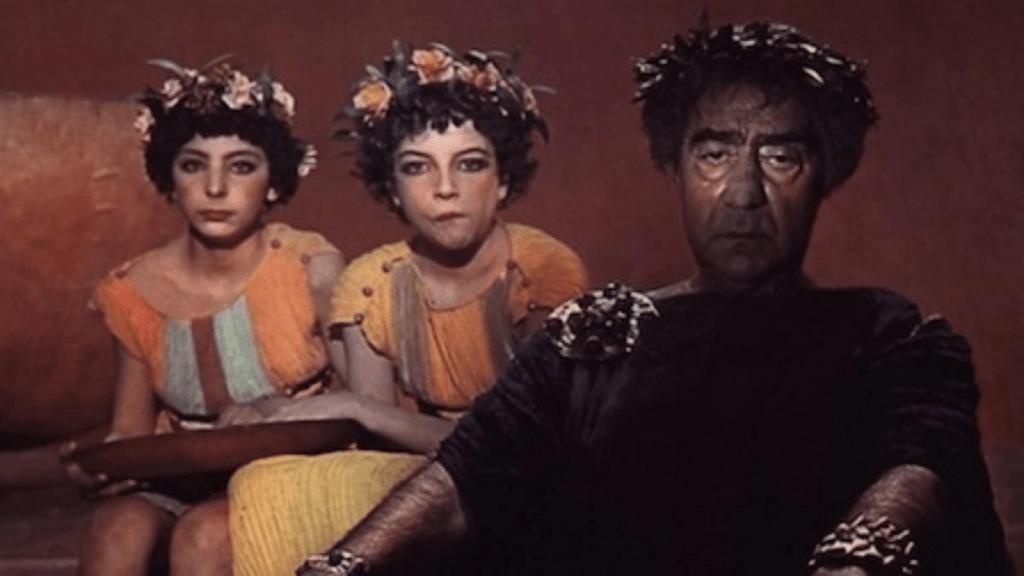
Satyricon could even be a sort of antique yet utterly ’60s picaresque if there was some other sense of structure or development, for instance in its themes, but this is absent too – and it is exactly this that makes me wonder if I’d almost like the film better if it was shown on an endless loop at an art gallery. As a film of just over two hours, it felt rather endless to me – and we did indeed end up interrupting it repeatedly and watching its individual episodes in instalments. It is possible that this way of watching Satyricon is a main reason why I ended up not enjoying it: Fellini’s satire might need the intensity that comes from watching it in one sitting, and ideally in a darkened cinema, because visually it is indeed pure cinema: the ways in which Fellini and his collaborators (especially production designer Danilo Donati and cinematographer Giuseppe Rotunno) combine different types of media and aesthetics – Roman murals, modern theatre, the gaudy colours of Technicolor, the kind of ritualistic surrealism that Pasolini used in his Greek tragedies (made around the same time, in collaboration with the iconic Dante Ferretti). There’s a strangeness to the look and feel of Satyricon that is impossible to place: is it archaic or utterly modern? And the film has a theatricality at times that punches through the film: there is an extended scene that pokes fun at the crass inhumanity of the ultra-rich, but throughout the spectacle of gluttony and tastelessness there are extras that don’t look at what is going on in the scene but straight at the camera, and by extension at us. I’m not sure how effective the social satire is, but there are images like this sprinkled throughout the film that stand out and burrow their way into the audience’s imagination. It is well possible that these would be even more effective if we had seen the film in a single sitting, allowing ourselves to become fascinated, bored, disgusted, confused, entranced again and again.
Francis Ford Coppola’s Megalopolis, possibly the man’s final film ever, was released this week, and a lot of the reviews made me think of Satyricon: apparently the film is a mess, and the summary of the critics’ reactions on Rotten Tomatoes (I know, but bear with me for now) reads: “More of a creative manifesto than a cogent narrative feature… an overstuffed opus that’s equal parts stimulating and slapdash”. There is a brand of film that is about invention and ideas, and depending where you’re coming from, this can be read as generosity or as incoherence. Sometimes this works for me – I’m thinking for instance of Leos Carax’s Holy Motors or even of David Lynch’s Twin Peaks: The Return. Sometimes it doesn’t, and this may have as much to do with when I watch a film, what mood I’m in, how tired I am, whether I watch it at the cinema or at home, whether the seat I’m in is comfortable, whether I’m hungry or not. Having seen it once, Satyricon didn’t do all that much for me, but I’m intrigued enough to hope that I’ll get the chance at some point to watch it in a different context. I suspect it won’t ever be near the top of my list of Fellini favourites, but I could imagine that the experience would be quite a different one.
 A Damn Fine Cup of Culture
I have a book that treats Satyricon as a horror movie. And there are a number of rather horrible things that happen. Particularly the man getting his hand chopped off a few minutes into the film. That looked quite real.
One thing I read said that Fellini’s purpose in making the film was to counteract the stereotypical “Roman” epics of the 50’s and 60’s that are usually moralistic. He wanted us to see how different Roman society was and not judge it too much.
I guess Megalopolis is kind of similar, but I don’t really think I’d put them together. Megalopolis has a definite message about the political troubles we’re going through now in the US. Coppolla believes there are strong parallels between the fall of the Roman Republic and today.