I admit: knowing many of those old, black-and-white monster movies only from short snippets or animated GIFs, I tend to go in assuming that they’re kinda silly, and while you might enjoy them, it’ll be the kind of enjoyment that comes with an ironic distance. You enjoy them for their silliness, their camp aspects. You enjoy them because it’s so obviously a guy in a rubber suit stomping on toy cars.
Sometimes that may be true, or you might enjoy the historical aspect, or the craftsmanship of a time when the effects guys were literally making up a new industry. Sometimes, though, you can watch one of these films and realise that they still work as what they were meant to me: earnest works of horror. Perhaps not in their entirety – but there’s an earnestness and filmmaking skill on display that can’t be dismissed with any amount of jaded irony.

I was surprised to find that the original Godzilla, released in 1954, falls more into the latter category than I’d expected – though Godzilla Minus One, the 2023 take on the material, had prepared me for a film starring the O.G. kaiju that wasn’t camp or ironic, a film that worked as a serious take on what happens when a prehistoric lizard is mutated by nuclear tests and decides to take a trip to Tokyo. Obviously Godzilla Minus One looks very different from its distant ancestor: its VFX are pretty much photorealistic and convincing throughout. But in many ways, 1954’s Godzilla is film that resembles last year’s surprise hit to such an extent that I’d almost call Godzilla Minus One a remake (remember those?): there are many of the same plot points, character types and set pieces in both movies. one key difference, though, is that the newer film is set just after the war, with Japan still very much a defeated country (the title plays on this, Japan having been brought to zero by the war and even lower by Godzilla, though it’s the kind of Japanese play on words that, while it might be in English to begin with, is puzzling to English speakers). The original, on the other hand, finds Japan in recovery and Tokyo lit up by neon signs and adverts.

Obviously, the 1954 film’s special effects are a far cry from the CGI used to great effect its great-great-great-grandchild – and a modern audience will know that they’re looking at miniatures just from the way the footage looks, especially in motion. But while the datedness of the visuals does create a certain distance, except for a very small handful of moments it’s not the distancing effect of irony and camp. The effects work on the original Godzilla is inventive, skillful, and tremendously charming, and the granddaddy of all things kaiju himself also works surprisingly well. Perhaps his eyes do look a bit too much like those of a grumpy teddy bear, but even if he and the destruction he brings upon Tokyo don’t look real in the strictest sense, they feel real. Godzilla isn’t as wantonly sadistic as 1933’s King Kong (which has an adolescent nastiness in its monster kills that is in equal measure off-putting and exciting), but it is earnest about the damage Godzilla inflicts on the city – and it is impossible not to read it in light of the urban destruction that World War 2, and especially the bombing of Hiroshima and Nagasaki, brought on the country. Here, again, the film prefigures its 2023 quasi-remake: neither Godzilla nor Godzilla Minus One wink at the audience, asking them to cheer on the kaiju-made disasters as mere spectacle. People suffer and die at the fiery breath of this nuclear terror.
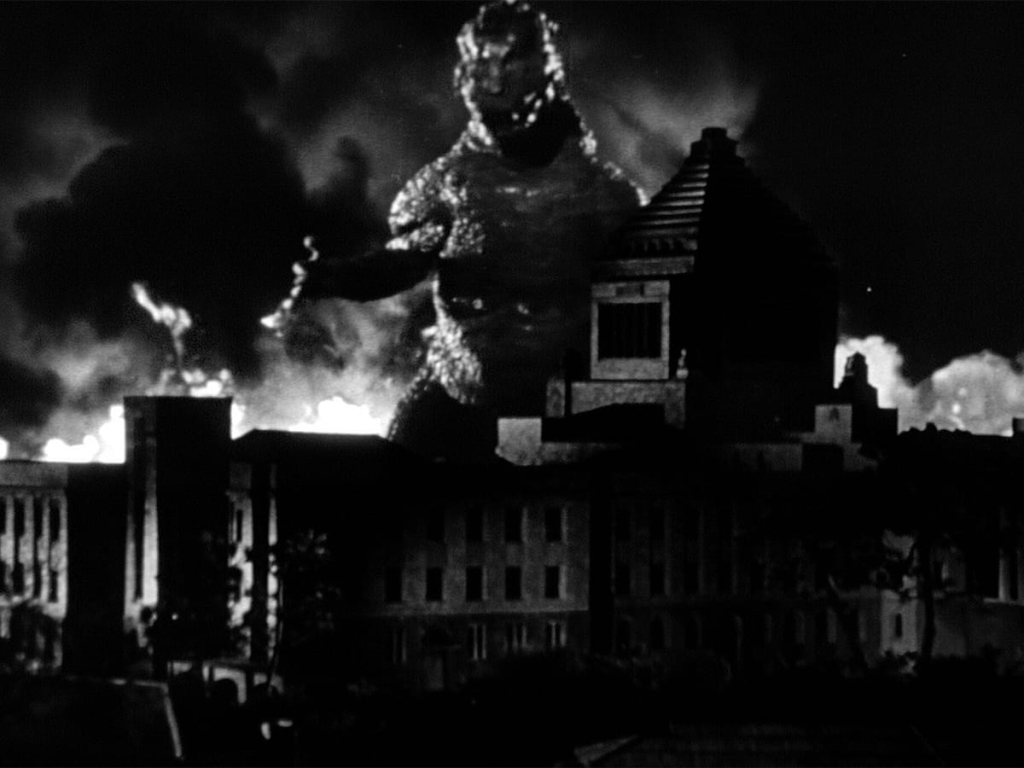
And, differently especially from the American productions of recent years bringing the mutated lizard and his kaiju chums to computer-generated life, the scenes which focus not on Godzilla but on the tiny, squishable human beings, who have only recently survived the destruction of a war are essential to the story, transporting that earnestness successfully. Here too, what I found was very different from what I expected: there is an understated, even mournful quality to much of the storytelling and acting, and the characters are not (intentionally or unintentionally) laughable. I was surprised to find Kurosawa stalwart Takashi Shimura in one of the leading roles, but he is a good fit, never playing his character in a knowing way, aware that he is in a silly monster movie in which a guy in a rubber suit stomps on miniature buildings. Shimura takes the part as seriously as he takes his role as the aging ronin Kambei in Seven Samurai or the dying bureaucrat in Ikiru. And this is emblematic of the original Godzilla as a whole.
Verdict: The earnestness of Godzilla could have backfired if the film had been made with less skill or if it had allowed itself even a single wink at the audience. It is no mean feat to pull this off, and later films in the franchise don’t even try (Son of Godzilla, anyone?), but the original film mines Japan’s recent national trauma in ways that amazingly never feel tacky or misguided. Perhaps it’s the kind of trick that can only be once, because afterwards, what’s a franchise to do but escalate the mayhem? Bigger and bigger threats, more kaiju, or indeed the surprise offspring mentioned just a few lines ago – these don’t lend themselves to the “poetry after the A-bomb” of J. Hoberman’s essay for Criterion. There’s a reason why poetry, by and large, doesn’t do sequels, prequels and remakes, and why we don’t really think of it in terms of big screen franchises. There may be almost 40 Godzilla movies out there – but in all the ways that matter, there is only one Godzilla.

 A Damn Fine Cup of Culture
One thought on “Criterion Corner: Godzilla (#594)”