Stop me if you’ve heard this one before: a conventional yuppie who, if you look at him from the right angle, reveals a streak of disaffection with his life bumps into a free-spirited young woman. She introduces him to the wild side of life, and they embark on a whirlwind romance. All together now: can you say “Manic Pixie Dream Girl”?

If you rolled your eyes at this, rest assured: that was pretty much my first reaction to Jonathan Demme’s Something Wild – so much so that after about half an hour I ejected the Blu-ray and watched something else instead. For those first 20-30 minutes, I felt more and more that I really didn’t need yet another take on that particular well-worn cliché. Charlie Driggs (Jeff Daniels) and Lulu (Melanie Griffith), as she calls herself to begin with, weren’t endearing to me: I found them and their idea of what breaking free from convention looked like grating. It’s one thing to watch teenagers who believe they’re the first ever to break free from the bonds of social mores; it’s quite another to watch two supposedly grown-up people behaving like those teenagers. There’s something to it that is smug and self-satisfied and, frankly, a bit boring.
While it took us a couple of years to get back to it, I’m glad we decided to give the film a second chance, because in Something Wild Demme ends up doing something more interesting, and more complex, than another spin on the merry-go-round of rejecting the social shackles of conventionality. For one thing, its Manic Pixie Dream Girl? She isn’t – she’s too much of an actual person for that, and not really the platonic idea of a dream girl, though you can see why Charlie is drawn into her orbit (even aside from the sex). Lulu is as much of an act as Charlie is at the beginning of the film: he’s pretending to be the perfect yuppie family man, she’s pretending to be wild and exotic and free, because both of them are trying to escape the versions of themselves that they used to be. If Charlie hopes that she can release him from a life he doesn’t really want anymore, she also projects her own needs into him. Each uses the other to try and prove something to themselves – and neither succeeds entirely. There is a revealing scene about a third into the film where Lulu (now identified as Audrey Hankel) takes Charlie home to her mother Peaches, and Peaches (who comes across as the most conventional of small-town moms, but plays a mean harpsichord) sees right through the both of them and their act – yet what she cares about is that each of them is good for the other, and if that includes cosplaying as irresponsible adolescents for a couple of days, that’s okay. As long as he looks out for her and no one gets hurt.

And then Ray Liotta appears on the screen (in his first big movie role, no less!) and brings the pain as Audrey’s ex-husband Ray Sinclair. Not only does he add another layer to Audrey’s character and her Manic Pixie Dream Girl-ness, Liotta is also a live wire complete with the risk of electrocution: his Ray is frightening, a Stephen King bully brought to life, but with a striking streak of charisma that makes him even more scary. In key ways, he displays the same kind of behaviour as ‘Lulu’ did, but turns it up several notches, showing what is inherent in her earlier movie-style kookiness: its manipulativeness, its sociopathy. Her adolescent wildness curdles into sadistic glee in him, and it turns Charlie’s walk on the wild side into something much more dangerous.

Verdict: Daniels and Griffith are good in this, even if it took me a while not to roll my eyes at their early-film antics right out of the playbook of Manic Pixie Dream Girl films. I always enjoy seeing Daniels in roles that aren’t only comedic, and Griffiths makes Audrey a more layered, interesting character than she appears to be at first. As far as the film’s cast is concerned, though, it’s Liotta who practically runs away with Something Wild once he makes his appearance. Ray could be a cliché of a psychotic bully, but Liotta has an electric energy that makes me think this was pretty much his audition tape for Goodfellas.
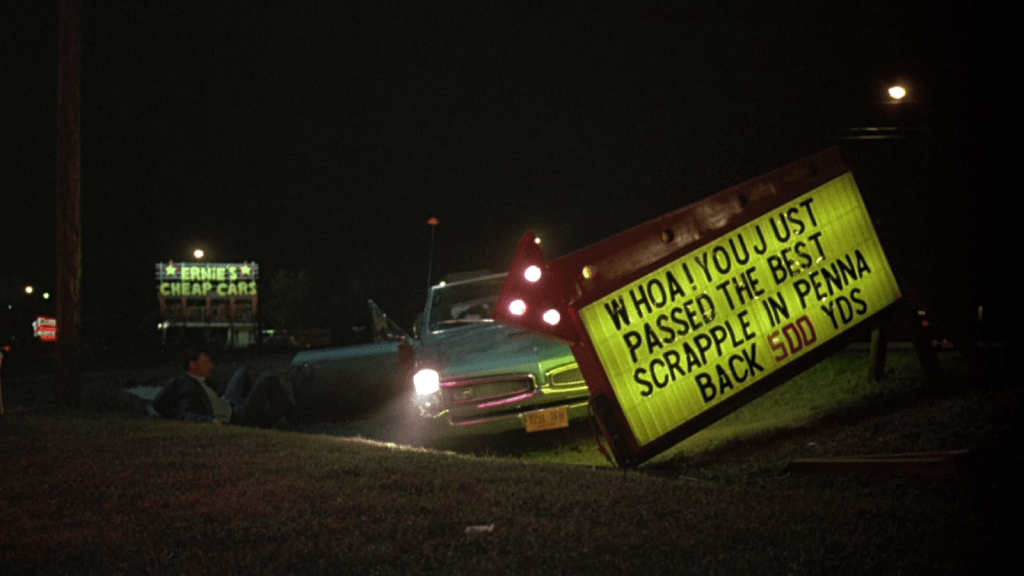
Something Wild has more than that to offer, though: Demme has a great eye for the low-key strangeness of a certain kind of small-town Americana. If you were to describe the details, it might sound quirky and twee: the harpsichord-playing mother, the motorcyclist with his helmet-wearing dog, the high school reunion where everyone wears silly little Uncle Sam hats. But past its first half hour, the film doesn’t feel quirky: there’s a fittingly irony-free quality to how all of this is depicted that almost feels documentary – this is an America that exists, even if it rarely makes it into the movies in such an unvarnished way. Something Wild is aware of the ridiculousness of this world, but it doesn’t look down at it – and Ray and the danger he represents is as much a genuine part of this America as the stupid tiny hats and the dogs on motorbikes.

I frequently find that I like Demme’s films less than I think I ought to (including his iconic Silence of the Lambs), and I don’t think that Something Wild will ever figure on a list of my favourites. Much like Before Sunrise, I wonder whether it may best be watched first when closer in age and attitude to Charlie and Audrey. But even if you bounce off it to begin with, there’s a richness beyond the beginning, which can feel clichéd, both in its characters and in its world – and there is that Ray Liotta performance. Even if you were to give up on Something Wild after half an hour the first time you sit down to watch it, the film does reward being given a second chance.
 A Damn Fine Cup of Culture
One thought on “Criterion Corner: Something Wild (#563)”