Six couples – three men, three women, engaged in various sexual and romantic relationships – are seated around the dinner table. All of them work for British intelligence. One of them has been tasked with finding out which one of the other five is engaged in traitorous deeds. The food, while delicious, is spiked with a truth serum. What else is on the menu? Fun and games – that will end up with a steak knife being used for something quite different than its intended function. The words that are exchanged are just as sharp. And this is just the beginning.

It is difficult not to think of Edward Albee’s classic Who’s Afraid of Virginia Woolf? in this early scene of Black Bag, the latest film by Stephen Soderbergh, the world’s busiest retiree. The film’s script by David Koepp (who also worked with Soderbergh on Kimi and Presence) clearly courts these associations with sly winks at the play. But the comparison doesn’t go far beyond the admittedly fun nods at Albee’s caustic drama, because where his George and Martha are engaged in bitter marital warfare and use their guests as welcome weapons in the battle, the married couple at the heart of Black Bag – George Woodhouse (Michael Fassbender) and his wife Kathryn (Cate Blanchett) – are formidably loyal to each other. Kathryn may be the traitor, she may be engaged in selling state secrets to an enemy that wouldn’t hesitate to use these secrets to kill tens of thousands, and George is nothing if not a dogged investigator, determined to find out the truth – but both are committed to the other over everything else. Or are they?

Apart from the Albee references, another comparison is quick to come to mind but equally only describes Black Bag very superficially: George, with his glasses, his restraint and his implacable sense of purpose, is easily read as a younger, more overtly attractive take on John le Carré’s George Smiley (what’s the collective noun for a group of Georges?), as is his mission of trying to find out who the mole is, knowing only that it is someone close to him. But where le Carré’s novels are about betrayal first and foremost, and his characters are lonely by choice as much as by circumstance, Black Bag is about marriage.
And boy, there are few married couples in recent cinema history as sexy as George and Kathryn. Obviously it helps that these are two actors as skilled as they are attractive, having fun with a witty genre script, but it is the characters’ commitment to each other that amplifies their allure – and other characters in the film remark on how hot they are as a married couple loyal to one another, particularly in a world where everyone is so skilled at lying that it becomes second nature to them in their private lives too. The material is also a perfect fit for Soderbergh, a director who has shown a penchant for competence porn: films in which people are shown to be tremendously good at what they do. (It is not an accident that Soderbergh has returned to the heist genre repeatedly.)
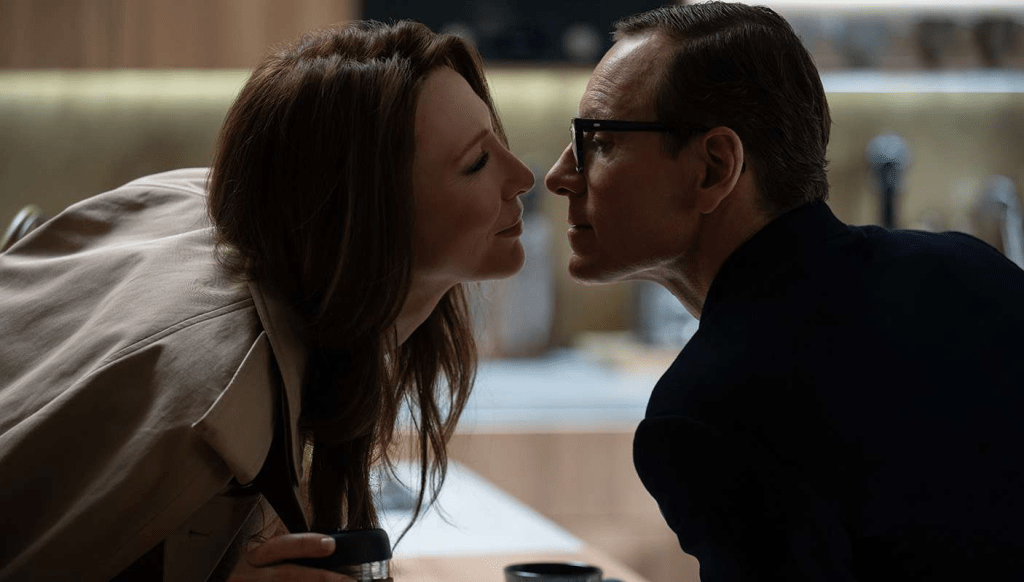
I am still a bigger fan of Soderbergh’s early filmography: Out of Sight, Traffic, Ocean’s Eleven, The Limey (a smaller film that doesn’t get nearly the attention it deserves) – but Black Bag is the most fun I’ve had with one of the director’s films in years. While it is about marriage – and it is more positive about marriage than most dramas on the topic -, Black Bag is not a film that has a lot of heart. That’s not what Soderbergh is aiming for: many of the film’s characters are emotionally atrophied to the point of sociopathy, and arguably this includes George and Kathryn, whose love for one another doesn’t have an iota of sentimentality. But that doesn’t make it any less sexy: watching the two of them exchange glances and caresses is more exciting than finding out who the traitor is.
It is not a huge flaw of Black Bag that its thriller plot isn’t always as clear as it could be: after seeing the film, I had to resort to Wikipedia to understand one or two aspects of its story fully, but even when I wasn’t entirely clear on who had done what and to what effect, I never lost track of the underlying relationships and motivations. In the end, while Black Bag obviously does operate as the kind of thriller in which any one character could be a traitor, this is almost secondary: its main attraction lies in watching its two protagonists being tremendously good at what they do: being MI6 operatives and being married to one another.

 A Damn Fine Cup of Culture