Is bigger always better? Arguably, that’s the main question the Mission: Impossible franchise has set out to answer, at least since reinventing itself in its current format with 2011’s Mission: Impossible – Ghost Protocol, directed by Brad Bird. Once you get the Kremlin blown up and climb up the Burj Khalifa like a real-world Spider-Man, where do you go? Well, obviously, you ride a motorbike off a mountain in order to parachute through a window of the moving Orient Express. You try to escape a sunken submarine that’s rolling towards the abyss, while torpedoes come crashing from their enclosures to your left and right.
Is this one-upmanship impressive? Undoubtedly. Does it make for a good film? Let me get back to you on that one.
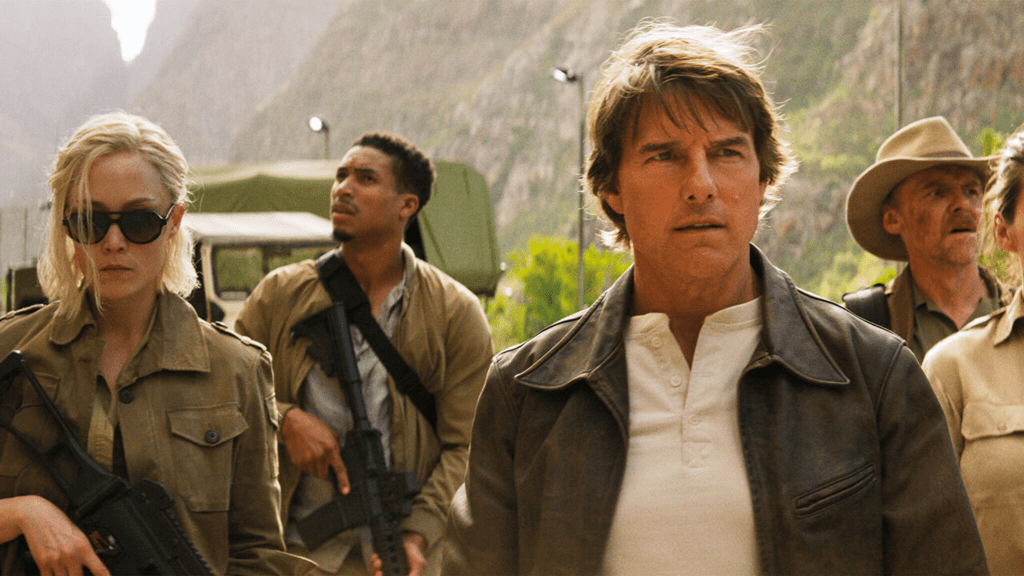
For a while, I saw the Mission: Impossible franchise as similar to the Alien series of films in one key respect: each film had a different director and a different style, from the original Mission: Impossible (well, I say “original” – that one already was a big-screen reboot of a classic TV series), helmed by Biran De Palma as a stylish, jazzy espionage thriller, to Mission: Impossible 2, a quasi-camp action opera directed by John Woo, slo-mo pigeons obviously included, on to Mission: Impossible III by J.J. Abrams, at that time a supposed writer-director wunderkind coming straight from TV hits Alias and Lost, and eventually Mission: Impossible – Ghost Protocol by Brad Bird, fresh off the Pixar hits The Incredibles and Ratatouille. Not all of these films were equally good (again, much like the Alien films), but the variety of storytelling and aesthetic identity was a large part of the appeal.
But Brad Bird’s take on the formula obviously impressed the right people, most likely including Tom Cruise. While Bird himself didn’t return to the franchise, it’s clear that Christopher McQuarrie, who’d previously been known more as a screenwriter than a director, took Ghost Protocol as a template for his instalments – a move that paid off, both critically and financially. At least initially: although Mission: Impossible – Dead Reckoning Part One (a film whose title is even clunkier in hindsight, seeing how its sequel dropped the numbering) grossed almost US$6 million, it was considered a box-office disappointment compared to its massive budget. Still, the critics loved McQuarrie’s movies, and rightly so: here were big-budget action films that didn’t look like the samey CGI fests happening a screen over featuring superheroes from the Marvel and DC stables. There is an admirably hand-crafted look and feel to the Mission: Impossible films and their stuntwork, even at their most grandiose, which feels so much more tactile than the superpowered fisticuffs of the MCU and DCU, whose films were expensive but often generic and downright ugly in their action.

I enjoyed McQuarrie’s work on the series, but at the same time I felt that something had become lost by locking into one director and one style. At that point, it wasn’t enough for the action setpieces to be different from what had come before: they had to be bigger, and bigger yet again. And there’s no doubt about it: Mission: Impossible has created several of the most impressive stunt setpieces in present-day cinema – but there is a limit to that kind of action arms race. The Final Reckoning features some fine, fine stunt work, yet I was sitting there, fondly remembering the Langley heist in the first Mission: Impossible, a sequence that didn’t require anyone to jump a motorbike off a mountain or dangle off an airborne biplane for long stretches of time for real. In becoming bigger and bigger, the series’ stunt setpieces have started to feel desperate, for want of a better word – and I’m finding it difficult not to see them as expressions of Cruise’s need to prove to his audience and to himself that he is and always will be Teflon Tom, Daredevil Cruise, the eternally young, eternally handsome, eternally superpowered chosen one. Going back to 1996: the Langley break-in was stylish and fun, and in no way underwhelming in comparison with the superlatives of the franchise’s second half. To some extent, I can’t shake the impression that the series’ stunt work started off serving the films, but it has since come to serve Cruise’s need to be recognised as the world’s first and only real superhero.

This effect is only amplified by the increasingly self-serious tone that the Mission: Impossible films have taken on in recent instalments, in particular the two-parter manqué that is Dead Reckoning and Final Reckoning. While these films aren’t entirely humourless, it’s difficult to get past lines describing Ethan Hunt as “the living manifestation of destiny” (which, seriously, what does this even mean, and have they put a second’s thought into the yucky echo of Manifest Destiny?) and the self-referential monologue in Final Reckoning: “This was your calling. Your destiny. A destiny that touches every living thing.” I don’t need a Mission: Impossible script to be made up of pithy sub-Whedonesque one-liners – but I doubt anyone thinks that the films are better when they couple their action bombast with verbal pathos than when they had the jazzy lightness of Lalo Schifrin’s original Mission: Impossible theme. Worse, still, is how often the self-important plotting and dialogue seem to be aimed at convincing us that Ethan Hunt is a messianic figure: “Every risk you’ve taken, every comrade you’ve lost in the field, every personal sacrifice you made, has brought this world another sunrise.” It’s almost as if the film doesn’t just include yet another race against time to save the world and mankind as a central plot point: instead, it feels as if it tries to invest itself and its star with the same import. Mission: Impossible – saving cinema and the world one instalment at a time.

To be fair: even in Dead Reckoning and The Final Reckoning, there are scenes that are fun and indeed funny, that have the kind of lightness that I look for in this kind of spy action. There is a wonderful fight early in The Final Reckoning that plays out entirely off camera, in sound, as instead we watch the face of a character who’s looking at a scene, invisible to us, of Ethan Hunt defeating a handful of henchmen. But such scenes are undermined by the over-reliance on pathos – and, in The Final Reckoning, by its insistence on tying in every single Mission: Impossible film. Remember this plot point, character, MacGuffin from a decade ago? Especially in its first hour, the latest film in the series almost feels like a test – remember when this happened in some movie made in 1996, or 2006, or 2011? -, followed by The Final Reckoning assuming that the audience failed the test anyway and showing us yet another flashback to an earlier, and in most cases better, film. There is a way to pull off this kind of self-referentiality with wit and elegance, and the movie manages this in one particular case that makes for one of the loveliest aspects of The Final Reckoning (again, think Langley break-in), but the extended series of nods to the series’ beginnings only highlights how badly the movie fluffs its self-reference, and indeed self-reverence, yet again.
In spite of all of this: The Final Reckoning isn’t a bad time at the cinema, and it benefits from frontloading its most egregious flaws. Once past its first hour, there is as much here to enjoy as there is to roll one’s eyes at. But, for our sake as well as for that of poor sexagenarian Thomas Cruise Mapother IV, I do hope that the title keeps its promise: let this be the final movie in the series, or at least the final one in this style and focusing on this particular main character. Give the franchise a rest for a while and think about whether a spy action franchise really has nothing to offer other than constant, tiring escalation: of stakes, of setpieces, of the extent to which its lead is a Christ figure risking his life for mankind while dangling off an edifice almost as big as Tom Cruise’s need to be adored.

 A Damn Fine Cup of Culture