Ghosts, demons, spirits: who doesn’t like them and the ways they make life more interesting? Kwaidan is full of them, in various shapes: supernaturally-propelled hair taking revenge on a bad husband, an ice spirit taking on human shape and marrying a human woodcutter until he breaks a promise, nobility and soldiers killed in a long-ago war employing a blind monk for his storytelling skills, and ghostly visitors taking umbrage at being drunk by a samurai when they appear to him in a cup of tea.

The ghost stories that Masaki Kobayashi tells in Kwaidan (1964), based on the Japanese folk tales collected by Lafcadio Hearn, are strange yet strangely familiar. Tales of revenge and strange oaths and supernatural punishment are not specific to Japanese culture, and the broad outcomes of each of the four stories the film tells are usually clear from the start to anyone who’s read such stories before: the humans who encounter the supernatural visitors often suffer for getting too close, they break some arcane rules, and punishment is sometimes deserved but just as often unfair in kind or degree.
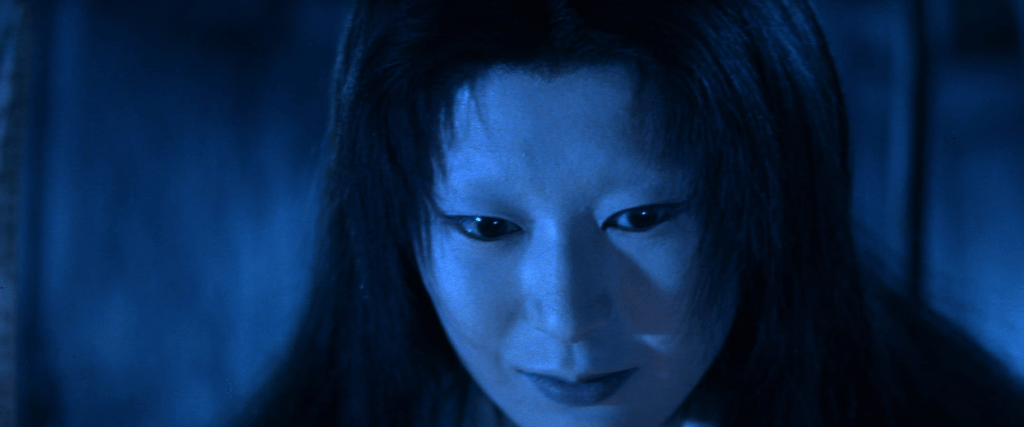
At the same time, while the stories follow fairly universal templates, the setting, aesthetics and vibe are very specific. To most western viewers, the world of Kwaidan is likely to be strange even before the supernatural rears its semi-transparent head. The storytelling, while thoroughly cinematic, is influenced by Japanese theatre, and the visuals recall traditional woodcuts. There is no trace of naturalism in Kobayashi’s film – and that’s where its great strengths lie: in its aesthetic, its use of colours and sound. It takes a while to get used to the way Kwaidan looks, with striking shadings and textures that can seem gaudy at first – but they are key in creating the world Kobayashi and his cinematographer Yoshio Miyajima (who two years earlier worked with the director on Harakiri ) present us with.
Sound is just as important: the music, often veering towards the shrill and atonal, combines with sound effects to create a soundscape, though one in which utter silence is used frequently and to great effect. The world in which these ghost stories happen is not just visually uncanny, its sound is just as key at letting the audience know that things are not right, even before overtly supernatural things begin to occur.
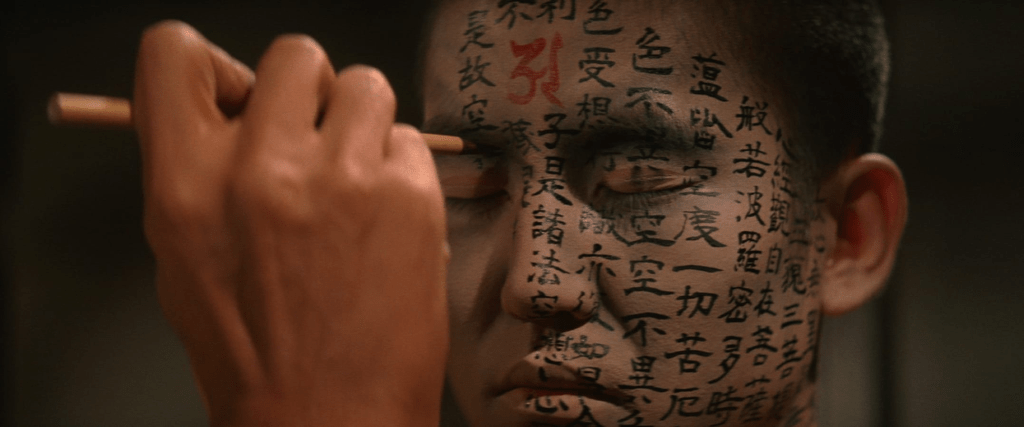
Verdict: Kwaidan is a deeply artistic, visually and aurally intoxicating mix – but it is also one that, for me at least, often worked on that level only. It is wondrous to look at: strangely, even abstractly beautiful at times, at others striking in garish, almost ugly ways, but always effective. Its dreamlike quality, often slipping into the nightmarish, is fascinating. Its stories, however, have the simplicity of folk tales, and its characters are little more than types. I admire Kwaidan as a work of art, and I would love to see it on a big screen and with no visual distractions, but coming to this film from Kobayashi’s deeply affecting Harakiri, I missed something more human. I found the film’s aesthetics engaging, but its characters much less so. At the same time, there are moments of idiosyncrasy where Kwaidan grabbed me: the woodcutter putting out the slippers he has made for his wife after she has revealed her real, supernatural identity and left him, a gift to a frightening creature he still sees first and foremost as his beloved wife; or the sheer terror of the disloyal husband who returns to the wife he’s abandoned and finds himself attacked by her disembodied hair, of all things; or the monk writing protective sutras on the blind monk committing the silly, deeply human mistake of forgetting to protect the ears, which promptly become the target of the confused ghost looking for his favourite storyteller.
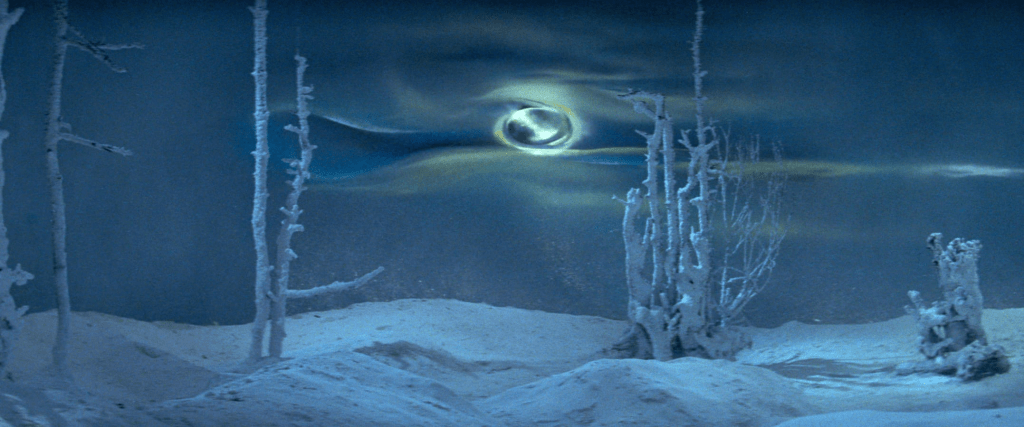
It may be strange to criticise a 1960s Japanese film inspired by traditional theatre and other art forms, a tonal poem veering into the abstract and surreal, for being formulaic in the stories that provide a vehicle for the film’s beauty, but I wish that Kwaidan had veered more into the strange flourishes that the film offers every now and then. It is in these idiosyncratic moments, when the characters in the stories become more than the broad types they’ve been so far, that the stories of Kwaidan grow into more than just the inspiration for the film’s striking visual and aural compositions. It’s when a story ends not in the predicted denouement of some kind of supernatural punishment but instead in a non sequitur that is almost goofy in its strangeness that I don’t just admire Kwaidan but love what it could be beyond its obvious artistry of the senses.
 A Damn Fine Cup of Culture