Murder, memory, sharks. Two-faced cats. Corpses left to rot. Disembodied legs cleaning up the seedy underbelly of Recife, one well-placed kick at a time. The story may just be reactionary and homophobic – but hey, the hairy leg sells newspapers! Want to hear another story?

The Secret Agent, directed and written by Kleber Mendonça Filho, is set in the Brazil of 1977: a “period of great mischief”, as the opening text puts it. Considering that this is the second half of a military dictatorship that lasted 21 years and that saw widespread institutionalised torture, disappearances in the tens of thousands and hundreds of killings, the choice of words is not a little cynical. However, it would be wrong just to see these words as a glib quip in reference to dark times: there is also something deeply mischievous about The Secret Agent.
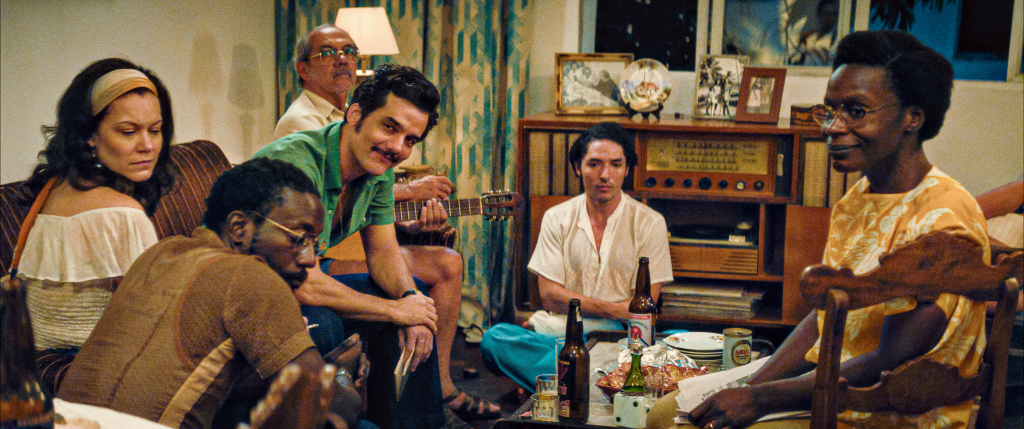
The film tells the story of Armando (Wagner Moura) a former academic who is on the run, having fallen foul of a powerful businessman who has the right, but also the decidedly wrong, people in his pocket. He ends up in a community of political refugees run by the tiny but formidable Dona Sebastiana. Armando’s wife is dead, and his young son Fernando is looked after by his father-in-law, a projectionist at a local cinema – but Armando lives in the hope of being able to take Fernando and leave the country for good – that is, if he wins the race against time and against the men who have been sent to “shoot a hole into his mouth”, as the corrupt industrialist puts it in his crude instructions to the hitmen.

At a glance, The Secret Agent may seem like a fairly straightforward story, a thriller set against the background of political violence and corruption. And the film is that – but it is much more besides. Its own mischief is that it is a film that runs amuck with the joy of storytelling: The Secret Agent is less a single story of a man on the run as it is a collection of tales shooting off excitedly and in all directions from that main thread, and the sum of these stories forms an image, practically a Wimmelbild (the kind of picture in which you’re tasked to find some dude in a red-and-white striped shirt wearing a bobble hat and glasses). It may not matter that none of these stories are brought to much of an end: Mendonça’s film is about the potential of stories. Each of the characters Armando encounters, from the political refugees and the Janus cat with its two faces to the corrupt police officers and even the hitmen after him, is a mystery, a starting point for another story – even the leg found inside a dead tiger shark sparks off another episode, the aforementioned newspaper articles about the undead leg becoming something of a vigilante.
The Secret Agent is 158 minutes long, but it feels less long than many films with a shorter running time. This is certainly also due to a tremendously engaging cast and zippy editing: Mendonça’s filmmaking, apart from anything else, is great fun to watch, even if its audience has to have a stomach for some fairly in-your-face violence. As much as that, though, the enjoyment of The Secret Agent lies in its sheer joy in telling stories – some gory, some goofy, some thrilling, some tragic. But there is a purpose to the way it is eager to begin stories but hesitant to stick with them, there is a reason why so much of the world Armando finds himself in is filled with mysteries and secrets and ellipses. For one thing, no one in this world is safe, and the more that is known about them, the less safe they are – but more than that, it reflects one of the main horrors of the military dictatorship: people disappear, leaving behind few if any traces. What happened to them? Unknown. Are they alive or dead? Unknown. Who killed them? Unknown… even if there is a very likely answer as to who is responsible. Like the people who have fallen into the bad graces of the powers that be, stories just stop short – such as the story of Armando’s mother. In the Identification Records Office, where he is employed under a false name, he seeks out a record of his mother’s life: she was the domestic – or, more accurately, little more than a slave – to a family of wealth and privilege, where she ended up pregnant by the family’s son. What happened to her after she had given birth? Unknown. Is she still alive? Unknown. Another story started and then just silenced, left unfinished.

In its final third, The Secret Agent zooms in on the story of Armando, the men who are after him, and the holy mess that results from all of this (as one character says, “it’s all a bit improvised, Brazilian style”) – and then it abruptly changes tack. No story is brought to its end… though several of its characters are. What happened? Who killed whom? Unknown. Instead, interspersed throughout the film, we get scenes set not in 1977 but in the present day: students transcribe tapes (more stories), make notes, try to fit all the pieces together. For themselves, and for those left behind – who, unexpectedly, may find more peace in forgetting than in futile attempts to understand.
The way The Secret Agent ends is almost wilfully frustrating and likely to be divisive – and I admit that, as the film’s credits rolled, part of me wanted to stand up and say, “Well, fuck you too!” to the screen. Which may be the point: the film revels in starting all these stories, but it is intent on throwing our wish for a satisfying ending back in our face. Watching The Secret Agent raises the question whether its wild fabulation is fabulation for its own sake, or whether it wants to talk about the stories that are handed down to us in fragments, out of order, with big chunks missing in the middle. But here also lies one of the film’s contradictions: if The Secret Agent wants to be about the unfilled gaps in the narrative, the endings that will forever remain missing, it finds so much enjoyment in hinting at other stories, wild and exciting and thrilling, that the tragedy of Armando, Fernando, the political refugees, and others like them, ends up less memorable than the story-rich world Mendonça leads us into. The film comes most alive when it runs wild across genres and styles and tones, much like that hairy disembodied leg that runs off straight into urban legend, not in its sobering epilogue as it reveals what lies behind the fabulation.
 A Damn Fine Cup of Culture