Lost, but not forgotten

Since my love went on holiday today, we caught up on the series we’re watching yesterday, starting with Six Feet Under. One of the things I appreciate about the series is that neither the writers nor the actors feel that a story is only good if the characters are likeable. They have the courage to make the protagonists truly flawed – not the sort of flaw that you’re secretly supposed to like. (Did anyone mention Gene Hunt?)

Is that you, Butch and Sundance?

Nate, especially, has become a lot less instantly likeable. In the first season, he was the closest to an audience stand-in. He was, or seemed to be, the most normal member of the Fisher family. By season 4, he’s become self-righteous and self-pitying, but he’s still the character. He wasn’t rewritten or changed, he simply grew. And that’s one of the reasons why the series feels so real to me, in spite of a couple of melodramatic twists and turns: the characters aren’t static. Life has an impact on them, gradually shaping them, moving them in interesting directions. There are few series that manage to pull this off as well. No, scratch that – I don’t know any series that do it this well.

Lost, the second item on yesterday’s TV menu, doesn’t really do subtle character development (although it may be there, sometimes, in a handful of the characters). What it does, though, is this: the characters who die are given great send-offs. I remember finding Boone really boring… and then they went and made him interesting, and then they killed him off! It was pretty much the same with Shannon, arguably the most annoying character in the series, but then they made me think, “Hang on, perhaps she’s not that bad after all!” And then, BLAM! Cue one paranoid, pissed off Latina with a handgun, and bye-bye, Shannon!

Yesterday we watched Eko’s Last Stand. Now, Eko… Him I liked more or less from the very beginning. He was an intriguing character, and Adewale Akinnuoye-Agbaje has charisma. Eko’s spiritual side was a great foil to the increasingly fanatical Locke in season 2. His backstory made for a nice change from most of the more ‘whitebread’ character bios. But yesterday we watched him being picked up by Smoky, slammed against trees and then tossed to the ground like a broken toy. And what do we get in the way of new characters? Nikki and Paulo, the Slumber Twins. Almost makes you wish that the two of them meet a sticky end very, very soon…

The last in the trio of TV series we watched yesterday was Deadwood. I’ve written about the characters before, apart from which I’m way too tired to make this entry much longer. Let me just say, though, that I love the series’ casting. And I get a certain sly, postmodern kick out of Milch’s casting of Garret Dillahunt, first as Jack McCall in season 1 (he’s the one who shot Wild Bill Hickock), and then as Francis Wolcott, geologist, sexual deviant and the person who buys Wild Bill’s very last letter. I imagine their casting calls come on a Moebius strip.

Jack McCall…

… and Francis Walcott - twin brothers separated at birth?

By my troth, thou art a hooplehead

If anyone bemoans the state of TV in my presence, I tend to point them in the direction of HBO. At least if they’re not against watching series that may be very sexual or violent, or that may “contain language” (as opposed to all the Marcel Marceau-inspired television programming, of course). I’ll tell them to check out Six Feet Under, naturally, and The Sopranos. I myself haven’t checked out The Wire yet, but it’s definitely at the top of my list. From what I’ve seen so far, HBO series have a fairly consistently high level of quality, in terms of acting, writing, directing, cinematography.

I was rather surprised to find just how much I liked Deadwood. As a genre, the western doesn’t interest me that much. It took me two or three episodes to acclimatise to the language – not just to the incessant swearing, but to the elaborate quality of the dialogues. But then I was hooked.

One of the reasons is definitely the language. I know that the word “Shakespearean” is overused in criticism especially of TV and cinema, usually to give the younger, technological media a veneer of respectability that isn’t really needed anymore. But series creator David Milch’s writing does strike me as similar in quite a few respects to Shakespeare’s plays. Milch deftly mixes ‘high’ and ‘low’ language; he uses an impressive range of registers, styles and imagery to convey the characters. The difference is simply that with Shakespeare most people need to read the footnotes to see how filthy the language is at times. (I could imagine that it’s either frustrating as hell for the actors to speak the dialogues or greatly enjoyable. Or both.) The characters. Now, in a list of the best fictional characters on television, you couldn’t leave out an Al Swearengen. As a matter of fact, I’d say that you couldn’t leave him out of a list of the best fictional characters, period. (I imagine he might be joined there by Tony Soprano and his mother Livia. Now, I’d love to eavesdrop on a barroom conversation between Tony and Al.) I wouldn’t even consider it hyperbole to compare Al Swearengen to one of Shakespeare’s greatest creations, Falstaff. He’s just as rich, complex and ambivalent – and arguably as attractive – as the fat, vainglorious, cowardly and ultimately tragic knight of Shakespeare’s Henry IV. (Having said that, I would love to see Ian McShane in a Shakespearean role. Richard of Gloucester, for instance.) 

Ellsworth

While everyone loves Al, I must say that some of the more minor characters are my favourites. The first of these is Ellsworth. It’s difficult to write a fundamentally decent character and not make him boring, but they more than succeeded. And how can you not love a character who says the following, keeping a completely straight face?

Joanie Stubbs:   Will you keep a girl company?
Ellsworth:   I will, but I’m expensive.

Or indeed this?


Ellsworth:   Well, Ma’am, I’ve got myself a working gold claim.

Joanie Stubbs:   Well, sir, is that a damn fact?

Ellsworth:   A hell of a working gold claim, and if we knew each other better I’d throw “fucking” in there somewhere.

Joanie Stubbs:   If you did I’d try to catch it.

Ellsworth:   A working fucking gold claim, Joanie, and thank you for allowing me my full range of expression.

My second favourite character must be Dan Dority. He’s not the brightest, and he doesn’t exactly have great impulse control. But there’s something funny and sweet to his devotion to Al. His genuine distress when he thinks that Al prefers pretty boy Silas Adams to him, or when Al almost dies of a gleet. Again, like Shakespeare at his best, Milch mixes pathos and comedy perfectly in his best characters.

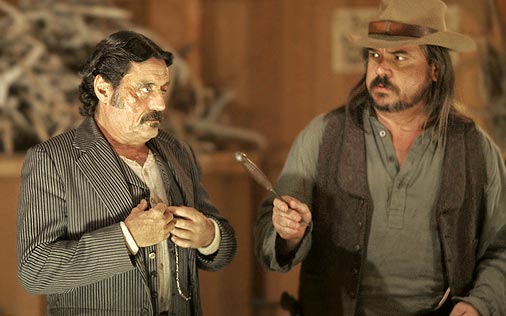
Dan Dority and Al Swearengen


It is to Dan and to Ellsworth, to Al, Sol, Seth, Trixie, Joanie, Charlie, Alma, Jane – and yes, even to E.B. – that I raise my glass of bourbon and say: “To your health, cocksuckers and hoopleheads! See you soon!”


P.S.: If you’re looking for a (Swiss-)German blog to read, especially if you’ve got a thing for outlandish international cuisine (and flame-baked Smurfs), check out Magenta’s Lucky Page. Highly recommended!