July Variety Pack (2)

Have I mentioned before that Criterion is planning to ruin me financially? As a matter of fact, I have my suspicions that the company was created entirely for that purpose. This guy’s version of a honeytrap? A life-long subscription to Criterion. I just haven’t figured out yet what the incriminating pictures would look like – although now that I’ve brought it up, I sort of wish I hadn’t…

The thing about Criterion (often in combination with the A.V. Club or with DVD Verdict) is this: it gets me to watch stuff I wouldn’t even have heard of otherwise, like A Night To Remember (discussed here). Or…

Make Way For Tomorrow

… a film that, if I’d read a plot synopsis beforehand, I would probably have avoided, because it sounds like sheer melodrama (even more so in black and white): an elderly couple losing their house and ending up separated, each staying with another one of their less than understanding children, and their final day together before they’re split up permanently. Yet it’s turned out one of the most poignant and sad films I’ve seen in a while, and the sadness of its last half hour doesn’t bear a trace of melodrama. Don’t let the text panel at the beginning fool you into expecting a moralising story about how children should honour their parents – the film is astute about the difficult relationship between parents, especially of the elderly kind, and their grown children, and it doesn’t ignore that its two protagonists aren’t the easiest of people to be with. What elevates the film from a good, though probably not special film to something great is the final act, which doesn’t make any concessions to an audience expecting a happy ending – or at least a clear denunciation of the children and an easily understood lesson in morality along the lines of “Thou shalt…” and “Thou shalt not…”. Instead what we get is an emotional honesty that hurts by being entirely unvarnished.

Jane Eyre

“Cary Fukunaga… Didn’t he do that film about gang brutality in Mexico, Sin Nombre or something? Sounds like just the right guy for that Jane Eyre flick we’re doing!” I don’t know what the producers were thinking when they hired Fukunaga for their adaptation of Charlotte Brontë’s classic – but they were absolutely right to do so, as the result proves. Jane Eyre is difficult to do right, as there’s a major temptation to streamline it into a generic historical romance, Jane Austen with less humour and more madwoman in the attic. The casting of two misfits who supposedly aren’t conventionally attractive with Michael Fassbender and Mia Wachowski would have suggested an audience-pleasing approach, but Fukunaga, his cast and his crew, while cutting their source down to the essentials (you can’t afford not to, unless you’re doing a BBC-style miniseries) get to the heart of Brontë’s novel. The casting and acting work wonderfully, the script is respectful of the original novel without being beholden to it, and the cinematography is breathtakingly gorgeous at times. I’ve sometimes described films as the moving equivalents of paintings – you’d want to frame them and put them on the wall, but you don’t necessarily want to pay attention and listen to them. Fukunaga’s Jane Eyre is the sort of film you want your eyes to feast on but there’s plenty to listen and pay attention to as well. And for all its beauty, it’s not your conventional pretty costume drama, thank god.

Benny’s Video

I know that at least one occasional reader of this blog hated this film with a vengeance when she saw it years and years ago. Myself, I wouldn’t say I’m a fan of Haneke’s, but I’ve found all of his films intriguing. It’s easy to get pissed off at what the films often do at a first glance: there’s something both didactic and smug about their themes and tendencies, as if Haneke judges you for watching, say, Funny Games and dares you to switch it off, while at the same time wanting you to continue watching to validate its thesis. At the same time, there’s usually more going on underneath the surface, and Benny’s Video is a good example of this. Going in, I expected a film about a young man desensitised to violence by the videos he watches, and there is some of that – but at the same time the videos are partly a red herring, as especially his parents prove at least as compromised as him, and they don’t have the convenient excuse of “Slasher flicks made me do it!” The film has some rough edges and some of the director’s decisions are questionable – at times the characters and their actions are sketched too cursorily, turning ambiguity into muddledness – but even at this early point in his career Haneke is masterful at staging scenes clinical yet uncomfortable without pushing any gratuitous viscera in your face. Even when I end up angry at Haneke’s manipulations, he makes me think more than most directors do… so perhaps he’s not doing such a bad job at being didactic after all.

Great visuals…

… shame about the writing – especially since I’m talking about the adaptation of a novel.

I’ve just watched the Cloud Atlas trailer, and it looks amazing. It would look even better if I hadn’t also been listening to the lines from the film that are intoned in the trailer – most of which strike me as portentous yet facile drivel. Was the book like this? I have to admit I don’t remember; when I read Cloud Atlas, it didn’t particularly click with me. Still, the trailer is well worth looking at. Visually the film would seem to risk becoming garish, but it definitely looks very intriguing.

Link to the Cloud Atlas trailer on iTunes Movie Trailers (sorry, not on YouTube yet!). Make sure to go HD!

P.S.: There’s a Variety Pack coming soon(ish) – watch out for it by next Wednesday!

A League too far?

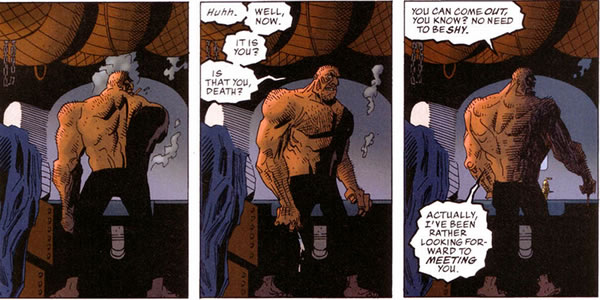
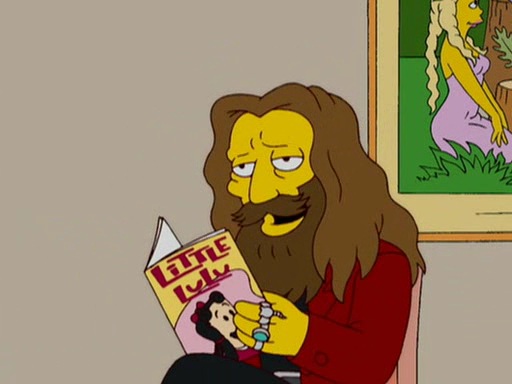
Has it finally happened? Have I gone off Alan Moore? What’s next: will I stop liking rare steak? (I admit, I like good quality beef and my carbon footprint looks like nothing so much as a gigantic hoof-print…)

Well, what has happened is this: I used to get most if not all new Alan Moore comics by default, and after reading League of Extraordinary Gentlemen: Century: 2009: Are there any more subtitles coming this way? that’s simply not the case any more. I haven’t liked any of Moore’s recent works as much as those created during his heyday – masterworks such as WatchmenFrom Hell, V for Vendetta – but I’ve found enough things to like even in decidedly lesser Moore such as Smax, his Top 10 spin-off.

For the record, I think that the first two League of Extraordinary Gentlemen volumes are fantastic examples of strong storytelling and characterisation. Thematically they may not be as complex and rewarding as the works that made Moore famous, but they’re still examples of an author at the top of his craft. The continued adventures of the League though… To my mind Moore made two mistakes: one being that his ambition to create a world where all fictions are true overrode any wish he had to tell a good story with great characters, the other that the closer the story came to our present the less Moore had to say about the culture he was riffing on. 1910 and 1969 are still well crafted, and the latter even manages to intrigue as a story, but 2009 simply doesn’t say anything much of interest about modern pop culture. Its critique is shallow and lazy, making the Grand Old Madman of Comics come across as an old coot going, “You kids, get off my lawn!”

The greatest crime, though, is that a series that once featured extraordinary characters written with depth and sympathy (for the most part) – well, that series ended up with versions of the surviving characters that were uninteresting and exchangeable. Mina and Alan, as the century rolled on, were reduced to pale shadows of their former selves, in ways that made them boring to read rather than resonating thematically, which may be what Moore was aiming for.

It’s a shame, because throughout Century there are scenes that show Moore has still got it, and one of my favourite bits in all of the League is the deus ex machina he employs at the end of 2009, managing to be funny and chilling at the same time. But it doesn’t quite make up for the increasing tendency in the comics to indulge in Where’s Waldo-style “Spot the reference!” games – and, what is worse, games that lack the gleeful joy of earlier instalments. Too much of 2009 feels perfunctory. So, quite seriously, has Alan Moore become too much of a caricature of himself?

Sadly, even Kevin O’Neill’s art feels lacking in 2009 – perhaps because the (near-)present is a less exciting playground than the fictional past. He’s still got some great visuals, but both in terms of writing and art 2009 feels tired too much of the time. Perhaps it’s time for Moore to take a holiday? Watch some good TV? Get over himself?

Artifice, authenticity, affectation

If there’s one word I wouldn’t mind seeing banned from use for the next, hmm, fifty years, it’s this one: authenticity. Yup, that’s the one, the word I’ve come to dislike as much as its closeish relative, the phrase “Based on a true story!” What’s my beef with it? It’s either phony, self-aggrandising or both. A certain doddering old father once told his son, “To thine own self be true,” and as a motto it sounds quite nice, except – I think this notion of an “own self” to which you should be true is silly. Do something because you want to do it, because you think it’s right to do it – but talking about an authentic self that you should honour? That’s fine, as long as your “own self” is one of the good guys – but what if you consider your authentic self to be that of a xenophobic bastard who hates those bloody foreigners? Does the notion of authenticity* ennoble your arseyness? People’s identities, their characteristics, are fluid, and pretending that there’s a ‘real you’ inside you that’s a yardstick for all your actions is romanticised claptrap at best, disingenuous bullshit at worst.

If you’re still reading after this rant, you’re probably wondering: why does a geek blogger who usually writes about movies, games, books and comics post a diatribe against the word “authenticity”? Doesn’t he have first-person shooters to play and pretentious wankery to write about them afterwards? Bear with me, gentle reader – relevance (of some sort) is just around the corner. It’s basically this: the overuse of the A word extends to art critics and the culture pages of newspapers and magazines. “Authenticity” is used as a word of praise for movies, when usually writers use it as a way of making their “it’s, like, for real, man!” comments sound sophisticated. Let’s be frank: authenticity in art – including any art form that’s primarily about narrative fiction – is an effect. It’s an artifice. It’s like a Photoshop filter: turn up the authenticity to 10, eh? It’s the fashionable, and often trite and superficial, name given to works that used to be described as being in the style of realism or naturalism. It’s an author’s conscious choice on how to present their material. It’s a style, an artifice, pretending not to be one.

So, what’s brought on this tirade? Probably the fact that I recently re-watched Drive, a film I greatly enjoyed the first time and downright loved the second time. How does it tie into this extended waffle on authenticity? Pretty much by eschewing the Authenticity Effect altogether. Nicholas Winding Refn uses a decidedly theatrical style – perhaps not as much as in his earlier film, Bronson, but Drive is still markedly focused on its own artifice, in its visuals, its central performance, its choice of music. The director’s hand is visible throughout. Refn is clearly not interested in the pretense of reality – yet his film, for all its artifice, resonates with me. While I’m watching it, the Driver feels real to me – not in spite of the artifice but because of Refn’s immense skill at using artifice as one of the colours on his palette.

Art, at its best, doesn’t try to replicate the look of reality in a facile way. It embraces its own stylisedness, using whatever style is most suited to achieving a certain effect – and yes, that effect can be realism or naturalism… but neither of those automatically makes a film more authentic, unless our understanding of authenticity is hopelessly naive. “Based on a true story” doesn’t make that story more real, documentary visuals don’t render the subject more authentic. After all, what we’re looking at here is art, and the moment art denies its own artifice, it becomes schizophrenic or shallow. If art wants to be true to its own self, then it is most authentic when it accepts its own dependence on skilled, intelligent, passionate artifice.

*I seem to dislike the word so much I keep spelling it as “authenticify”… To mine own self spell true, eh?

P.S.: Having grown up in the ’80s, the aesthetics of Drive may very well feel more ‘real’ to me, because that’s what my childhood, filtered through TV, looked and sounded like.

July Variety Pack (1)

I’ve been away for work and needed to recover from my lack of sleep, which I hope excuses the lack of recent updates. I’m back now, though, with a healthy list of films etc. to blog about. To start off with, here’s Wot I Watched On My Telly Recently. (More Variety Packs may follow later this month!)

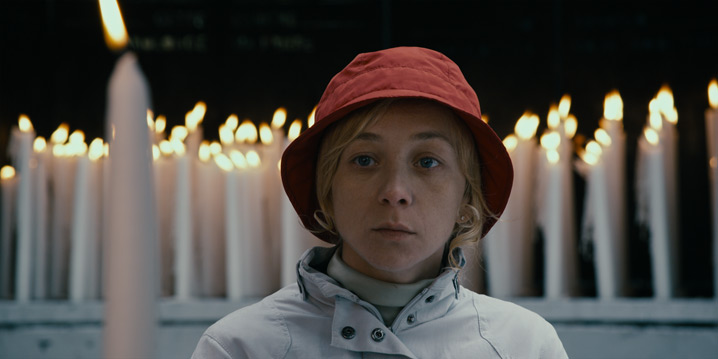
Lourdes

An Austrian-German-French co-production about pilgrims and/or tourists visiting Lourdes looking for miracles – probably doesn’t sound particularly appealing to most, does it? The film is definitely not for everyone, but it’s well worth checking out nevertheless, deftly mixing different themes and genres, from satire to psychological drama to a critique of the faith industry and of petty sanctimoniousness, while always feeling of one piece. Lourdes is also smart in that it doesn’t rely in any way on the viewer’s own beliefs (or lack thereof), and the performances are subtle and effective throughout. It’s the kind of film, though, where the truly interesting things go on inside the characters and remain implicit to the viewer.

A Night To Remember

Ah, Criterion — mon semblable, — mon frère! I’ve rarely gone wrong with Criterion DVDs, and the 1958 precursor to James Cameron’s Titanic didn’t disappoint either. The film makes an interesting counter-point to Cameron’s iceberg extravaganza; taking a disaster that lends itself to melodrama of the worst kind (which Titanic – the 1997 film, not the ship – indulged in some scenes, avoided in others), A Night To Remember is the more restrained, more British (for want of a better word) film, though it is exactly this restraint that makes it all the more devastating. It’s as impossible to avoid dramatic irony in filming the sinking of the Titanic as it is when referring to Mr. Lincoln’s night at the theatre, but the film doesn’t overplay its hand, nor does it go for a simplistic, smug class warfare view of 1st class passengers as parasites and steerage passengers as accented, saintly victims. Also, considering the film’s age, its effectiveness in depicting the disaster is in no way lessened by the datedness of its effects, which speaks for the quality of the directing, acting and script.

Che

I used to be a big fan of Steven Soderbergh. Starting with Out of Sight (still by far the best Elmore Leonard adaptation in my opinion, and the best use of Jennifer Lopez), I enjoyed almost every single one of his films, in terms of craft and storytelling. Yes, there were exceptions – Full Frontal comes to mind – but even slight works such as Ocean’s Eleven were examples of a director pretty much at the top of his craft. Then, probably around Ocean’s Twelve, something changed. I still liked the second cinematic méringue for its French New Wave experimental frothiness, but I started to get the impression that Soderbergh was mainly doing these films to scratch some private itch, and whenever he became aware of the audience and its wants and needs, as with Ocean’s Thirteen, there was something calculating and cynical about the films. Soderbergh, who’d always led with his intellect, seemed to have lost what heart there was in his films. I haven’t yet seen his most recent work, but Che, his two-parter about some guy on a t-shirt, failed to grab me, nor did it excite, educate, intrigue or irritate me in any way beyond the vague irritation that this Soderbergh guy used to have something to say.

Both parts of Che are beautifully shot, well acted and examples of great craftsmanship, but especially part 1 so assiduously avoids any suspicion of biopic clichés that it ends up a handsome but strangely empty variation on the theme of “What I did on my holidays”: And then Guevara went there. And then this member of his band of rebels died of a cough. And then that outpost was taken. Part 1 picks up towards the end, and part 2 benefits from the story’s more dramatic angle – if the first film is about Che’s (military) rise, the second depicts his slow, drawn-out fall – but just a bit more character, just a smidgen of story would have helped. As it is, the films feel strangely like a documentary shot by a cinematographer who wasn’t interested in much beyond how his film looks. You can do unconventional biopics and avoid the trap of facile psychoanalysis without stripping a film of personality altogether, Steven, m’kay?