One of the things that video games can do magnificently is create worlds. These posts are an occasional exploration of games that I love because of where they take me.
If I were to reduce the specific appeal that video games hold for me over any other medium, it wouldn’t be the predictable one. It wouldn’t be interactivity. Obviously it’s cool that games react to your actions, but let’s be honest: that interaction is often pretty limited – and, ironically, it tends to highlight the many ways in which the games aren’t actually particularly interactive. You can choose between option A and option B, or you choose whether to run left or shoot right. These actions can be fun, they can even be meaningful, but the freedom they offer isn’t exactly enormous.
No, the thing I’ve found that appeals to me most in games is exploration – and this is where I experience the freedom of games the most.

Sable is an indie game that came out in 2021. It evokes the epic grandeur of Dune with its sci-fi desert planet and the aesthetics and strangeness of French comic artist Moebius, while also having an intimacy that is more reminiscent of indie comics and the beauty and stillness of Terrence Malick (during the moments in his films in between philosophical ruminations, perhaps). It is about a young member of a nomad clan who embarks on her Gliding: the clan’s rite of passage in which the girl, Sable, will choose her mask and therefore her purpose and role as she passes into adulthood.
After a short tutorial in an enclosed section of the map, showing the player what Sable can do, she’s left to depart into the desert and, well, explore. To begin with there is very little overt guidance or a main quest with a to-do list that is so typical for games. No Big Bad to defeat, no overarching crisis to avert. When the quests come, they’re simple and small-scale for the most part: find some beetles, gather some seeds, that sort of thing. The quests that Sable accepts provide some structure to her Gliding, but what she mainly does, at least the way I played the game: she scans the horizon, and when she finds something that looks interesting – a strange tree, some billowing smoke, or even just an interestingly shaped rock formation – she hops onto her hoverbike and gets going in that direction. Once she’s there, she looks around and climbs onto whatever she can. There’s a giant bleached skeleton in between the dunes? Climb it. A rock that looks oddly artificial? Climb it. Some ruins atop a mesa, complete with an imposing statue of a warrior? Climb the mesa, and then, climb the statue.
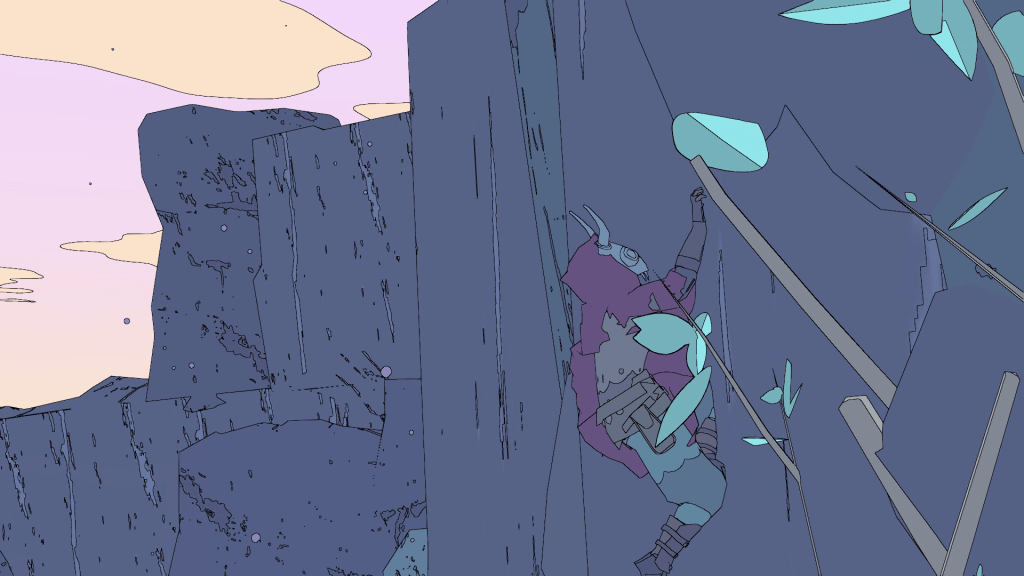
It’s this combo of zooming around on my hoverbike and climbing that I enjoyed the most about Sable, more than the interactions with the other inhabitants of the desert. The latter were fine but basic; they were also familiar from hundreds of other games, usually producing a handful of lines of dialogue and sometimes a fetch quest. Not that Sable‘s traversal was something never before seen in a game, but they let me experience (and, yes, interact with) the environment, which came to feel surprisingly tactile. Traversal in Sable has a physicality that for me makes the difference between the player feeling like a floating camera and feeling like they have an actual body and weight and inertia. Like they are present in this space. What’s key here is that Sable isn’t Spider-Girl, and her hoverbike isn’t the stuff that a space-bound Fast & Furious sequel is made of. Her stamina is limited and her vehicle is more like a second-hand Vespa than an Imperial speeder bike exported from Endor. Getting to that weirdly shaped rock on the horizon takes a while, as does getting to its top, and that is if you have the necessary stamina to get there and don’t fall off. The systems are simple, but they’re not frictionless – and that friction makes it all the more gratifying. What will you find up there, on top of that rock or on the roof of the ruined temple? An odd alien grub, perhaps, or the feather of a bird. Or nothing more than a stunning view of an alien sunset… and there, that thing in the distance, glinting in the setting sun. What is it? And off you pootle, on your desert Vespa, looking for more places to explore.
In games, the places I remember most intensely are generally the ones I’ve explored, not the ones presented to me on a platter. The little caves I discovered, the plateaus with a gorgeous view, the odd little abandoned buildings. Were they relevant to the plot or to a quest? It didn’t matter. I made my way there, using whatever tools the game gave me, and I had no need to plant a flag and claim the place for myself. Just having got there was enough. It’s this sense of discovery I seek most in games, more than the spectacular setpiece, the momentous moral choice, or the heroic deed. Just seeing a place in the distance, getting there, being there. And that is one thing that Sable delivers in spades.

 A Damn Fine Cup of Culture
One thought on “They create worlds: Sable”