A Damn Fine Espresso: April 2026

While we do post articles about video games occasionally, the medium is pretty much underserved by A Damn Fine Cup of Culture’s podcasts – but we are hoping to remedy this at least somewhat with this espresso podcast: our guest for April is Johanna Pirker, computer scientist and educator at Graz University of Technology and the Technical University of Munich. In 2025, Johanna published her book The Game is On (currently only available in German, but there are plans for an English translation – and a Thai version is in the works!), in which she talks about the revolutionary potential of video games. Join Matt as he talks to Johanna about her work, her book, and about video games, from Johanna’s earliest memories of playing Prince of Persia on her father’s PC to more recent developments in the medium and art form.

For more from Johanna, make sure to check out her website and YouTube channel. Also, we’ve previously written about two of the games Johanna brings up in the podcast: Journey and Dear Esther.

Continue reading

They create worlds: Size matters, virtually

One of the things that video games can do magnificently is create worlds. These posts are an occasional exploration of games that I love because of where they take me.

Virtual Reality is one of those technologies that sound tremendously cool – on paper. No longer are you just looking at a 2D representation of whatever world a game creates: you can be fully immersed in a real world! Except it’s not that easy. For one thing, not everyone has the necessary space at their disposal, so you can actually walk around in the virtual world. For another, not a few people simply get nauseous in VR. And then there’s the challenge of tactility: not just seeing but feeling and touching whatever you’re interacting in the virtual world. There is a not inconsiderable gap between the idea of VR and the actual practice – a gap that can be reduced by means of clever game design, but this kind of design doesn’t necessarily lend itself to what people expect from VR gaming.

Ten years after the release of Oculus Rift, VR isn’t the runaway success that some breathless PR people predicted, and as a result, less and less money is being put into the development of VR experiences and games. If your audience is relatively small, you can’t really afford to develop VR fare that has the kind of AAA production values you get in normal video games. And this generally means that big games, with large worlds, the kind of thing you find regularly in non-VR gaming, are a rarity when it comes to Virtual Reality. A lot of games developed for the tech are much smaller in scope, somewhere in between an escape room and a theme park ride, and they are generally as on-rails as the latter. With a modest budget, you may still be able to put together a handful of interconnected rooms that are reasonably detailed and nice to look at; a whole world, though, is an entirely different matter.

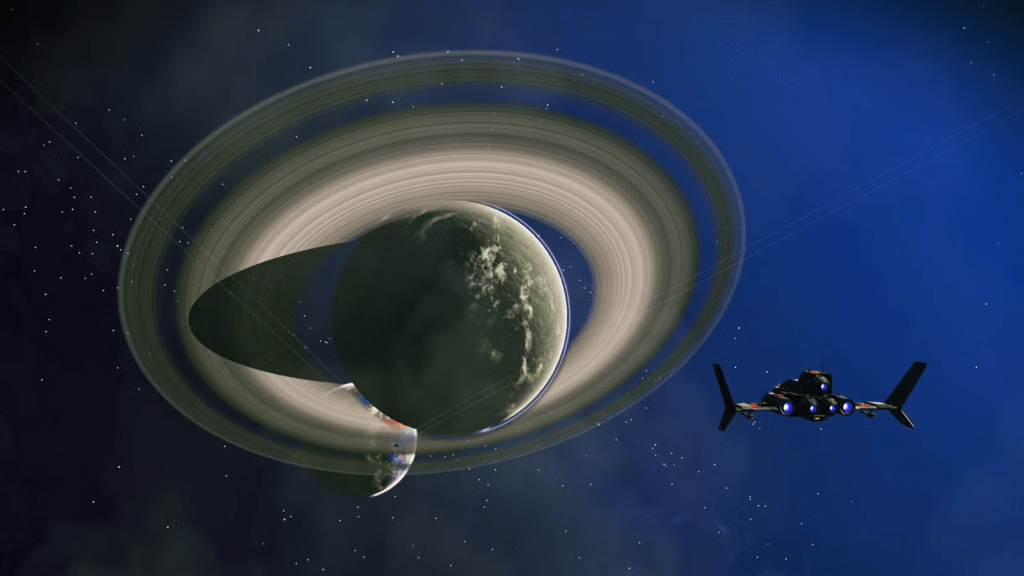
A whole universe? Now you’re talking

Continue reading

Six Damn Fine Degrees #272: Live, Die, Repeat

Welcome to Six Damn Fine Degrees. These instalments will be inspired by the idea of six degrees of separation in the loosest sense. The only rule: it connects – in some way – to the previous instalment. So come join us on our weekly foray into interconnectedness!

Time loop narratives are almost always power fantasies. Sure, there’s a comical element about them, but that’s part of the fantasy: the protagonists of time loop stories are caught in an existentialist Looney Tunes short, but whenever they step on a rake or have a bomb blow up in their faces, they go back to start with added knowledge: if they cut this wire instead of that one, if they push this button rather than pulling that lever, if they jump to the right two seconds after they hear the car horn, they’ll survive. And thus, step by step, they master their situation.

In that sense, time loop narratives are the kind of power fantasies that are typical for video games.

Continue reading

Shortcuts: January 2026

Considering how much we watch, read, listen to and play in any given month, it’s almost a bit sad that we only write about a fraction of these. So, starting this month, we’re trying a new monthly format: on the last Wednesday of each month, we will release a few shortcuts: quick impressions of films, series, books, albums, games, or any other damn fine cups of culture that we’ve enjoyed this month, whether they are new or we only just got around to them now.

So, with no further ado, here are our first Shortcuts. Enjoy!

Continue reading

The Five Stages of Backlog Anxiety

There was a point in my mid-40s where I realised: I have so many games purchased on Steam, I will not live to play all of them, at least not unless I start going through them one by one… and not unless I stop buying a single additional game.

And, looking at my collection of films on physical media? The same may be true. I have a bit more of a fighting chance: my library of games on Steam is in part so large because once a game I’m even just mildly interested in is on sale for US$10 or less, I tend to buy it. Films still cost more, especially those highly addictive Criterion releases I can’t seem to do without. Still: I buy films at a higher rate than I watch the films I’ve bought. The same is definitely true for books.

And, frankly: when I realised the extent to which my backlog would survive me? I felt an unsettling sense of vertigo. (And, embarrassingly, I briefly hoped that by the time I’m old, there’d be a way to upload my consciousness into the cloud, where I would then spend eternity working off my backlog.)

This is fine.
Continue reading

They create worlds: the melodies of Silksong

One of the things that video games can do magnificently is create worlds. These posts are an occasional exploration of games that I love because of where they take me.

In 2017, a small Australian studio called Team Cherry released Hollow Knight. The game, an action adventure set in a world of insects, was well received by gamers and critics, and its reputation grew over the following years, as much for its challenging gameplay as for its melancholy world and atmosphere. Over time, Team Cherry aded to the game in various ways game – but the main expansion they originally promised, which was to feature Hornet, one of the game’s characters that starts off as an antagonist only to become an ally of the player character, proved too ambitious. As a result, Team Cherry announced in 2019 that Hornet’s adventures could not be contained in an add-on of the original Hollow Knight but instead required their own game: Hollow Knight: Silksong.

It would take another six years until Silksong came out.

Continue reading

That was the year that was: 2025

Let’s be honest: it’s no big secret that 2025 was a shitty year in many ways, so much so that at times, as if we’d woken up in an episode of Black Mirror, it felt like reality itself had installed a doomscrolling plugin. You no longer have to take out our phone or tablet: just walk around with open eyes and the rest will take care of itself.

And yet: not everything is bad. Whenever I hear or read someone going on about how culture, originality, cinema and TV are dead, I can’t help but roll my eyes – because there is so much out there that is pretty damn good: fresh, engaging, challenging, riveting.

See exhibit A:

Continue reading

I’ll be in my trailer… watching trailers: Itsy bitsy spider women and giant policemen

Join us every week for a trip into the weird and wonderful world of trailers. Whether it’s the first teaser for the latest instalment in your favourite franchise, an obscure preview for a strange indie darling, whether it’s good, bad, ugly or just plain weird – your favourite pop culture baristas are there to tell you what they think.

Vengeance is a dish best served over many episodes: in this week’s Six Damn Fine Degrees, Melanie writes about the rather dark familial goings-on in the Chinese historical drama The Glory.

Continue reading

Is this the real life? Knit’s Island (2023)

So many video games are about escapism – but this doesn’t mean that the worlds we escape into when we play are necessarily better worlds than the one we inhabit. No, when we pick up that controller, we often find ourselves in situations that are brutal, life-or-death: warfare, disaster, the apocalypse. It’s therefore not surprising that perhaps the most common player interaction in games is killing – or its flip side, dying. Obviously, though, that’s partly beside the point: in a virtual world, death means very little, whether you’re the one doing the dying or the one who’s killing. One Nazi, zombie, mutant less – or, if it’s the Nazi, zombie or mutant who won that particular fight, you reload and get another chance at killing rather than being killed. The worlds we escape to may not be better than ours, but they’re exciting, and the reversibility of death is obviously a plus.

But is this all these worlds can be: places where we either kill or die, over and over?

Continue reading