Welcome to Six Damn Fine Degrees. These instalments will be inspired by the idea of six degrees of separation in the loosest sense. The only rule: it connects – in some way – to the previous instalment. So come join us on our weekly foray into interconnectedness!

An Ennio Morricone-scored movie that exists in a variety of versions? When reading Alan’s latest insightful piece on the many cuts initially made to Sergio Leone’s Once Upon a Time in America, I couldn’t help but be possessed by my teenage memories of watching that infamous sequel to a great horror classic, Exorcist II: The Heretic (1977) and learning about the many different re-edits it had gone through – to no avail: The movie was a massive critical and commercial failure and, despite releases of all kinds of versions, has found few friends since.
While the original Exorcist (1973) leaves us after the excruciating exorcism of Regan McNeil (Linda Blair), the end of her mother’s (Ellen Burstyn) ordeal and the death of the exorcist himself, Father Merrin (Max von Sydow), the sequel introduces us to a convoluted plot about teenage Regan in weird hypnosis therapy with ‘Nurse Ratched’ herself (Louise Fletcher fresh off her Oscar win for One Flew Over the Cuckoo’s Nest), her nanny Sharon Spencer worrying about her (Kitty Winn, while ‘mother’ Ellen Burstyn simply refused to reprise her role) and a new priest, Father Lamont (Richard Burton, in desperate need for cash after divorcing Liz Taylor again), coming face to face with the African demon possessing Regan in the first place.
The problems begin there, with the unwanted reinterpretation of what the original said and did: the newly-named demon Pazuzu is given a metaphysical origin in tribal Africa, the simple but effective Catholic guilt theme is lifted to ludicrous biblical plague proportions, using locusts as a central motif , and the finale brings Regan back to that legendary Georgetown house and stairs (rebuilt on Warner’s backlot due to New York officials’ refusal to have the film shot on location), but then twisting the scenes from The Exorcist by terrible reshoots, with Linda Blair flat out refusing to go through the same ordeal again and thus using an obvious double. Understandably, the original’s director William Friedkin not only absolutely hated the sequel but also accused Boorman and the production of stupidly diminishing the impact of his own movie by completely reframing it. It’s hard to disagree with him when watching the two movies back to back: The Heretic is still unforgivably dull, confusing and often utterly ridiculous.
Infamously, the sequel was also met with audience derision since its premiere, was almost universally panned by critics, and barely managed to turn a profit, mostly due to the reputation of the original. There were two notable fans, however: film critic Pauline Kael thought it “had more visual magic than a dozen movies” and director Martin Scorsese preferred it to the original, comparing Linda Blair’s quest for good to a modern-day saint. It’s hard to share their enthusiasm, unfortunately.
My teenage fascination stemmed from the fact that at least three edits of the film were released: an original theatrical version, an alternate version omitting almost ten minutes of material, and different versions for VHS and DVD releases until the 2000s. Some included clumsy freeze-frame recaps from The Exorcist, others had Richard Burton inexplicably die before the finale. Only much later did I see the original ending now available on the latest Blu-ray releases, with Burton’s Father Lamont walking off with Regan to save the world and Louise Fletcher staying behind in desperate silence. It arguably makes things even worse!
In my Exorcist fantasy, there had to be at least one version that would use the visually promising material (the flying demon scenes and some of the location shots are excellent) and turn it into at least something respectable. Maybe I just hadn’t found it. All these years, I kept wondering if, with the material at hand, an able director, an illustrious cast (besides Burton, Fletcher and von Sydow, there are James Earl Jones and Paul Henreid, making appearances as clergymen), it couldn’t have turned out much better.
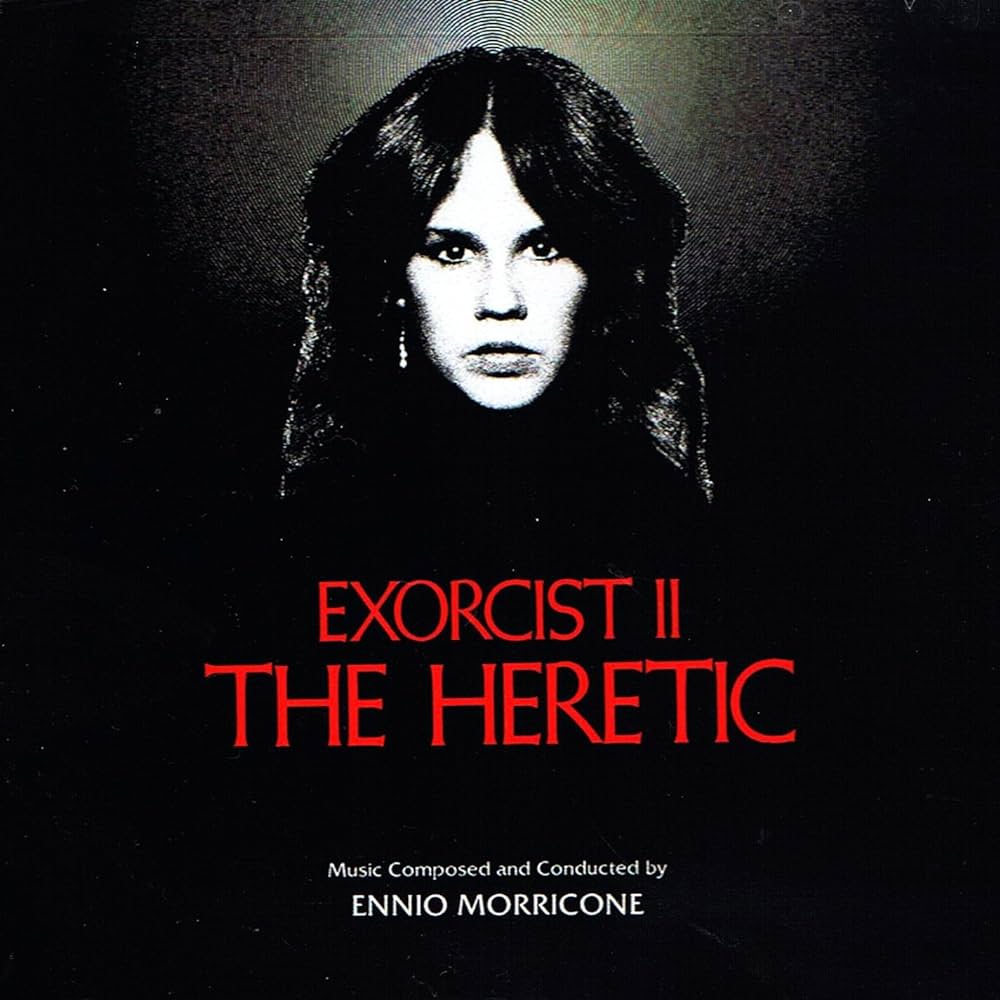
Yet, when I exposed myself again to the two-hour ordeal of rewatching it recently, I came to the same conclusion: It remains an unforgivable stinker – with one notable exception: Morricone’s powerhouse score from his late ’70s experimental phase, revelling in the tribal madness of Pazuzu’s Africa, a head-spinning frantic choir of ethnic voices with hard rock outbursts, as well as possibly one of his loveliest lyrical themes written for Regan fully appearing in the final scene. Little did I know at the time that this was meant for the alternative ending rather than what was intended by Boorman.
It almost left me feeling at peace with the film, because it lifts the mediocre special effects (thousands of dying locusts were actually thrown at Blair), the obvious studio setting and the helpless acting by Linda Blair, Louise Fletcher and Kitty Winn to delirious levels. Can one scene save a film entirely? Certainly not in this case, but putting on the Morricone record, one can at least imagine what a different production using the same score might have looked and felt like.
My kopfkino version (“head cinema”, as we say in German) certainly has all the goods of a great sequel that was never made, with no director or studio messing it up.
In the original ending, Louise Fletcher’s last words to Regan certainly stayed true for the film’s reputation: “I understand now. The world won’t. Not yet.” After such terribly received sequels (no need to mention 1990’s Exorcist III), there is dim hope on the horizon with Exorcist: Believer, tentatively coming out in October and seeing Ellen Burstyn return to her famous mother role.
In the meantime, don’t miss our own rewatch of the original coming out on podcast in November!
 A Damn Fine Cup of Culture
6 thoughts on “Six Damn Fine Degrees #147: The Exorcist, Too!”