One of the things that video games can do magnificently is create worlds. These posts are an occasional exploration of games that I love because of where they take me.
To be honest, I thought I’d burned out on the Assassin’s Creed games. For a long time, they were a staple in my gaming diet: a series of Dan Brownesque stores in which global conspiracies rub shoulders with ancient civilisations – and where you run around stabbing people. A lot. Mind you, while I kinda enjoy the ludicrousness of the setting, that’s not why I kept playing every single instalment in the series for the longest time. No, what kept bringing me back to the Assassin’s Creed well was that each game is mostly set at a specific place and time in history: I’ve climbed cathedrals in the Holy Land during the Third Crusade as well as in revolutionary Paris and late Victorian London. I’ve scaled Venetian palazzi and Egyptian pyramids. I’ve hobnobbed with the likes of Cleopatra, Blackbeard, the Marquis de Sade, half the Medici family, Dickens, Darwin and Marx. In short: I enjoyed the Assassin’s Creed games because they let me be a tourist, travelling less to distant countries than into the past.
At the same time, these were never particularly interesting games in terms of gameplay. They offered a lot to do, but what the player did was relatively simple and straightforward. The games’ systems worked, but they were never particularly interesting. Climb up a historical building here, jump into a cart filled with hay there, follow this person, stab that person, do a bit of parkour and fight some guards – all this and lots of busywork consisting of running from A to B to pick something up or deliver something. Every now and then the series offered some light puzzling or a particularly tricky sequence of platforms to reach a certain well-hidden spot, but nothing particularly taxing. The first problem with the Assassin’s Creed games? By the time that the series arrived in late 19th century London, I’d played nine of these already. As much as I enjoyed the tourism, did I really want to play the same game, with minor variations and some technical upgrades again and again and again?
The 2017 sequel Asssassin’s Creed Origins made things both better and worse: it featured a fresh setting with Egypt during the Ptolemaic period and a great, well-written protagonist, the Medjay (a sort of ancient sheriff) Bayek, and we left the confines of cities for the openness of an entire world. Origins took me to a world where different cultures collided, from Memphis (no, not that one!) to Alexandria, from desert oases to sprawling if ancient metropolises. But the size of that world was also a flaw: considering that the game was just as shallow as its predecessors in so many ways but there was so much more of it, Assassin’s Creed Origins wanted me to spend a hundred hours or more doing the same things over and over: killing members of the evil Order of the Ancients, finding trinkets, clearing out caves, burglarising homes – because I just needed some more bronze and leather to fashion this piece of armor or upgrade that weapon. And then we got Origins‘ sequel, Odyssey, which did the same all over – only in Classical Greece this time.

It’s Odyssey where I well and truly burned out on the Assassin’s Creed formula: there was just too much of it, and its main selling point seemed to be that there was so much. The series’ superficiality had long begun to grate, but in a smaller world with a shorter story I could ignore the flaws and enjoy the tourism. Unity, the game in the series set in Paris during the French revolution, boasted a map that was 2.40km2, Syndicate (the London instalment) gave us a playground with a size of 3.70km2. Origins? We’re talking about 80km2, and Odyssey: 130km2. My map runneth well and truly over.
So when the Viking-themed Assassin’s Creed Valhalla was announced, again set in an enormous open world (Norway, England, and several surprise locations), I was tired before the question even came up whether I wanted to play the game. I’d not finished Odyssey, so why would I want to do the exact same things again, only this time in early medieval England? Okay, admittedly, I liked the pictures and videos I saw of the game: where Odyssey had too clean a look for my tastes, too much of a ‘Mediterranean holiday’ feel, Valhalla‘s world looked colder and rougher and wilder. Even so: did I really need to subject myself to the same shallow game, just with a slightly different veneer?
Assasin’s Creed Valhalla came out in 2020, and while I remember having a lot of time on my hands not only that year but also the year after for some odd reason (were the cinemas somehow closed for months on end? I forget…), I was still not tempted. Even less so when I read about people playing the game for over a hundred hours before even getting to the end of the story. But video games being what they are, sooner or later there’s a sale, and I thought, “What if I just end up playing the game for 20-30 hours? It might still worth it, at its current price.” And, to be honest: sometimes a shallow game is just what I want. After a tiring day at work, sometimes I want to boot up a game that lets me do repetitive, non-taxing things while looking at gorgeous environments. Riding around ancient Britain, raiding the occasional settlement, exploring ruined castles and stone circles, collecting berries and mushrooms in the woods (because how else is a Viking to recover from receiving near-fatal wounds than by munching on some raspberries?), all of these can be almost meditative in their simplicity.
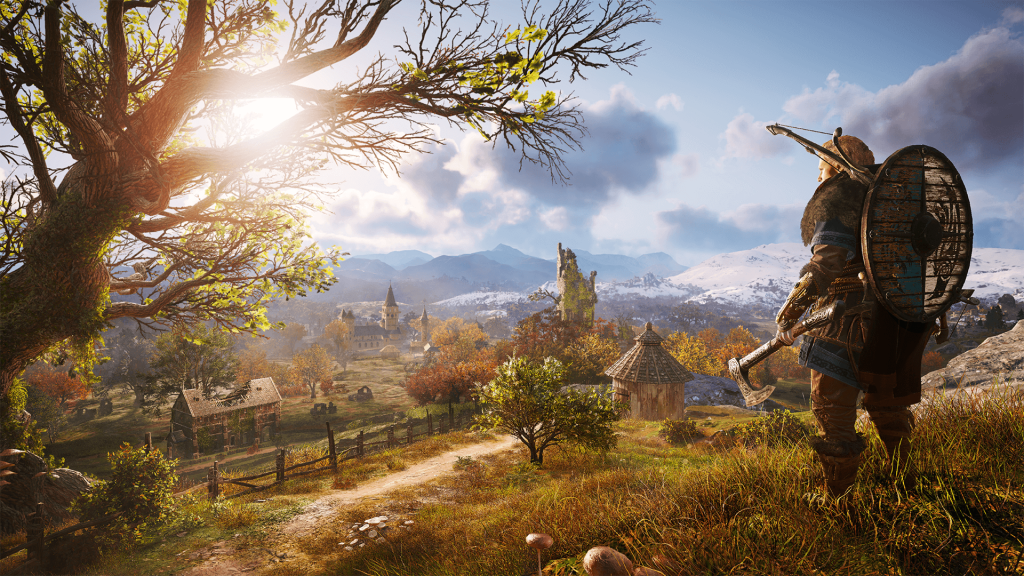
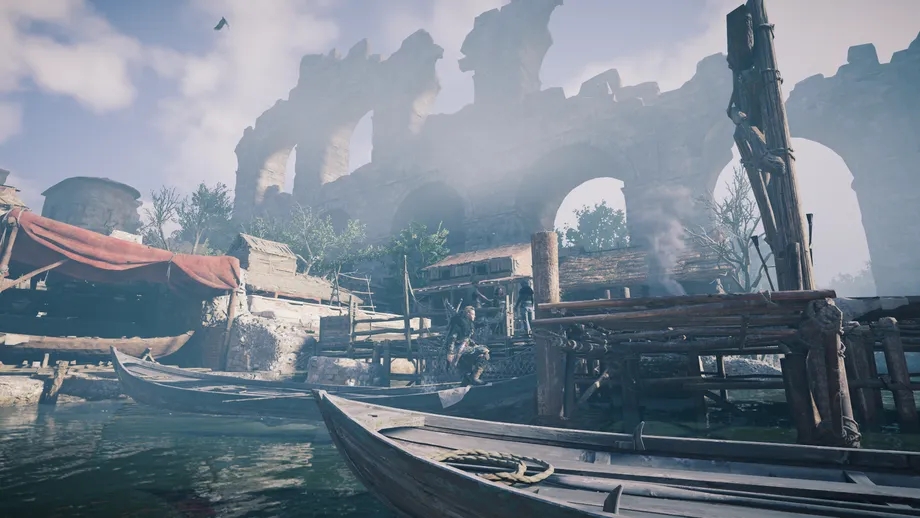
So, yes, I ended up getting Assassin’s Creed Valhalla, at a much-reduced price, and a couple of weeks ago I installed it. Valhalla is a monster of a game: the 100+ square kilometres of its England would be intimidating, if it wasn’t for me never even expecting to complete this one. It’s a discount vacation to a land filled with small settlements and one surprisingly large city, places with names such as Sciropescire and Ledecestrescire and Wincestre and (stop me if you’ve heard this one) Lunden. While the things I’m doing aren’t fundamentally different from the things I’ve done in Origins and Odyssey, the moments of joy in this one don’t come from following the breadcrumb trail of the plot or from fighting or upgrading equipment. They come from scaling a hill just as the sun is rising, or making my way to the top of a tower to look out over a landscape that’s just begun to be domesticated, while much of it is still untouched. It’s coming across towns where the Romans had been, with history visible as a palimpsest: buildings hundreds of years old that look ancient to the people who have made their home there, building next to and over these remnants of an earlier civilisation. The writing is generally mediocre, and often made worse by very middling voice acting, but when Assassin’s Creed shuts its mouth, it manages an atmospheric simulacrum of ancient times that nonetheless feels oddly present.

I don’t know how much time I’ve put into Assassin’s Creed Valhalla at this point. Judging from the map of England that I’ve slowly been uncovering, I suspect I’m not even at the halfway point. I keep expecting to find myself at the point where I wonder why I’m spending so much time with a game that I know to be mediocre in most respects, doing things that I’ve done many times before and that I didn’t even enjoy that much the first or second time I was asked to do them. The veneer of class and quality on these games is thin, and if I scratch hard enough I will find I’m basically playing a Skinner box of a forever game called Assassin’s Creed Whatever. But while the illusion holds, and as long as I don’t question it too much, I’m enjoying my time in 9th century England, a place that is oddly reminiscent of what snippets I remember of that cheesy ’80s series Robin of Sherwood (albeit without the Clannad soundtrack). I’m enjoying being a tourist – albeit one armed with a sword and a bow.
And I know exactly that in a year or two, I’ll have exactly the same conversation with myself about the next Assassin’s Creed game that expects me to put several dozen hours into repeating the same tasks over and over again. Assassin’s Creed never changes – and, apparently, neither do I.
 A Damn Fine Cup of Culture
One thought on “They create worlds: Assassin’s Creed Valhalla, or What I Did on My Viking Vacation”