
Welcome to Six Damn Fine Degrees. These instalments will be inspired by the idea of six degrees of separation in the loosest sense. The only rule: it connects – in some way – to the previous instalment. So come join us on our weekly foray into interconnectedness!
There are minor spoilers for the movie Gosford Park ahead.
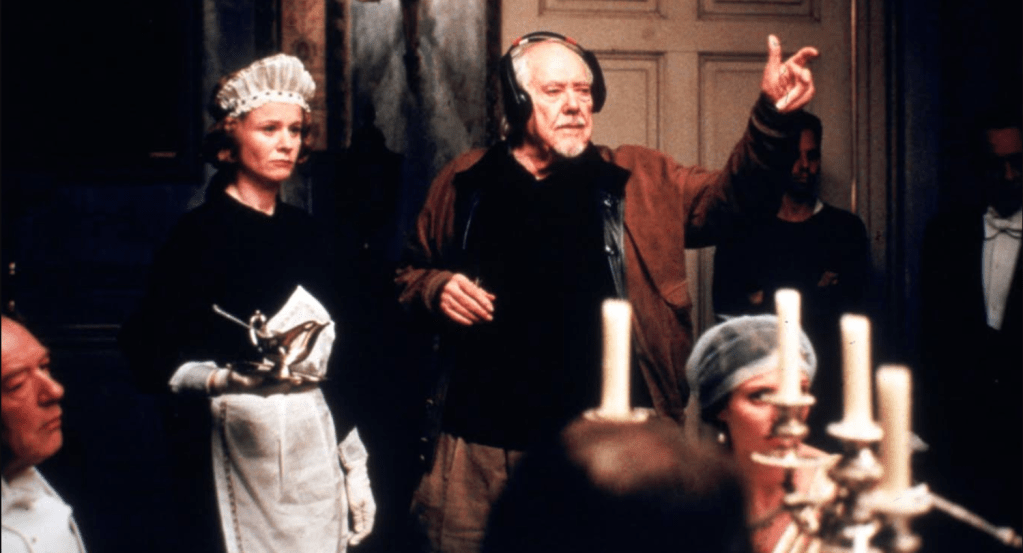
During the opening scenes of Robert Altman’s Gosford Park, in the chauffeur-driven car of the Countess of Trentham (Maggie Smith), in heavy rain, her Ladyship needs help with her cocktail shaker, – or a vacuum flask (those had already been invented by 1892). The maid, as was the custom at the time, gets out of the car in the downpour to help the Countess, when a car drives by. An American voice asks if they are “OK”. When reassured of this, a man in the passenger seat (Jeremy Northam) speaks up: “I’m William McCordle’s cousin, Ivor,” he says. And adds, by way of clarification: “Ivor Novello.” The maid’s jaw drops perceptibly. The countess is rudely dismissive. And at the time this film came out, audiences may have been wondering: well, who is he? “Is that,” whispers the maid Mary (Kelly Macdonald) to her irritable employer, “really Ivor Novello?!”, to which the countess snaps that yes, he is, and to get on with it.
Altman’s Gosford Park – an upstairs-downstairs commentary disguised as a murder mystery – is a great film for many reasons. The stellar ensemble cast, the script, costumes and period design. But Julian Fellowes, who wrote it, writes an existing star of the time into the plot. One whose popularity you could, without hyperbole, even compare to Valentino’s. But one whose music and films have been largely forgotten. Unfairly so, for a composer, writer, and star of stage and screen of such acclaim.
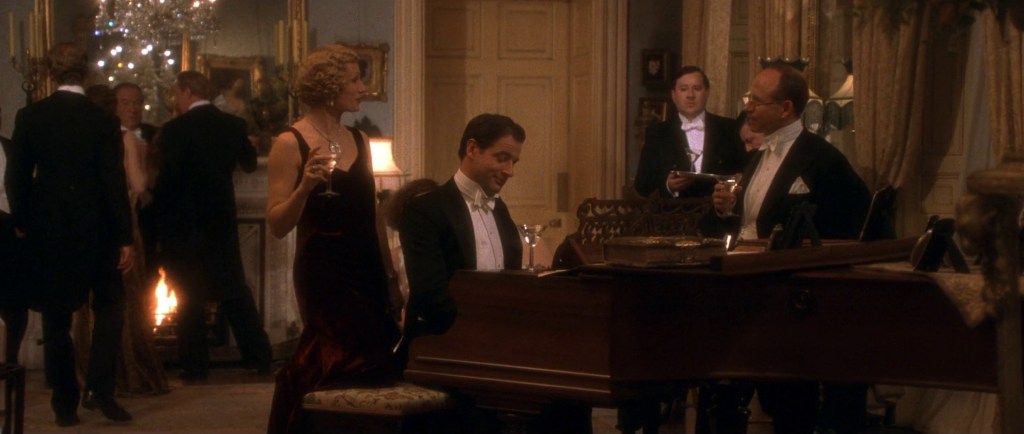
David Ivor Davies, as he was born, took the moniker after his mother’s maiden name, Clara Novello Davies, the redoubtable choral instructor and conductor. Later in the film, he will describe her as a teacher, which hardly does justice to this Mama Rose-like presence in Ivor’s life – nor to her own extraordinary career. She had enormous hopes for Ivor’s musical talents: she saw him as an important conductor, a composer. Not someone tarting about in films as, heaven forbid, an actor.
After the opening sequence, Ivor is next brought up by this Sir William McCordle (Michael Gambon), who explains that Novello’s American friend, Morris Weissman (Bob Balaban), whom we met in the first scene, makes films in Hollywood. Novello is then mentioned, downstairs, by the maid Mary, who finds his picture on the wall of Elsie’s (Emily Watson) room, which she shares. “That’s him! That’s Ivor Novello,” she breathes. “He passed us on the road… and he spoke to me. Well. He spoke to her Ladyship, but I answered.” And then, in response to Elsie’s remark that the American stars have “more oomph,” Mary speculates that, still, the lady of the house must be thrilled. “Oh, I don’t think!” remarks Elsie. And so it appears. The upstairs have little truck with Ivor, while the downstairs love having a movie star in the house. Back upstairs Mrs Nesbit (Claudie Blakley) is positively starstruck to find herself at a table with Ivor, while the Countess of Trentham looks on derisively. Clearly, having admiration for a movie star, immediately places one in a certain class of people – people who are decidedly not like the Countess of Trentham. “Tell me,” asks the Countess pointedly of Ivor, “how much longer are you going to go on… making films? It must be so hard to know when to throw in the towel.” And she continues: “What a pity about that last one of yours, what was it called? The Dodger.” “The Lodger,” responds Ivor, with a rather pained expression, but returning her look. “It must be so disappointing, when something just… flops like that,” she continues to the mounting horror of Mrs Nesbit. “Yes, it is,” says Ivor quietly. “Rather disappointing.” The Lodger refers, of course, to the brilliant 1927 Hitchcock silent, in which Novello plays an ambiguous dark handsome stranger, the lodger of the title, who may or may not be a notorious serial killer. Nowadays it is considered a classic, and upon its release was a critical and commercial success. Certainly not… a flop. Just too lowbrow, too odd, too popular, for the likes of the Countess. Elsie, in contrast, sensibly likes “a bit of a fright in the cinema”.

A brief conversation with the footman Arthur (Jeremy Swift) while setting the lavish dining table is also telling. He is a little mopey, because he did not get assigned to wait on Ivor, who travels without a servant. “Now you won’t get to see him in his underdrawers, oh my,” George (Richard E. Grant), the first footman, sneers rather cruelly. “Better luck next time.”
This line is an inside joke of sorts. While Novello, with his smouldering good looks and glamour, was famous for getting his female fans into a tizzy, the truth was he had at this time, and until his death, a relationship with the actor Bobbie Andrews. They may not have been exactly exclusive, but Bobby was his lover, his voice of reason, and his loyal friend. Though in the film, Novello is certainly not one of the characters explicitly outed, the infatuation with him is shown to not be limited to women. Nor was it in real life.
We are already halfway through the film when we hear Ivor Novello sing. In real life, after his voice broke, he never did. By all accounts, as a boy, he was a wonderful soprano, but as he grew up, he never sang again. He would later tell the story of being expelled from Oxford because he could no longer sing. More likely might be that he was a young gay man, he had trysts, and he got caught. As homosexuality in Britain was decriminalised only partly, and only in parts of the UK, as late as 1967, it makes sense that he would tell the story that way. Fact is, while he was a wonderful composer and an extremely successful one, he never did sing again. And it is conceivable that he missed it very much. But as other boys at Oxford who lost their youthful timbres generally managed to graduate, there is no reason why the extremely talented Ivor would be sent away for that reason alone.
In one of the best scenes in the film, Novello’s entertainment is received with mostly boredom from the glitterati, while the downstairs personnel excitedly gather to listen. “I saw him in The Lodger,” Dorothy (Sophie Thompson) whispers, “but I’ve never heard him sing in person,” is a clever line, because neither have we. His second song, “Her Mother Comes Too “is a nice wink to Noel Coward and Novello’s enduring friendship. They wrote the song together, and it inspires a little dance by the admirers from downstairs. “Lovely long repertoire,” sighs the Countess of Trentham sarcastically, while the kitchen staff enjoy the music, lounging on one one the many staircases. The butler, Jennings (Alan Bates), who is allowed upstairs due to his station, is obviously enjoying himself, and the smitten Arthur, who was so cruelly rebuked by head footman George earlier, takes one of the maids for a little twirl. But the plot must go on, and a bone-chilling scream announces the murder on which the film pivots.
By the time this fictional house party occurs, Novello had already written the song for which he became most famous. “Keep the Homefires Burning”, written in 1914, was an enormous hit. Novello, who wrote musicals – though ‘operettas’ might be a better term – managed a transition to the stage with help from the ever-devoted Bobby. He had some successes there too. Novello’s own Hollywood career had been a dud, after signing to do The White Rose (1923) with D. W. Griffith, which really did flop. In 1927 the Cinematograph Films Act made it a legal requirement for cinemas to show a minimum number of British films, which gave Novello more opportunities for the silver screen. Many of his films seem dated nowadays. But he is rather good in them, even if he seems to have his tongue firmly in cheek for some.
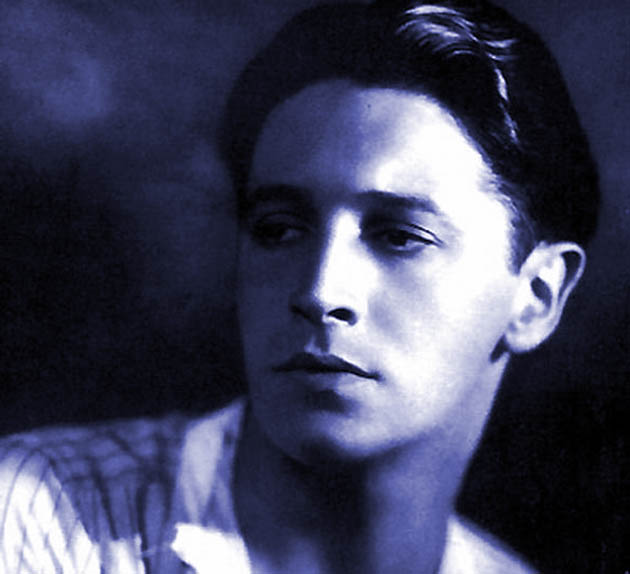
During the time when Novello was making a name for himself, Britain was still very much a class society. The theme of Gosford Park, the decline of the Empire and the old order after the war, could be seen in the disparity between theatre critics and audiences with respect to his music. The cognoscenti thought it all very low-brow and popular, while ordinary people filled theatres, just to see Novello in the flesh. Cinema, unlike now, was not considered art, like theatre was. Filmstars like Ivor, no matter how many fans he managed to attract, were seen as less than. The critics were wrong, of course. The theatre would have perished, if it hadn’t allowed ordinary people of all stripes to come and enjoy the shows. Film stuck around, and brought with it a wider, even global, audience. So Ivor Novello is almost the perfect star, to grace the fictional world of Gosford Park. In him, in his work, he unites the contrasts of that very particular time. When one’s position in life may not be necessarily set in stone, to be born from the cradle to the grave. When one couldn’t quite be out, but could still exude a particular glamour, that was attractive to men as well as to women. Altman, Novello’s biographer David Slattery-Christy writes, had an idea swirling about in his head to make a film about Novello. That never came to pass, but through Gosford Park, he managed to create a renewed interest in Novello, his films, and in particular the music he made.

 A Damn Fine Cup of Culture
3 thoughts on “Six Damn Fine Degrees #153: Ivor Novello in Gosford Park”