Welcome to Six Damn Fine Degrees. These instalments will be inspired by the idea of six degrees of separation in the loosest sense. The only rule: it connects – in some way – to the previous instalment. So come join us on our weekly foray into interconnectedness!

Julie’s wonderful reminder of silent film star Ivor Novello, whose most lasting screen appearance must indeed be Hitchcock’s The Lodger, but whose popular legacy was assured thanks to Robert Altman’s inclusion among the Gosford Park kaleidoscope of characters, reminded me of that other Hitchcock he made – and that’s why for my follow up post, it’s all Downhill from here!
Hitchcock wasn’t an enormous fan of the actor, apparently, considering him to be overly dramatic and minding his superstar image at the time. Still, he made him into his very first of many wrong men in his long filmography. And after The Lodger had proved to be a sizable hit for the director and star in 1927, their next project would become an even closer collaboration: an adaptation of Novello’s own play and script, Downhill.
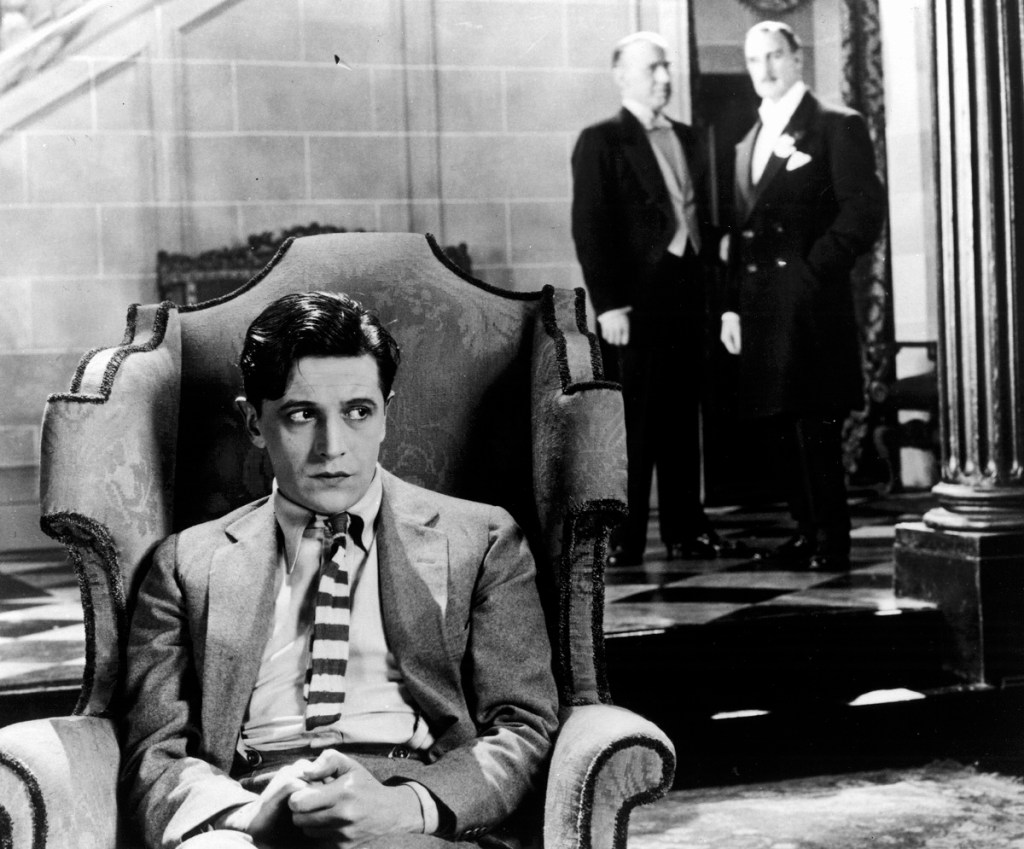
The plot revolves around Roddy, a young rich Oxford student, who is expelled from school and banned from home for a crime a fellow student committed: making a shop girl pregnant. His social downfall is marked by several stages: the unlucky marriage to an unfaithful actress, working as a paid gigolo and finally stranded at Marseille docks. Only upon his delirious return home does he find reconciliation.
What seems at first sight an unusual subject for Hitchcock, this tale of social downfall due to unlucky circumstances still bears the director’s clear mark: the wrongfully accused Novello sees himself put through an increasingly nightmarish path from light into darkness and back. Especially towards the end, the subjective camera, the expressionist lighting and the superimposed flashbacks make this initially rather improbable premise into a moving quest for forgiveness.
The film stands out as an unjustifiably rarely-seen entry into Hitchcock’s very early filmography: the use of title cards (what Hitchcock started out in film with), which function as an elegant structuring device in the film (e.g. ‘The World of Youth’). What starts out as a fascinating insight into life at college in the late 1920s, soon bears the creative mark of its director: the use of silhouettes in the cheerful dance scene at a shop, early Hitchcockian point-of-view shots (especially when Novello is accused at the headmaster’s office) and the use of superimposition for flashbacks and revelations.

Most strikingly, however, the film uses all kinds of symbolic images of Roddy’s downfall, for example in an underground train station, where the escalator’s long way down is shown. Hitchcock’s use of sets and camera movement is excellent (production design by Bertram Evand), revealing Roddy in a tuxedo as a waiter in show or hinting at the cheekily sexual connotation of a giant soda pump, while others underline the gothic shapes of the college and its interiors.
At the film’s heart, there is one of Hitchcock’s central themes, the question of trustworthiness of female characters and their power to destroy men’s reputations. Here, Novello’s Roddy is put through the wringer to clear his name of the accusations of improper conduct. The quest to prove his innocence is captured in striking images and use of light, for example the relentless sunlight Roddy faces at the music hall or the stark lighting of the Marseille dock set.
Finally, there is the excellent sequence on the ship back home, showing Roddy in a delirious state, with images of his mind and machines, turning records and a policeman mixing. We follow Roddy on a point-of-view walk through London and back home, followed by a moving sequence of reconciliation and forgiveness before the coda and ending.
Despite The Lodger being justifiably considered as the template for Hitchcock’s later films (from pretty much The 39 Steps to North By Northwest), Downhill is a gem in its own right and a great second foray for Ivor Novello into the world of the director!
If you can get your hands on the French Universal release of 2007, you’ll be in for another treat: Christophe Henrotte’s excellent new score, much reminiscent of Yann Tiersen’s lovely music for Amélie.
 A Damn Fine Cup of Culture
3 thoughts on “Six Damn Fine Degrees #154: Ivor Novello – All Downhill From Here?”