Welcome to Six Damn Fine Degrees. These instalments will be inspired by the idea of six degrees of separation in the loosest sense. The only rule: it connects – in some way – to the previous instalment. So come join us on our weekly foray into interconnectedness.
Werner Herzog must be one of the most frequently parodied filmmakers in the world. I have no evidence of this other than my own gut feeling, but is there anyone else that’s been caricatured as often as him? And good old Werner gets in on the fun too: he’s voiced versions of himself on The Simpsons, The Boondocks and American Dad – and it’s likely there’s an element of self-parody in him voicing a character described as “Old Reptile” in an episode of Rick and Morty.

In “Soldier of Illusion”, the double episode that the fourth season of Documentary Now! begins with, Alexander Skarsgård’s character is called Rainer Wolz, but Wolz is very clearly a parody of Werner Herzog, just as “Soldier of Illusion” is a comedic riff on Les Blank’s Burden of Dreams, which documents the chaotic production of Herzog’s Fitzcarraldo. August Diehl (who readers may know from films as different as Quentin Tarrantino’s Inglourious Basterds and Terrence Malick’s A Hidden Life) plays a maniacal, abrasive actor called Dieter Daimler – sound familiar? And while there may be impressions of Herzog more technically accurate than Skarsgård’s, all in all, “Soldier of Illusion” looks and feels like the real thing – although reflected in a funhouse mirror. The absurdity of the documentary project that Rainer Wolz and his doomed cast and crew undertake in the Ural Mountains is removed from Herzog’s own projects by degree, and even the biggest laughs that Documentary Now! came up with don’t feel much more outlandish than some of the tales of the adventures of Herzog and Kinski – which, in themselves, are probably not altogether accurate: when the legend becomes fact, print the story in which Klaus Kinski comes across as even more of a madman than he most likely was.
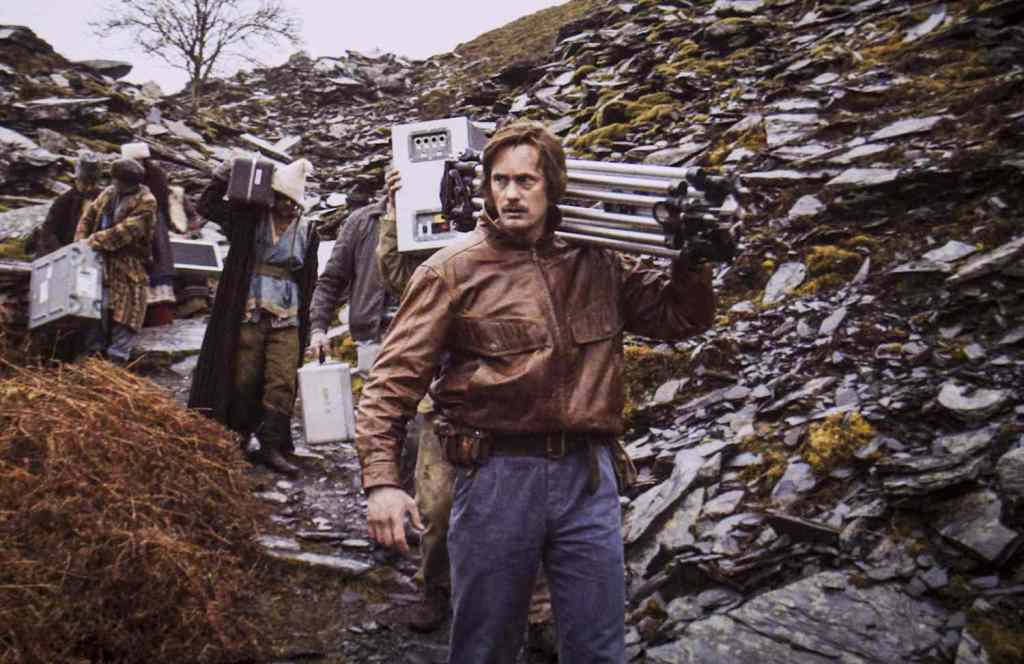
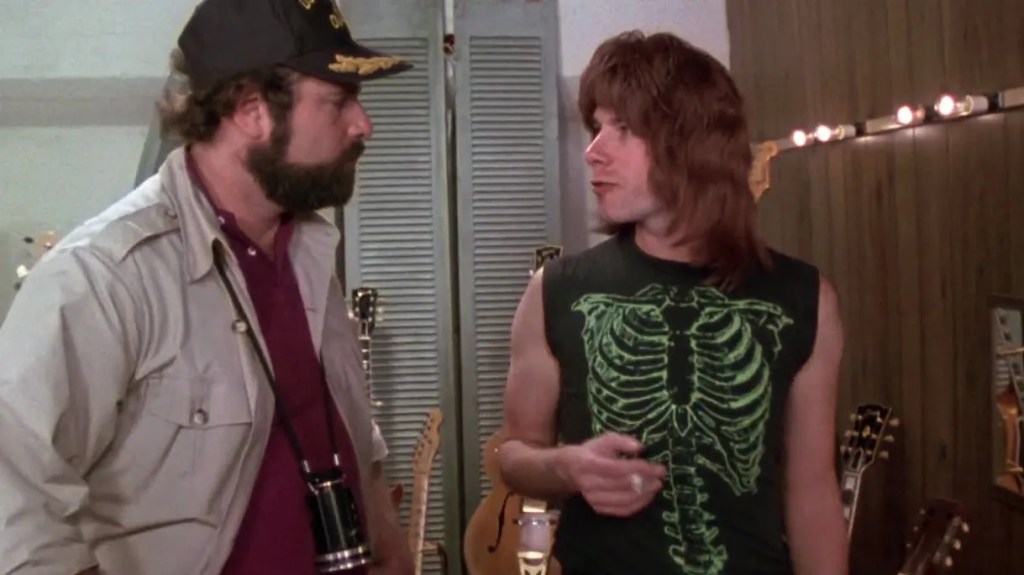
I’ve only seen two episodes of Documentary Now!, a series of lovingly made parodies of famous documentaries, “Soldier of Illusion” and “Original Cast Album: Co-Op” (which spoofs Original Cast Album: Company), but they are both fascinating examples of the mockumentary genre. The impression I came away with is that these are not critical or even mean-spirited towards the films that inspired them. Just as in what may be the most famous mockumentary of them all, This is Spinal Tap, there are obvious jokes in both of these, but they both come across as homages at least as much as they feel like caricatures.
Which raises the question: what’s the purpose of a mockumentary? Arguably, even when they don’t have one clear inspiration that they riff on (as is the case with all episodes of Documentary Now!), they are all parodies to some extent – if not of one specific film, then at least of the documentary genre. There is an extent to which mockumentaries are exercises in style. Look at the episode “Pillows and Blankets” of the comedy series Community, which depicts a drawn-out, epic pillow fight at a community college in the style of a Ken Burns documentary, complete with pans over stills accompanied a Burnsian voice-over (delivered by a wonderfully deadpan Keith David) delivering ‘first-hand’ narration. Community plays up the contrast between the silly plot and the earnest style and gravity for comedic purposes – but for a mockumentary to work, there generally needs to be a certain seriousness. You need to at least take the style seriously, you need to have a good, deep understanding, and ideally an affection, for the thing you’re spoofing. Which doesn’t exclude having fun with the material: neither “Soldier of Illusion” nor “Pillows and Blankets” are obviously laughing at the thing they’re parodying, but there can be something playful – and indeed joyful – to this kind of imitation.
Is that all there is to the mockumentary, though? In some cases, certainly – but like all good parody, the best mockumentaries comment on the thing they’re parodying. Which isn’t just Burden of Dreams or Original Cast Album: Company or Ken Burns’ The Civil War: it’s the genre of documentaries themselves, and their relationship to reality and truth. Obviously the plots are made up, but they’re made up of archetypes, tropes and clichés that we recognise. And we also recognise the ways in which documentaries turn facts – and, not infrequently, the things the filmmakers want to be facts, whether they are true or not – into stories. A good mockumentary helps us come to a better understanding of this, the storytelling that is inherent to documentary filmmaking as much as it is to fiction.
Last year, we ran a podcast episode in which we discussed three documentary films: Patricio Guzmán’s Nostalgia for the Light, Kirsten Johnson’s Dick Johnson Is Dead and Mark Rappaport’s From the Journals of Jean Seberg. All three of these take what could be called a literary rather than literal approach to their subjects. They are intensely subjective, but they try to get at truths that require subjectivity to some extent. People who don’t watch much in the way of documentaries often have this idea that documentaries depict reality much like a photo supposedly depicts reality: you just show what is there. Neither notion is true. Documentaries are stories as much as fiction, and documentary filmmakers make choices: what to present, how to present it, what to juxtapose it with. Who is given a voice? Who is left out? Is there just one perspective or are there many? By choosing the format of parody and focusing on the style and the storytelling strategies of documentaries, mockumentaries allow us to focus on these strategies ourselves. If they are an exercise in style first and foremost, they let us take a closer look at the style in question: how does it shape a story, how does it in fact determine the kind of story you can tell?
Okay, I admit: all of this makes the mockumentary sound like a dry, academic genre – which it certainly isn’t, especially when it’s done well. For all of the Brechtian distancing it brings to the table, allowing us to see the thing it is about from a fresh perspective, a good mockumentary is wonderfully enjoyable. We can watch “Soldier of Illusion”, enjoy the comedy as well as the reminder of Werner Herzog, his films, his fraught relationship with Klaus Kinski, his weird, wonderful idiosyncrasy. We can enjoy the spoof songs in “Original Cast Album: Co-op” or This Is Spinal Tap while we’re reminded of the songs they parody. Coming to a better understanding of how documentaries work? That’s a bonus.
P.S.: By coincidence, just yesterday we watched “The Goof Who Sat By the Door”, a stand-alone episode of Atlanta‘s fourth season – another wonderful example of mockumentary, depicting the life, career and death of Thomas Washington, the entirely made-up first Black CEO of The Walt Disney Company. Like all the best mockumentaries, it works as parody but also manages to transcend its comedic intentions and become something more.
 A Damn Fine Cup of Culture
4 thoughts on “Six Damn Fine Degrees #169: Don’t mock the mockumentary”