Welcome to Six Damn Fine Degrees. These instalments will be inspired by the idea of six degrees of separation in the loosest sense. The only rule: it connects – in some way – to the previous instalment. So come join us on our weekly foray into interconnectedness.
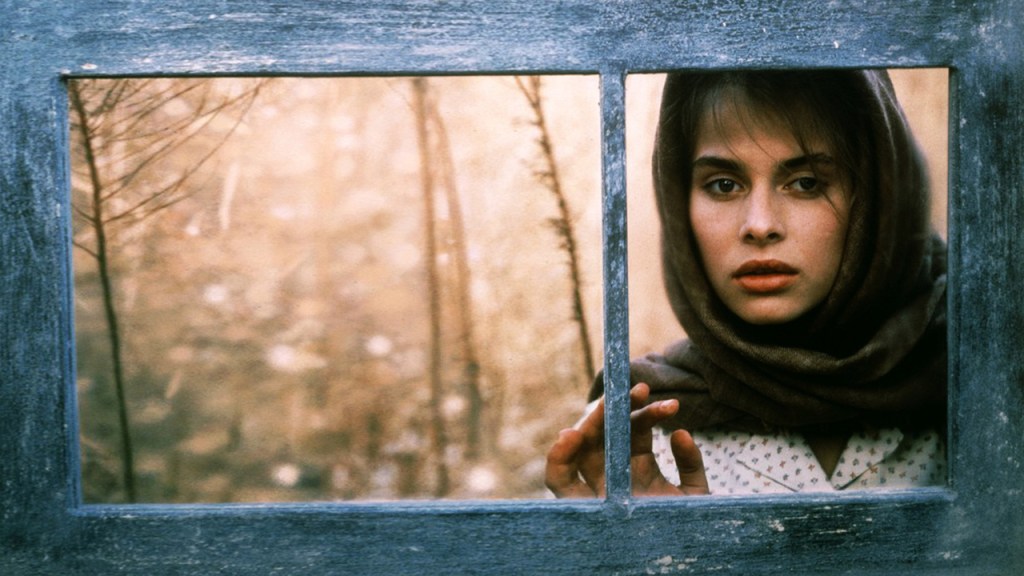
These days, with director Werner Herzog still nourishing his infamously conflicted yet cinematically so fruitful relationship with Teutonic titan Klaus Kinski (even spoofed in Documentary Now!, as described in last week’s post by Matt), it is an almost forgotten fact that for a while, some forty years ago, a very different Kinski made her way into the audience’s consciousness: his daughter Nastassja.
Two of her roles in particular have endured: her role as Tess in Roman Polanski’s adaptation of Thomas Hardy’s novel Tess of the d’Urbervilles (1979) and the iconic impression she left in Wim Wender’s Paris Texas (1984) as Harry Dean Stanton’s young wife. However, her filmic output was all but eclipsed by the 1990s already, and she has rarely been seen since, apart from reality TV appearances (Let’s Dance, Dschungelcamp) – but it’s also her way into filmmaking that from a present-day perspective raises all kinds of red flags and question marks: her full frontal nudity in her first two roles at barely 15 years of age (Hammer’s To the Devil a Daughter in 1976 and “Reifezeugnis”, Wolfgang Petersen’s legendary entry into the German crime show Tatort in 1977) and her mentor-mentee relationship with director Roman Polanski, shortly after he had fled the US justice system on charges of statutory rape of an underage girl.
The controversies have since only piled up, not least since her half-sister Pola’s accusations of sexual abuse against their father (and Nastassja Kinski’s own reckoning with the type of abuse she experienced from him) and her recent legal case against the scenes of nudity in the aforementioned Tatort episode. Comparisons were immediately drawn to the similar controversy around Franco Zeffirelli’s Romeo and Juliet (1968), with lead actors Olivia Hussey and Leonard Whiting suing Paramount in 2023 for abuse and fraud for their own scenes of nudity while underage. This case was recently dismissed, but it leaves an equally bitter taste about such long-revered films, studios and filmmakers (among many) as Zeffirelli and Polanski.
It was also the latter who had nursed her acting career by sending her to Lee Strasberg’s legendary acting studio while he himself came off a tumultuous decade of personal tragedy (Sharon Tate’s death at the hands of the Manson clan) and cinematic triumph (Rosemary’s Baby, Chinatown) and was establishing a foothold in French cinema. When looking for a new project, he reread Hardy’s novel, which his late wife had warmly recommended, having herself in mind as Tess. He later dedicated the film “To Sharon” in the opening credits but had since made the daring casting decision to have the German newcomer take over the lead role. Nastassja Kinski was sent to rural England to perfect her Dorset accent and was coached for months in London before joining the production in France, which stood in for 19th century England, allowing Polanski to avoid setting foot in potentially legally perilous Great Britain.
In Laurent Bouzereau’s documentaries accompanying the 2013 restoration, Polanski, Kinski and crew recount their inspiring experience of making Tess, and how this translated into a uniquely friendly relationship between cast and crew rarely seen on film sets. Watching the result of this, one cannot help but marvel at Polanski’s mastery of the literary adaptation, the beauty of the Oscar-winning photography by the late Geoffrey Unsworth (and his French replacement in the middle of production, Ghislain Cloquet), the beautiful score by Philippe Sarde and the stunning costumes by another Oscar-winner for the film, Anthony Powell. Kinski turns out to be perfect casting for Tess, whose loving and abusive relationships and quest for her family’s potential aristocratic ancestry she carries with both pouty stoicism and moving frailty.
Just like with Tess, it is a dilemma that we often face in the present-day discussion around filmmakers and actors (often rightfully) fallen from grace and the essential discussions going on around abusive studio systems and creative relationships: can one still enjoy their filmic output based on artistic merit alone, or does the context of production history and problematic relationships make their films all but unwatchable? Numerous of my favourite films and filmmakers have undergone a critical reappreciation over the past decade and have sometimes fallen on one side or the other of the controversy. (How abusive or nurturing was Hitchcock’s grooming of Tippi Hedren? Where do we stand on Woody Allen and Mia Farrow’s decade-long claims on the narrative of their relationship and breakup?)
Stripped of context, as a piece of filmmaking, Tess, to me, is flawless, as is Nastassja Kinski’s part in it. In context, besides Polanski’s own culpability and the truth about the abuse by her father, it also makes me want to do more research into Kinski’s career, her lack of success despite working with other high-profile directors (Francis Ford Coppola’s One from the Heart or Paul Schrader’s Cat People) and her withdrawal into private life, with her last cinematic appearance being David Lynch’s Inland Empire in 2006. For me, each of those layers is increasingly chipping away at the sense of enjoyment I felt when first seeing Tess.
Separating what happened to her career from the indelible impression she makes in the role, as well as the specific circumstances under which the film was made and by whom, is thankfully becoming next to impossible when seen through the rearview mirror. And despite not being able to go back to that initial, innocent first viewing, it becomes an essential opportunity to reflect on the difference between the piece of art, the people behind it and the role of the informed appreciator.

 A Damn Fine Cup of Culture
3 thoughts on “Six Damn Fine Degrees #170: Whatever happened to Nastassja Kinski?”