Welcome to Six Damn Fine Degrees. These instalments will be inspired by the idea of six degrees of separation in the loosest sense. The only rule: it connects – in some way – to the previous instalment. So come join us on our weekly foray into interconnectedness!

~ Here be spoilers.
“I can’t believe you’re doing this to me again,” the vampire Eve (Tilda Swinton) chides gently while video-calling her lover and soulmate Adam (Tom Hiddleston) via her Apple phone. Eve has been living in Tangiers, surrounded by her books, in a carefully curated bubble of literature and art. Her main friend there is Kit Marlowe (John Hurt) – yes, that one, the Elizabethan poet to whom the majority of Shakespeare’s work is sometimes attributed (Jarmusch himself is an anti-Stratfordian). But Adam, hidden away in his dilapidated apartment somewhere in the lonely and ruined outskirts of Detroit, is depressed. These times depress him. The people depress him. He seems to keep himself going only by collecting the rarest of rare guitars, and composing funereal-sounding music in anonymity. He is greatly irritated that, in an underground way, his music is a success. He just wants to be left alone. And so there’s nothing for Eve to do but to pack some of her beloved books* and leave Tangiers for Detroit.
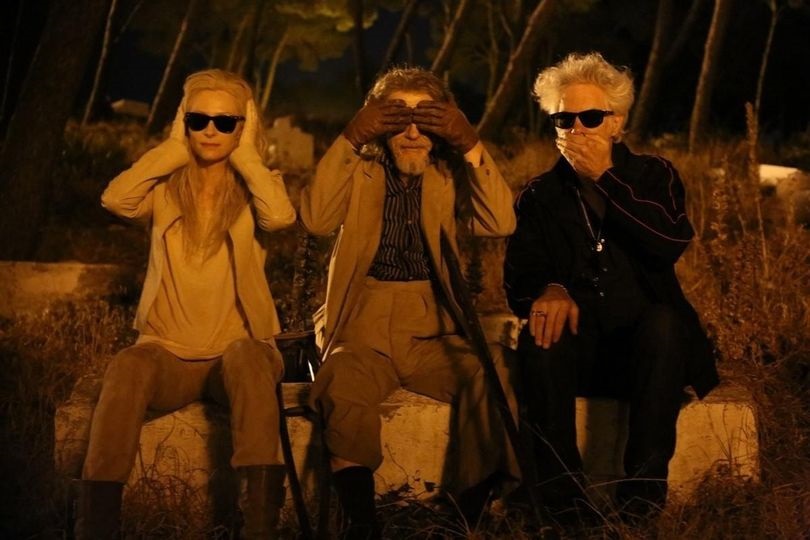
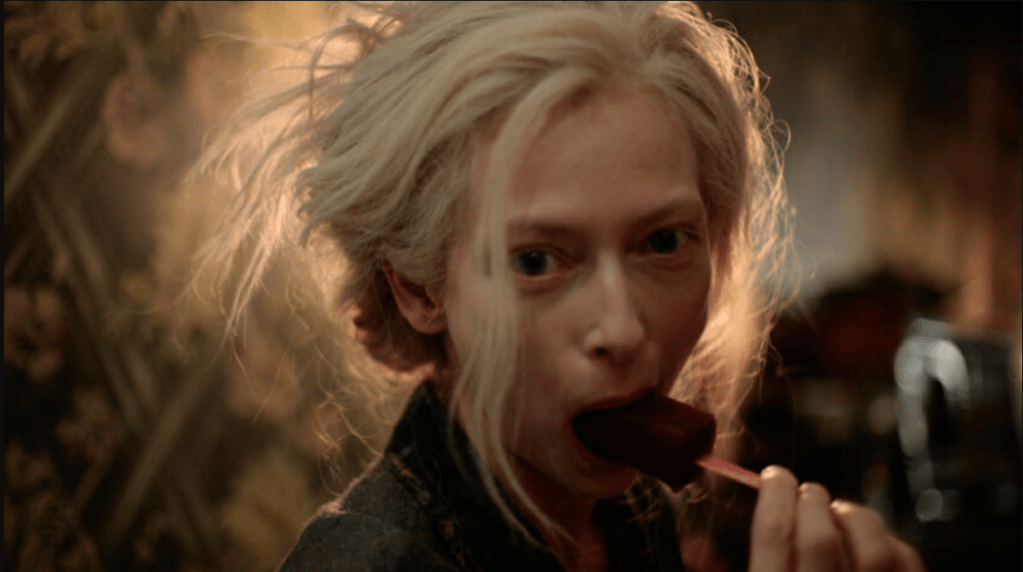
One of the joys of this film is in their interaction. They sip blood from sherry-glasses, enjoy blood popsicles, play chess, dance, and go for long drives in a deserted Detroit. She, in a quiet sophisticated way, sees wonder in most things. Such as the little striped skunks scrabbling about in the overgrown yard: “mephitis mephitis,” she observes with a smile in her voice. She maintains a generally positive attitude in a muted way: she is a survivor. “How can you have lived for so long and still not get it?” she admonishes Adam gently at one point, “This self obsession is a waste of living, It could be spent surviving things, appreciating nature, nurturing kindness and friendship … and dancing. You have been pretty lucky in love though, if I may say so.” Up until this point in the movie, what neither of them see much of are living people. Zombies, Adam calls them. He has one person who visits him when he’s found some particularly rare guitars, named Ian (Anton Yelchin), who does the general fetching and carrying. He is also in contact with a haematologist (Jeffrey Wright) to procure “the good stuff,” type O-negative blood, under the name of “Dr Faust” (or “Dr Strangelove”, as Wright observes wryly, with more than a little apprehension). When Eve and Adam drive through Detroit it seems deserted – not because it is in fact deserted, but because, to them, the people who inhabit the world might as well not exist. They’re useless even as food: the vampires don’t dare feed on them, as there’s a risk their blood is “tainted”. (It is never explicitly explained what by, but it is heavily implied that people are poisoning the very earth).
Their time together is disrupted by the arrival of Eva (Mia Wasikowska), Eve’s sister. Eva is a party girl. Happy-go-lucky, young, greedy. She wants what she wants, and lots of it. She wants to go out clubbing and finally convinces Eve and a very cranky Adam to join her, leading the deliciously idiosyncratic pair, gloved and in sunglasses, to an underground rave. The night (or morning) ends in disaster, however, when the pair discover poor Ian dead on their sofa. Eva has drained him. This occurrence makes it acutely, painfully clear how dependent vampires are on their handlers. And although the scene itself is played as mordant comedy: how can they stay in Detroit with Adam’s only link to the world severed? Suffice it to say that the way is to Tangiers, where more misfortune awaits, and our lovers are faced with a stark choice.
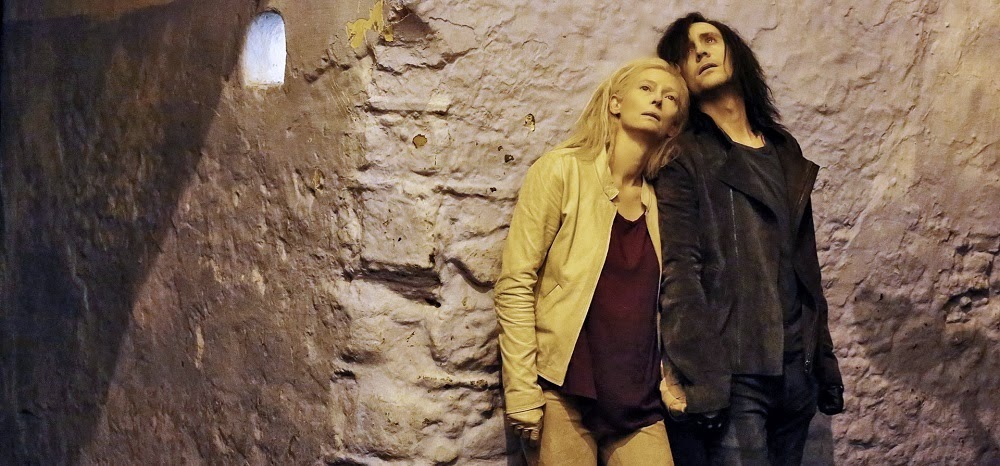
Only Lovers Left Alive is best experienced as it unfolds. It is buoyed more by atmosphere than plot, requires some patience and some affinity with Jarmusch’s leisurely way of filmmaking. As an example, in the opening scenes we see a gramophone record playing Wanda Jackson’s “Funnel of Love” slowed down and remixed to such an extent that it becomes a witchy lament. We see Adam and Eve rotate with the record, separated by miles, but still connected. (There is more than one reference to Einstein’s spooky action at a distance, or quantum entanglement.) The look and feel of the film is precisely curated: Eve with her gloves, clad in shades of fawn and white. Adam with his long black hair over one eye, a slim-hipped goth. The film is also drily funny. After Eva has drained Ian she whines, “Oh I didn’t mean to. He was just so cute! And now I feel sick.” “What did you expect!” Eve retorts “He’s from the fucking music industry!” But as much as the film makes us feel for our lonely vampire lovers, they are still vampires. Entitled, remote and – in the end – bent on their own survival. Whether the film actively means to or not: questions of appropriation and of white privilege assert themselves. Is it really worth it, to be allowed to hang out with these aloof, sophisticated creatures? Jarmusch, at least, seems infatuated with them. In a Vanity Fair interview, he has mentioned that part of the work with Swinton was deciding on her history. A woman in a position of leadership. A druid perhaps? Her age is never mentioned in the film, but in this interview it is estimated that she became a vampire 2,500 years ago. If that is so, she would certainly have seen the rise and ruin of Roman Britain. From the successful invasion under Claudius in AD 43, to the emperor Honorius’ admonition for the British to “look to their own defences”, after the sack of Rome in 410 AD. A survivor indeed, and for all the trappings of Elizabethan politeness and deference, a survivor at all costs. We, the zombies, may be entranced by the glamour. But when push comes to shove, these two have seen the rise and fall of empires, and have no compunctions about leaving us by the wayside, drained and lifeless. And inasmuch as there is a moral to this story at all: the shadow of the aristocrat is ever present. Even, or perhaps especially, in the arts.
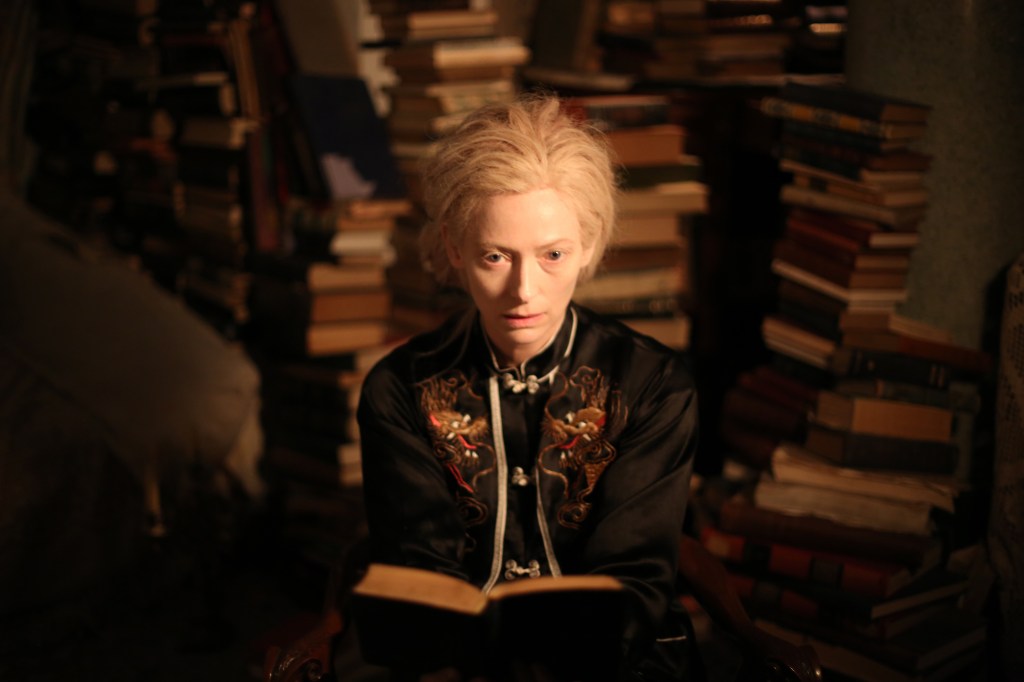
*These books include, not coincidentally, Glenn O’Brien’s Jean-Michel Basquiat, David Foster Wallace’s Infinite Jest, Cervantes’ Don Quixote, Verne’s Les Anglais du Pôle Nord, Kafka’s Die Verwandlung, Elif Shafak’s Bastard of Istanbul and Ariosto’s Orlando Furioso, among others.
 A Damn Fine Cup of Culture
3 thoughts on “Six Damn Fine Degrees #209: Only Lovers Left Alive (2013)”