Welcome to Six Damn Fine Degrees. These instalments will be inspired by the idea of six degrees of separation in the loosest sense. The only rule: it connects – in some way – to the previous instalment. So come join us on our weekly foray into interconnectedness!
Revenge is one of the staples of our culture. Think of Hamlet, or The Count of Monte Cristo, or even of Carrie. Think of Kill Bill or Mad Max or The Princess Bride. Revenge is a motif, and indeed a motive, that’s clear, easily understood, and it allows us to vicariously enjoy our darker impulses through others. We may fantasise about getting our own back on those who have wronged us, but we rarely put it into practice – and most definitely not as spectacularly as Maximus the Gladiator, or Beatrix “the Bride” Kiddo, or Inigo Montoya, the sword master we’ve all wanted to be at one time or another.
Melanie is certainly right that in Western culture especially, revenge stories often (but not always) come with a sting in the tail: the person enacting revenge may find out that, once they have had their revenge, their life is left hollow and meaningless, or there’s an ironic twist where, in bringing about revenge, they lose everything they had left. There is probably a moralistic element to this that misunderstands the cathartic potential of a good revenge tale played straight: just because we enjoy an over-the-top revenge enacted on an over-the-top villain doesn’t mean that we’re all just one step away from donning our vigilante outfits and going out to fold, spindle or mutilate the ones that have done us wrong.
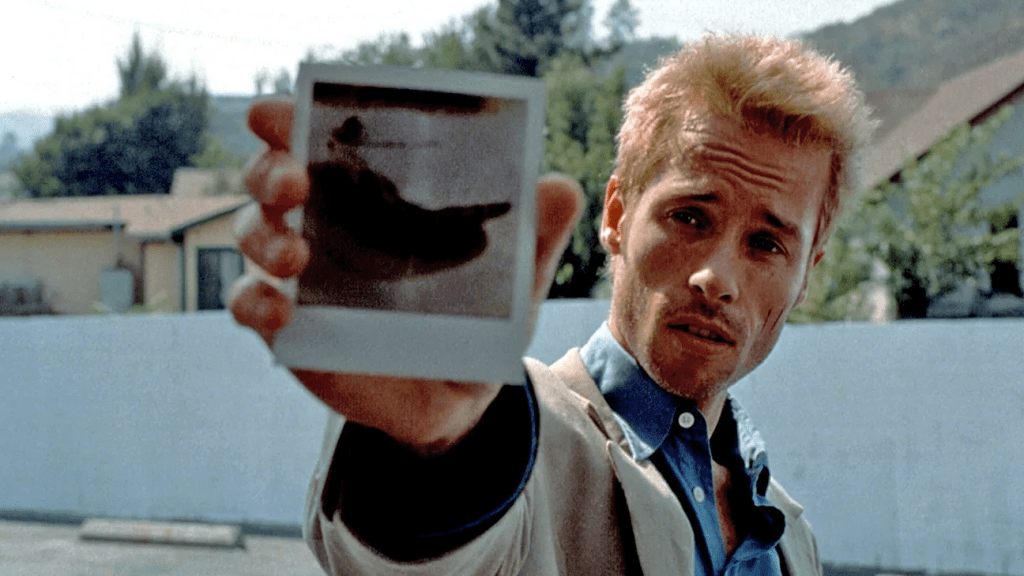
Christopher Nolan’s Memento, the director’s second feature film, is a fun inversion of such revenge tales. The movie’s high concept is this: its protagonist, Leonard Shelby (played by Guy Pearce), suffers from anterograde amnesia, meaning that he is unable to form new memories. Anything that happens to him, he will have forgotten in a matter of minutes. The only things he can remember are memories from before the attack that left him with this condition – but Leonard has found the ultimate life hack for anterograde amnesiacs: he meticulously records clues and commands to himself, first by writing them on Polaroid pictures, then by having them tattooed on his body. In effect, he becomes his own human Post-it.

Warning: The following contains spoilers for Memento. Though, if you’re lucky, you may forget them a couple of minutes after reading them.
And what is it that Leonard records? The clues to the identity of the man he needs to revenge himself on. See, the man that attacked Leonard, causing his condition, is also the man who assaulted, raped and killed Leonard’s wife. The problem is: Leonard cannot remember anything about the attacker, so he must follow the trail of breadcrumbs to find the culprit under what are understandably difficult conditions. How long has Leonard been going about his puzzle-box revenge? No idea. But revenge is all he has left – because, quite literally, it has become his entire existence since his wife’s death. He cannot meet new people and form new relationships, because he would forget about them within minutes… unless he takes a photo and writes down a clue to himself: Do not trust her or She will help you out of pity or Don’t believe his lies. Not exactly the material that good, lasting relationships are made of – but it may be enough if all you want is revenge. He’s the one. Kill him. Just don’t forget to take a snapshot once you’ve got the guy, because what’s the point of revenge if you forget you took it a few minutes later?

As you can imagine, Leonard’s system isn’t exactly foolproof. You can’t take a Polaroid of every moment of every day, and even if you do, photos can be stolen or destroyed. It’s a system that’s easily manipulated – by others, certainly, but even by Leonard himself. Angry at the barista who messed up your coffee order? Take a Polaroid of him and write on it, “He’s the one.” The best thing about this? Leonard won’t even remember the manipulation. And like that, he becomes the perfect instrument of revenge, to be used by others as much as by himself. His sense of self, the sense he makes of his life, has become defined entirely by his quest for revenge, and if there’s any moralistic irony to the revenge, he quite literally won’t know, so it doesn’t matter to him. We, the audience, might find irony, poignancy, or even tragedy in what Leonard does – but he doesn’t. He can’t.
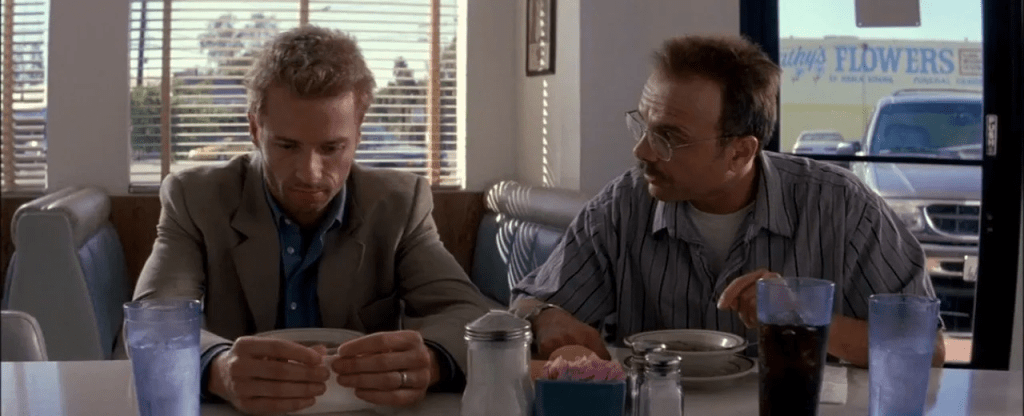
Memento was the first time I became aware of Christopher Nolan, and I remember enjoying the film a lot back in 2000. Here was a clever, witty, darkly funny revenge tale – though perhaps one that may not have been quite as clever as its makers believed it to be: I still dislike the clunky Sammy Jankis subplot, which feels like Christopher Nolan felt the need to make something already heavily hinted at (namely Leonard’s unreliability as a narrator) explicit, like the third clue in an escape room: here’s the solution you couldn’t figure out yourself. However, while this may mar the film for me, it doesn’t ruin Memento. There’s a sense of humour that is very welcome: while it isn’t entirely absent in Nolan’s other films, by and large they have become more and more dour and self-important – and for me at least, the more the films insist on their seriousness, the less they succeed at conveying the seriousness of their themes. By comparison, Memento is a clever little neo-noir treat with a witty gimmick and a lightness of touch, and it tells an effective story about the lies we tell to ourselves about the person we want to be. The main thing Nolan himself could still learn from this movie is that he doesn’t need to have one of the leads pretty much look at the camera and spell out the themes. It’s simply not necessary. Someone should possibly tattoo “Don’t spell out your themes in clunky ways” on Nolan’s chest.
 A Damn Fine Cup of Culture
2 thoughts on “Six Damn Fine Degrees #216: Sometimes the best revenge is the one you forget about”