Welcome to Six Damn Fine Degrees. These instalments will be inspired by the idea of six degrees of separation in the loosest sense. The only rule: it connects – in some way – to the previous instalment. So come join us on our weekly foray into interconnectedness!
I wonder: there must be researchers that analyse the children’s TV programmes that people grow up with, across generations and countries. If so, what does their research say about the shows I grew up with, in 1980s Switzerland?

I’ve talked before about growing up with a lot of television that wasn’t specifically aimed at kids. This was partly because of the English-language videos we were sent by my uncle, an eclectic mix of films and TV shows recorded mostly off BBC and ITV: one of his Betamax dispatches might have included Zulu, Star Wars and half a dozen episodes each of The Benny Hill Show, The Two Ronnies and M*A*S*H (the latter in the rare, superior version without a laughter track, no less). It was also due to my parents letting us watch pretty much anything, both with and without them. (We had two televisions, one in the living room, one in my parents’ bedroom, so I was often able to watch whatever I was more interested in than the rest of the family, which may have been one of my favourite things growing up.)
Which doesn’t mean however that I didn’t watch a lot of TV aimed squarely at kids. In the afternoon, when I got home from school, and well into the early evening, I would switch on the telly, choosing between cartoons from the last several decades, ranging from Tom & Jerry via The Flintstones and, to a lesser extent, The Yogi Bear Show and Top Cat (I don’t think we ever got The Jetsons for some reason) to collections of Pink Panther animated shorts, called Paulchen Panther for the German-speaking world, with a very German voice-over by the actor who was responsible for dubbing, among others, (takes a deep breath) Sean Connery, William Shatner, Paul Newman, Rock Hudson, Franco Nero, Kirk Douglas, Clint Eastwood, Marlon Brando, and others. Yes, I grew up in an odd world where James Bond, Captain Kirk and the Man without a Name sometimes had the same voice.

One thing we didn’t much get on TV when I was a kid was the archetypical Saturday morning cartoons of the 1980s, even though I grew up in the ’80s, so I didn’t get to see glorified toy ads such as G.I. Joe or Transformers. The TV programmers responsible for kids’ television on the German channels thought they were too violent, overly commercial, or both. I think I could have seen ThunderCats or He-Man and the Masters of the Universe at the time, but even when I was a kid I was too much of a snob to be interested in those. And no one except for really small children or those with late-hippie or very conservative parents would have watched Swiss kids’ TV at the time.
What we did get a lot of in the mid-1980s was Japanese animation. But here, too, the difference between countries and even language regions struck: French-speaking Switzerland got the action-packed razzle-dazzle of Les Chevaliers du Zodiaque, in which mythological warriors would duke it out across the globe, and we got… Heidi, Girl of the Alps. The Adventures of Pinocchio. Alice in Wonderland. The Wonderful Adventures of Nils. Maya the Honey Bee. (Okay, we also got an anime series called Captain Future, loosely based on a 1940s pulp sci-fi magazine, which I found fascinating and silly in equal parts.)
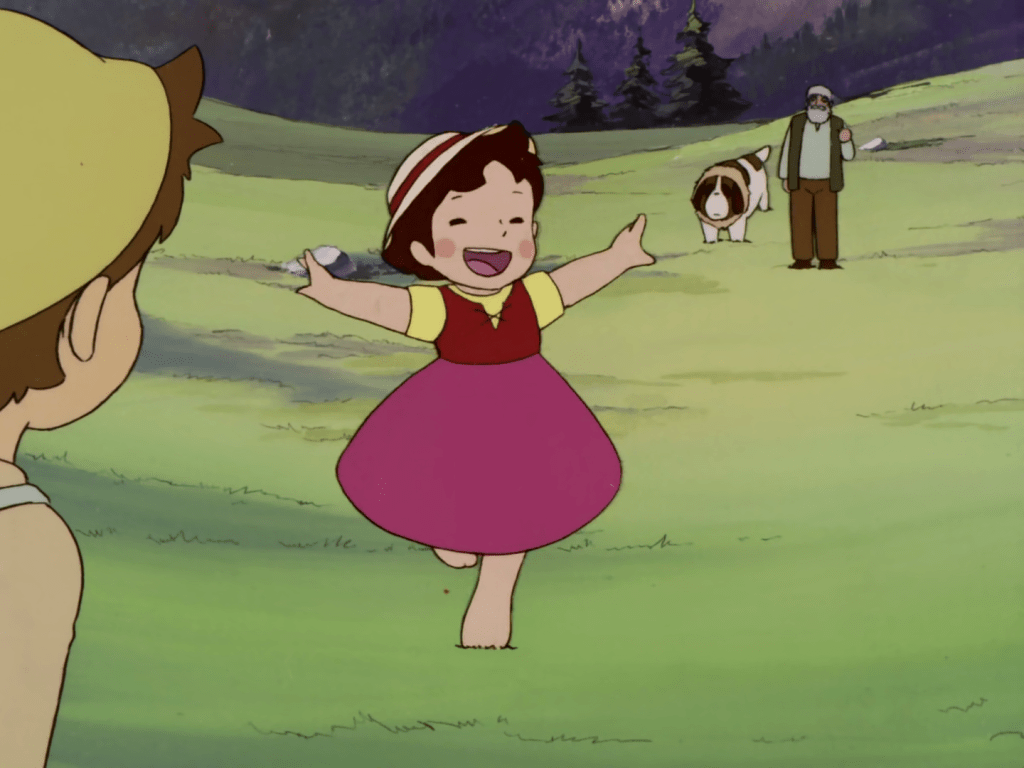
I can’t remember how long it took me to realise that so many of the children’s series I was watching were Japanese, because the stories they were telling were European, at least originally. They were based on classic children’s novels from Germany, Italy, Sweden, and even Switzerland. I only found out much later that there was a vast catalogue of these anime adaptations, including cartoon series based on Little Women, The Swiss Family Robinson and even the story of the Von Trapp family. (While that series looks like a rather sedate affair, I could well imagine an anime version of The Sound of Music in which Maria and Captain von Trapp kick Nazi ass across Austria, Dragonball-style.)

Surprisingly, even though I grew up in Switzerland, it was the animated, Japanese Heidi that was my prototypical version of that most Swiss of all children’s books. I didn’t much like the series, finding it kitschy and twee as a kid, but in hindsight I wish I’d paid more attention – because Heidi, Girl of the Alps was directed by Isao Takahata, who’d later go on to make animated classics such as Grave of the Fireflies, Pom Poko and The Tale of the Princess Kaguya (which we talked about on our podcast almost four years ago), and another key contributor to the series was Hayao Miyazaki, perhaps the most beloved anime director across the world. If I were to revisit the series, I wonder if I’d see their creative thumbprints all over it.
Looking back, it is fascinating to see the eclectic cultural mix we grew up with at the time: European children’s books from the 19th and early 20th century, adapted as anime by Japanese companies, dubbed into German, and all of them with a German Schlager-type title song composed and produced especially for the German TV version (so we didn’t get the original title tunes), sung by some of the stars of Schlager at the time – such as the “golden voice of Prague”, Karel Gott, a Czech superstar of the time who sang the title tune for Maya the Honey Bee. Even 40 years later, I could, if not sing, then at least hum, the title songs of so many of these series – independently of whether I liked the series or not. And regardless of whether or not I liked these shows, I do think that they contributed to my interest in film and TV across countries, cultures and languages, and in storytelling that blends these in weird and wonderful ways.
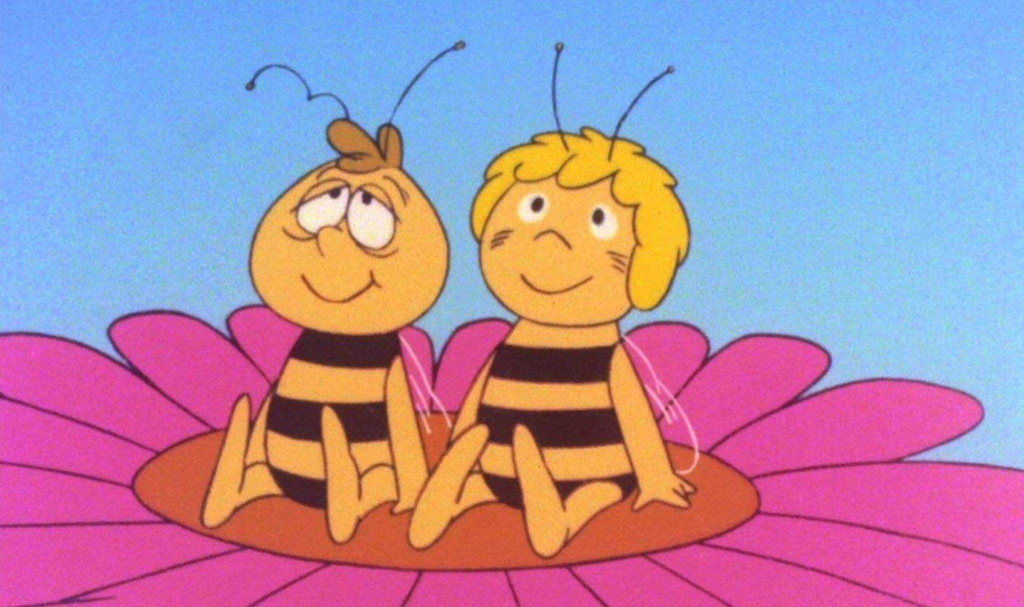
P.S.: Incidentally, there is a childhood photo of my sister and me, in which I must have been perhaps three years old, with the two of us costumed for carnival as the adventurous Maya and her best friend, the lazy, easily scared drone Willy. Looking back, it is quite amazing how little time I’ve spent in therapy.
 A Damn Fine Cup of Culture
3 thoughts on “Six Damn Fine Degrees #224: When I was a child, I watched as a child”