Welcome to Six Damn Fine Degrees. These instalments will be inspired by the idea of six degrees of separation in the loosest sense. The only rule: it connects – in some way – to the previous instalment. So come join us on our weekly foray into interconnectedness!
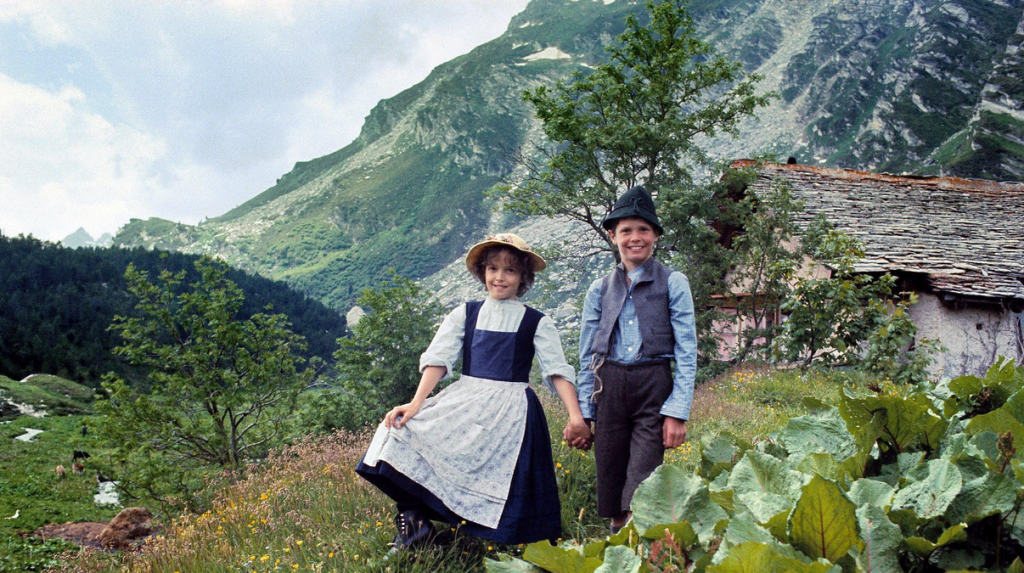
Growing up in Switzerland, everyone is of course hyper-aware of its uber-famous orphan story Heidi, Johanna Spyri’s 1880 novel about an alpine transplant who performs miracles on grumps, frumps and wheelchair-bound aristocrats. Needless to say that even much before the iconic 1974 Japanese animé adaptation so poignantly remembered in Matt’s last post, Heidi had become a global ambassador for idealised images of our country and had spawned a wide range of stage, film and TV adaptations. And despite Switzerland’s best efforts, the most interesting versions were contributed by other countries and cultures, and I don’t just mean Japan.
Of course, one could try to include the weirder side of the Heidi exploitation phenomenon, for example the three competing Heidi villages in Switzerland (either location of the original story or one of the film adaptations), or the fact that there have been no less than seven musical adaptations over the past two decades for various stages inside and outside Switzerland. One could take into account oddities like Heidi The Ride at Plopsaland fun park just outside of Dunkirk in Belgium or the Heidi phenomenon not just in Japan specifically but also, very noticeably, in Turkey (‘Haydi’ means ‘Let’s go’ in Turkish, and the book was one of national father figure’s Atatürk’s favourite books). Hey(di), they even put poor Heidi on Swiss and German postage stamps over the years!
The filmic adaptation side is no less impressive (and weird): a total of eight distinct animation versions have been released since Japan’s 1974 hit. I don’t remember ever seeing any in full form, but the Zuyio Enterprise production by director Isao Takahata (with its weirdly different soundtrack in the German version) was certainly enormously recognisable. As children, we would endlessly belt through Gitti & Erika’s schlager song composed by Christian Bruhn, who himself composed an endless string of hits for ‘70s and ‘80s TV shows (my personal favourite still being “Patrik Pacard” by Lady Lilly).
Equally impressive is the list of live-action TV series from 1953’s British version (starring Julia Lockwood, daughter of Hitchcock heroine Margaret from The Lady Vanishes) to, alas, the computer-animated 2015 European rehash of the 1970s version. However, the bulk of adaptations certainly still lies in an eclectic collection of eleven cinematic adaptations. Early on in film history, 1920’s silent short movie was a first, but Shirley Temple’s 1937 stint as Dutch (!) orphan Heidi certainly made a more lasting impression and claimed Heidi as a Hollywood project.
Swiss film production (rarely taking off outside of the national market) had to catch up with 1952’s adaptation starring Elisabeth Sigmund as Heidi, Heinrich Gretler as Alp-Oehi (Heidi‘s grumpy yet misunderstood grandfather) and German comedian Theo Lingen as Frankfurt servant Sebastian, making Heidi’s exile in the city more and more bearable. Two more versions with a similar cast but no longer based on Spyri’s novel followed suit (Heidi und ihre Freunde, Heidi und Peter) before Heidi became an Austrian production (1965, starring Sissi’s father Gustav Knuth as yet another father figure, Alp-Oehi).
A standout to me is 1968’s version by US TV station NBC, and not only because it famously interrupted the football finale and enraged millions of fans (aka the Heidi Bowl): star-studded with Michael Redgrave as Alp-Oehi, Maximilian Schell as Klara’s father, Herr Sesemann, and Jean Simmons as tough governess Fraeulein Rottenmeier, it also featured one of the most rousing early scores by John Williams (still called Johnny at the time). His enthralling ouverture and prologue capture all the (admittedly American) ideal of alpine perfection and natural innocence. Later on in the score, Williams conjures up one of his most beautiful musical miracle moments for Klara’s first steps without her wheelchair.
Heidi reappeared only three decades later in a US/Austrian co-production in 1993, with Jason Robards (Alp-Oehi) and Jane Seymour (Fraeulein Rottenmeier) taking up key roles. Finally, the 2000s saw another back-to-back face-off between Swiss and English-language cinema: 2001’s modernised version by Markus Imboden saw Heidi face the problems of the 21st century at its outset, and 2005’s British production starring Max von Sydow as Alp-Oehi, Geraldine Chaplin as Fraeulein Rottenmeier and Diana Rigg as the grandmother boasted star names of a different kind. It took Swiss director Alain Gsponer (who had already made a short film of Heidi in 1998) to come up with 2015’s hit version starring Bruno Ganz in the grandfather role to put a tentative end to the Heidi adaptation cycle. But wait, 2022’s grindhouse fest Mad Heidi cannot be entirely discarded, even just for its “sheer tastelessness” (quotation by our own Matt).
So, has everything been said then about Heidi and how different generations of filmmakers, movie markets and audiences have seen it? Is there one version that truly caught the essence of this eternal tale? To me, it will always be 1978’s TV adaptation that we saw repeatedly and with enormous joy during our 1980s childhood. Not only is it extremely faithful to Spyri’s novel, it also features a cast of performers I could never forget: Katia Pollentin (Heidi) is heart-warming without being kitschy, René Deltgen (Alp-Oehi) balances pain and kindness equally well and there are unforgettable takes by Sonia Sutter as Fraeulein Rottenmeier, Katharina Böhm as Klara and especially Brigitte Horney as Grandmama. To my youthful self, this would be simply the best television had to offer, and it sent me on my first (of many) chase down cinematic rabbit holes (oh wait, that’s a different uber-famous 19th century girl).
 A Damn Fine Cup of Culture
3 thoughts on “Six Damn Fine Degrees #225: Heidi, you’re not in Switzerland anymore!”