
Welcome to Six Damn Fine Degrees. These instalments will be inspired by the idea of six degrees of separation in the loosest sense. The only rule: it connects – in some way – to the previous instalment. So come join us on our weekly foray into interconnectedness!
From brotherhood to sisterhood: The Chinese costume drama Flourished Peony (2025) is at its heart a female empowerment story. It was one of the top dramas in China aired this year, featuring Yang Zi and Li Xian, the power couple who earned their first roaring success in 2019 with the crowd-pleaser Go, Go Squid.
Flourished Peony is set in the Tang Dynasty. It follows the story of merchant’s daughter He Wei Fang, nicknamed “Mu Dan” (Peony). She escapes her disastrous marriage by faking her own death and starting anew in the bustling metropolis of Chang’an. There, she puts her exceptional peony-growing skills to use by opening a flower shop.

I’m having a really hard time putting this plot into words that sound sufficiently adventurous. This is not Robin Hood or the Three Musketeers. And yet, there is peril, a growing cast of enemies closing in, friendship, thrill and triumph and a verrrrry, very slow burning love affair. It’s exciting! Which is, perhaps, the first lesson this series has taught me: For women, staying alive is often adventure enough. They don’t need to go actively looking for it.
“All women share the same fate,” Mu Dan surmises somberly near the end of the series. Fifth Miss, the peasant girl who never even got a name before being sold to an abusive innkeeper as a wife (in China, they used to number their children and refer to them by number). The princess Li You Zhen whose marriage is a bargaining chip. The concubines, married off to government officials as spies for the powerful Prince Ning. And Mu Dan, the wealthy and beloved merchant’s daughter who married into an impoverished official’s family that despised her and methodically plundered her dowry.
All women share the same fate – once they marry, their lives belong to their husbands. Whether they live or die is up to other people’s whims.

Having escaped her in-laws’ attempts at murdering her, Mu Dan arrives in Chang’an with no residence permit, no identity and little money. What she has: a love of peonies, prodigious business skills and a talent for making friends.
Peonies being, of course, those most precious of flowers, grown for the gardens of the aristocracy.
Soon, Mu Dan has teamed up with Fifth Miss, whom she gives the new name Sheng Yi, and with the cheerful wannabe pugilist Xue Xi to open first a flower stall and then a fancy flower shop. They perform the rite of sisterhood – which, in a Chinese context, is a big thing, implying full familial ties. Indeed, over the course of the series, many women play a part in helping Mu Dan succeed, sending an undeniable message. Only by supporting each other can women become truly powerful.
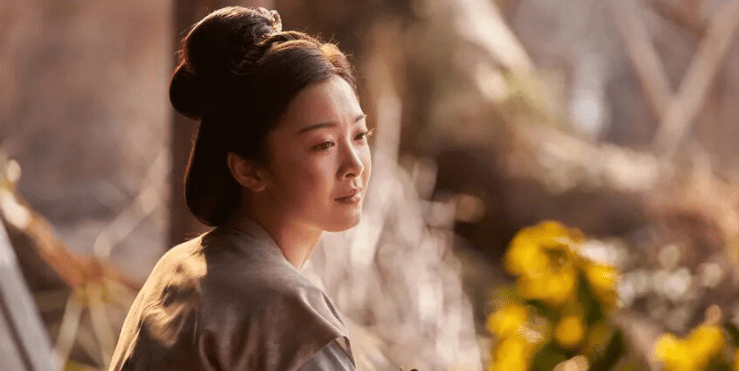
She finds an unlikely backer and investor in Jiang Chang Yang, to all appearances a corrupt official (Xi Lian in a fun performance). He is the Emperor’s Floral Envoy. From context, this means that his job is to collect treasures for the Emperor (and bribes for himself). He likes to take along two empty carriages when he goes to visit, for his hosts to fill up. Of course, there is more to him than that.

Flourished Peony is a start-up drama, a businesswoman drama that shows a woman succeeding against all odds to become wealthy and happy. This is its own genre, in contrast to Imperial Court intrigue or harem dramas. Other examples are The Story of Pearl Girl (2024), directed by Xie Ze and Romance on a Farm (2023), directed by Hong Lin.
One big difference to other genres is that Mu Dan is a commoner, a merchant. The heroine is wonderfully free of many constraints that bind noblewomen. She gets to drink wine straight from the jar in celebration, yell at a man and force him to kowtow and, most of all, drive a hard bargain and quibble about profit shares.
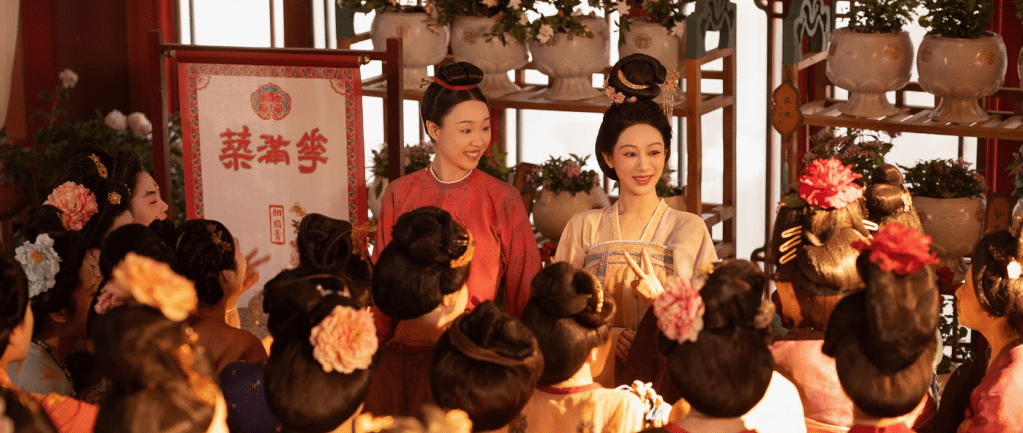
There is such a joy and vibrancy in how Mu Dan approaches life – like the wild dwarf peonies she gathers in the mountains that bloom in adversity, while the cultivated peonies in the backyards of the nobles seem to shrivel up and die if you so much as breathe at them wrong. Her enemies manage to take her business from her something like three times, and each time she turns the situation around in her favour, fights, buys or bargains her way back and triumphs. Because she’s not only smart and talented at money making, she also has a mindset that looks for the opportunities in every setback.
“It doesn’t matter. I will get it back,” she says more than once, while her friends are stressing out. Having almost died several times, she knows: “Life is all that matters.” As long as you are alive, you can bargain your way back. Life counts more than reputation, than possessions, than principles. This is a very “commoner” way of looking at things and most of the noble cast would look down on it, if they ever thought about it.
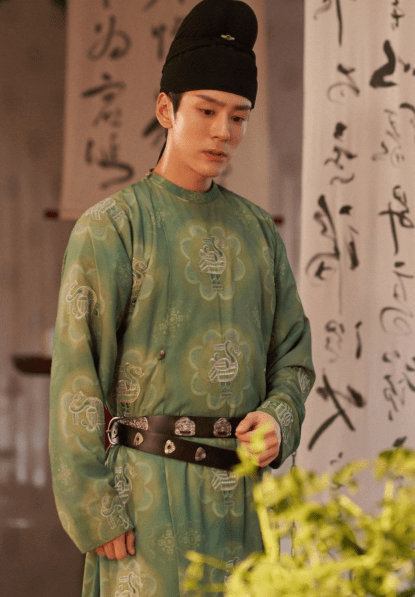
Mu Dan’s foil is her ex-husband Liu Chang. Miles Wei, usually cast as a hero, puts all the trembling rage he is capable of into chronicling Liu Chang’s descent into brooding obsession. Liu Chang is a lofty scholar, proud of his moral integrity. He pines for his long lost love Princess You Zhen. What that means is that he treats his wife badly for almost a year because he can’t forgive his parents for arranging the marriage for money, and he can’t forgive himself for going along with it. His answer is to show backbone by refusing to interact with his wife at all. This is the kind of futile gesture that will accompany most of his screen presence: It helps nobody and only ends up endangering innocents. He is rigid, unforgiving, uncreative. He is the exact opposite of Mu Dan who understands that life will sometimes live.
When Princess You Zhen, freshly widowed, rushes to his side, Liu Chang drops everything to be with her – only to realise that she is no longer the innocent girl he idealised. The first view he gets of her is when she gets out of a carriage, using a servant’s back as a stepping stone. Using her power to get what she wants, she tells him, is something she has learnt to do the hard way, in order to not get stepped on herself.

Liu Chang falls straight out of love with the Princess and decides to get his wife back. The fact that he can’t makes her suddenly into a symbol of everything he has lost. The more Liu Chang pushes her away, the more the Princess is determined to have him. The more she is determined to have him, the more Liu Chang refuses to have his life commandeered by others. Over the course of 32 episodes, this turns into an incredibly unhealthy dynamic: Liu Chang stalks his ex-wife, the Princess has him followed and enacts revenge on Mu Dan whenever she catches Liu Chang at it. Mu Dan always bounces back. In the end, Liu Chang gets his leg broken by his annoyed future father-in-law, Prince Ning, and is forced to marry into the family.
“I am just like Mu Dan”, he complains bitterly about being completely at the mercy of his in-laws.
But he isn’t. Mu Dan accepts that things are currently the way they are, and she looks for creative opportunities to change them. Liu Chang holds stiff, trying to stop things that are already in motion by sheer force of his scholarly righteousness. Similarly, the Princess clings to Liu Chang, not because of who he currently is but because of the past he represents.
For both of them, it’s a way to act out against the lack of agency in their lives. Liu Chang and his princess, both incredibly privileged, have a wealth of resources to draw from to make happy lives for themselves and others. The only thing they can’t have is the past. This is what they could have learnt, had they ever looked at Mu Dan and seen her worth.
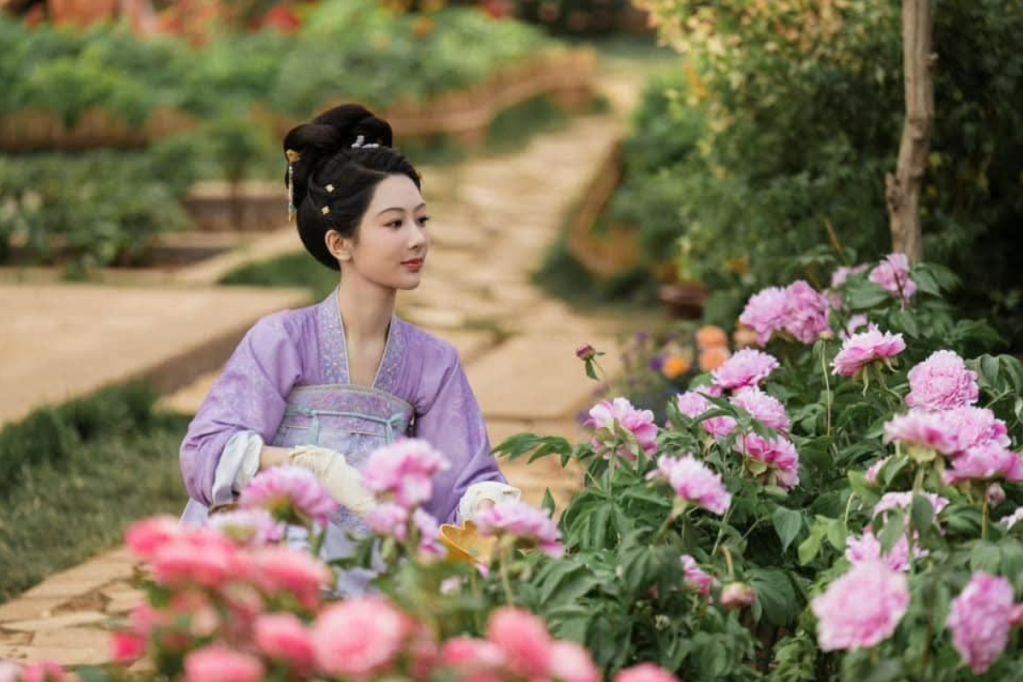
The Empire belongs to the common people, this series seems to say, the Empire thrives because the people live, wholeheartedly grabbing opportunities as they see them. It is this vibrant root of society that also allows all those precious noble and scholarly peonies to bloom and flourish.
 A Damn Fine Cup of Culture