
Welcome to Six Damn Fine Degrees. These instalments will be inspired by the idea of six degrees of separation in the loosest sense. The only rule: it connects – in some way – to the previous instalment. So come join us on our weekly foray into interconnectedness!
Last time I followed up on a piece on A Damn Fine Cup of Culture, about films we remember from our childhood, I went for the epic, exciting, but relatively grim fare of Once upon a Time in The West. The foundation of my lasting love of spaghetti westerns, but arguably entirely age-inappropriate. On the whole, though, most of the films that stand out vividly from when I was a kid, were rather more cheery affairs. There were Laurel and Hardy shorts, Disney’s latest (or earliest) take on princesses, but preferably talking animals. Song and dance numbers: essential.
“Gentlemen Prefer Blondes was in heavy rotation at our house when my daughter’s age was still in the single digits,” writes Laura Boyes in her smashing essay on the film. “She enjoyed the strong friendship between the two powerful female characters (much easier to understand than the romances), the brassy color, the songs, and the comedy.” And so it was for me, at that (and, frankly any other) age. And as we discussed on the podcast, way back in 2020, Monroe and Russell were the perfect ‘princesses’. Plucky, brash, independent, glamorous. There were romantic interests in the film, of course. But they were not the point, in the same way the prince who saves Sleeping Beauty ought not to be the point. It was all about their adventures, the way it should be, at least according to a little girl who was barely aware that ‘romantic love’ was anything more than an abstract concept that would, at some point, become relevant for some obscure reason.
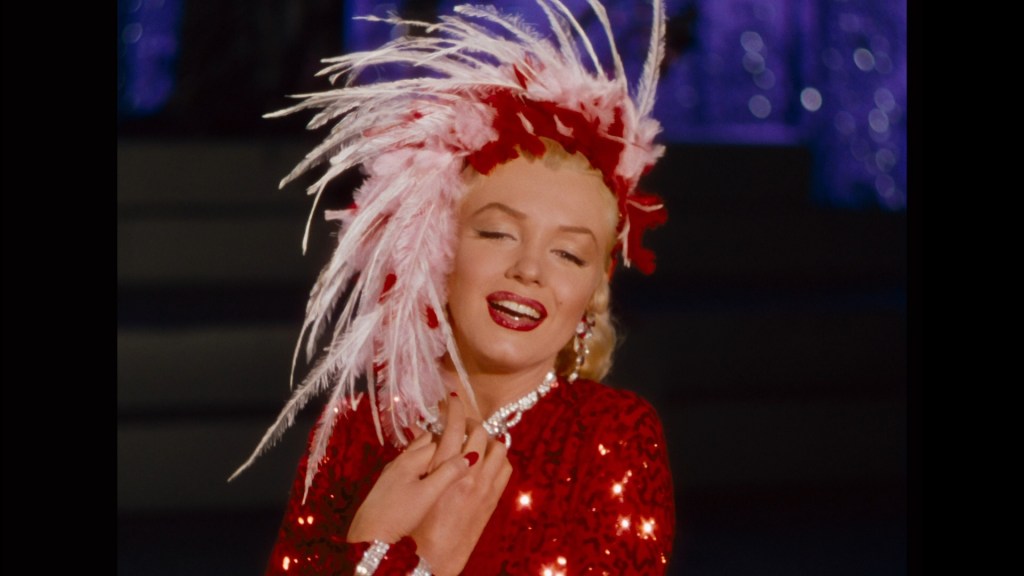
Blonde bombshell Lorelei Lee (Marilyn Monroe) wants to marry a millionaire. She’s found one, in Gus Esmond jr. (Tommy Noonan), whom she has duly wrapped around her little finger. Problem is: his father, predictably, is dead set against such a union. As Lorelei, who is in her own way rather cannier than her demeanour would suggest, wants rid of the sort of fatherly interference that might end her prospects, she decides to go on a European adventure with her friend (doubling as chaperone) Dorothy Shaw (Jane Russell). And while Lorelei’s behaviour is under a microscope due to her association with Gus, Dorothy makes it quite clear she is under no such restrictions. She wouldn’t mind a shipboard romance. (Or two. Or perhaps more, the entire Olympic team are on board after all.) She ultimately decides on the “tall dark and handsome” prospect of Ernie Malone (Eliott Reid), but he may turn out to be something other than he appears.
Anita Loos’ original story, as it was written in 1925, is set in the “bathtub gin” era and deals with the relative liberation (or perceived hedonism, depending on the commentator) of women of that time. Howard Hawks’ 1953 film transports it straight into the ’50s, a time that was significantly more circumscribed, and yet it still manages to retain some of the sharpness of its satire.
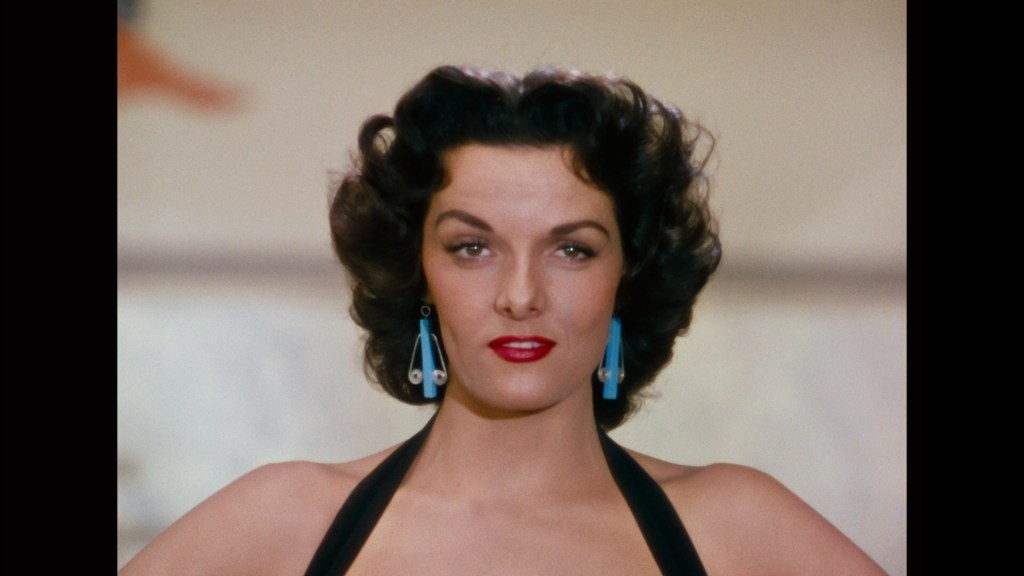
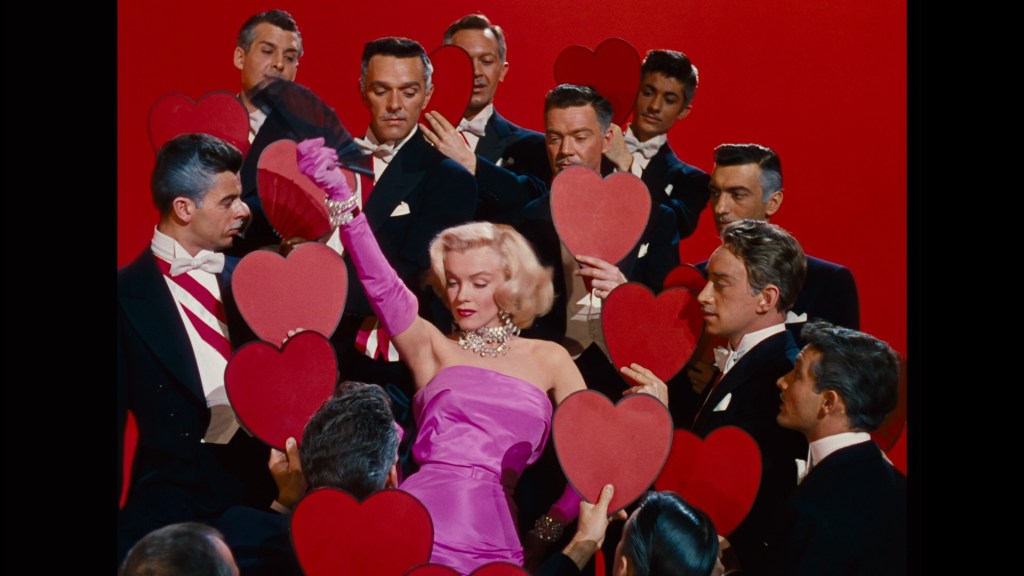
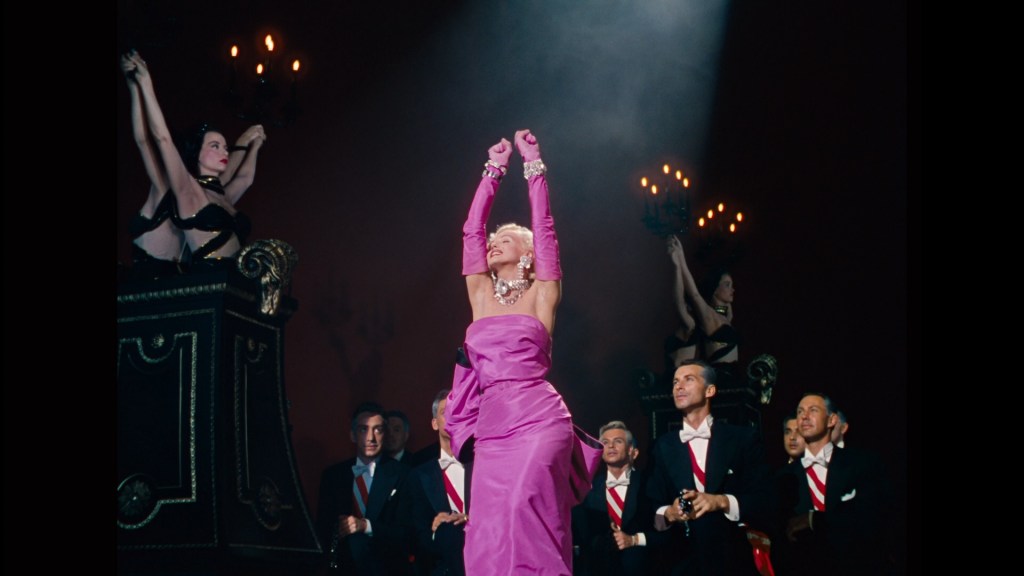
The costumes are restrictive, never show too much skin, or even allow much movement at all. The Schiaparelli dresses very much suggest sculpture, rather than flesh and blood. The glorious strapless pink concoction that was later referenced by Madonna in her music video for Material Girl is perhaps the most famous. But it’s pretty characteristic that most of the dresses, though form-fitting, cover the women from the neck all the way down to the ankles. There is a distance, too, in the mis-en-scène. Note the scenes in which Monroe performs, and Gus gawks at her from the audience. They don’t even share a frame. In a way, she is as unapproachable as a statue, and her allure lies purely in male projection. Not actual availability.
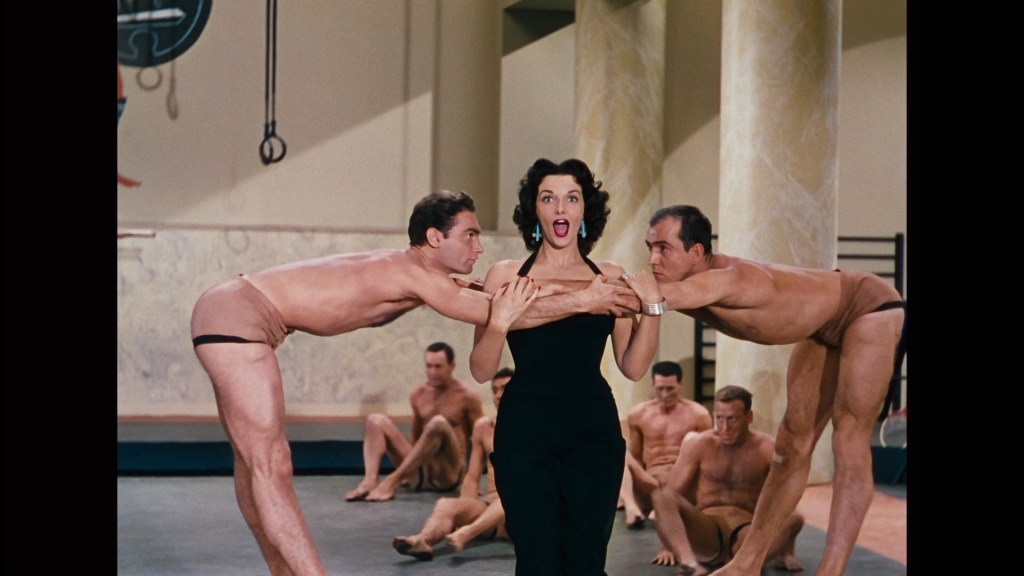
Despite its attempts at making this sex comedy’s plot as prim and proper as possible in a heteronormative sense, in many other ways the film is queer as all get-out. There is a scene in which Russell dances around in an arresting black catsuit, surrounded by athletic gentlemen in beige swimming trunks – and nothing else – in which the self-containment of the group of men is telling. “Is there anyone here for love?” sings Russell, while the men flex their muscles and do their exercises, seemingly unaware of her existence let alone her allure. It is a marvel that has to be seen to be believed: it is 1953, and this astonishing musical number made it into the film. It’s a signature set-up for the supremely gifted, and highly influential, Jack Cole: “I didn’t do the big musical numbers” Hawks would relate later, calling Cole “one of the best [dance directors] there is”*. So while Hawks might have been the main director, Cole directed the song and dance numbers, including the famous Diamonds are a Girl’s Best Friend. Their quality, and his own clear defiance of the suffocating norms of the time, still makes them sparkle to this day.
For all the plot’s romantic entanglements, the friendship between Dorothy and Lorelei remains the core of the film. It reads as genuine, and despite the many marketing efforts to whip up a perceived rivalry between the two, the relationship between Russell and Monroe in real life was warm. Though the role of Dorothy in the play and on Broadway was much smaller, the film gives the women’s parts more equal weight, in light of Russell’s more established star status, emphasising a firm female friendship which is not regular fare in classic comedies, and is very refreshing.
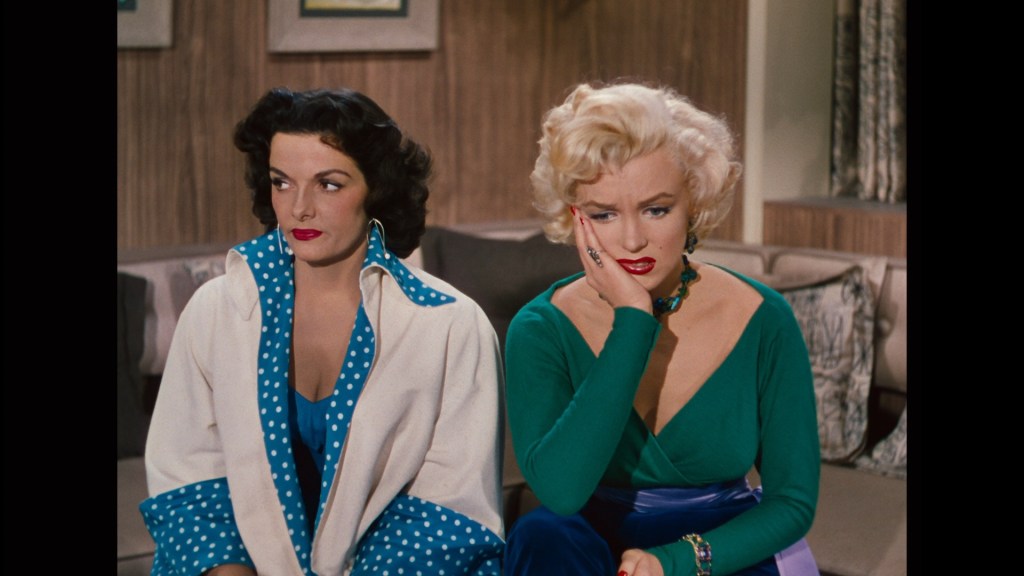
The film has stuck with me, and as my interest in movie history grew, so did my appreciation for this campy, brash, plucky Technicolor gem. And although I have no idea what my mother made of my nine-year old rendition of Diamonds are a Girl’s Best Friend, let’s be honest: for all their insistence on pastel-tinted fairy-tale romance, security for Cinderella and Aurora meant marrying money too, though for princesses this was presented as simply par for the course. Surely, there’s not much more morality, let alone liberation, in that message either. And it was as late as 1991, when a deeply literate animated protagonist, with a burning ambition to expand her horizons, was reduced to choosing between an irascible quadruped – albeit with a charming entourage of singing household items – and an actual monster. So however one might feel about propriety in children’s fare, these pastel princesses were never permitted to be as disarmingly frank about such matters as our Lorelei Lee, camp though she undoubtedly is. “Zanuck believed in colour,” Hawks would later comment, slightly sniffily, to Peter Bogdanovich. “I like pastels. The Fox laboratory was all geared up for colour – you got colour that really came out and hit you – there was no sense in trying to dodge it.”* And, truth be told, some of us might not necessarily want to, Mr Hawks, at nine, or any other age.
Sources:
*Hawks’ quotes are from Who The Devil Made It, by Peter Bogdanovich, Ballantine Books, 1997
- Also do check our Alan’s post, on the unspeakable Charles Coburn.
- Stills from Gentlemen Prefer Blondes (1953), rights holder: 20th Century Fox / The Walt Disney Company.
 A Damn Fine Cup of Culture