So many video games are about escapism – but this doesn’t mean that the worlds we escape into when we play are necessarily better worlds than the one we inhabit. No, when we pick up that controller, we often find ourselves in situations that are brutal, life-or-death: warfare, disaster, the apocalypse. It’s therefore not surprising that perhaps the most common player interaction in games is killing – or its flip side, dying. Obviously, though, that’s partly beside the point: in a virtual world, death means very little, whether you’re the one doing the dying or the one who’s killing. One Nazi, zombie, mutant less – or, if it’s the Nazi, zombie or mutant who won that particular fight, you reload and get another chance at killing rather than being killed. The worlds we escape to may not be better than ours, but they’re exciting, and the reversibility of death is obviously a plus.
But is this all these worlds can be: places where we either kill or die, over and over?
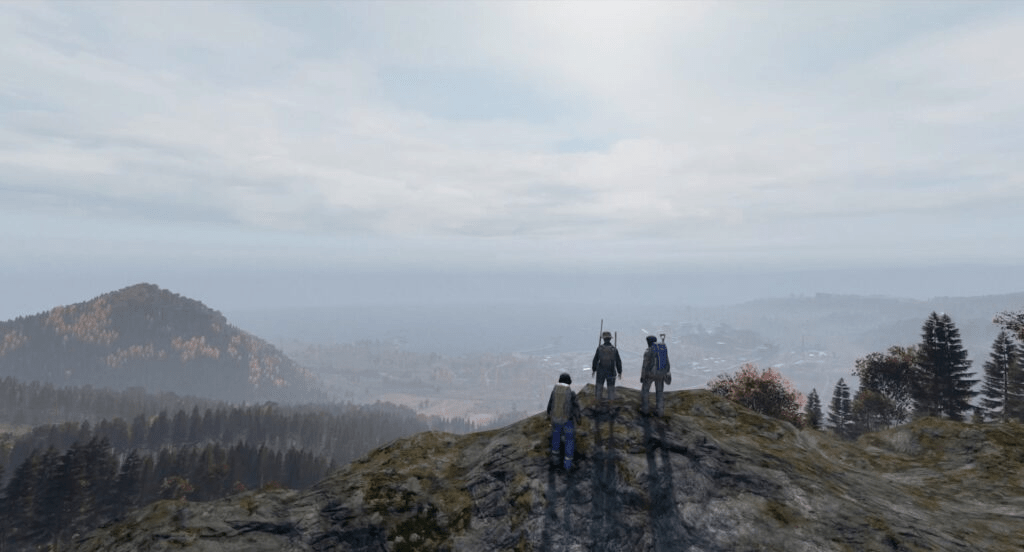
Knit’s Island (2023) is a documentary that stands out first and foremost because it was filmed (almost) entirely in a game, namely the survival game DayZ. Let’s make that more accurate, and more of a mouthful: as Wikipedia puts it, DayZ is a “multiplayer online survival video game”. It puts you in a fictional post-Soviet country, the Republic of Chernarus, after the kind of outbreak has occurred that always seems to occur in such games, where you try to scavenge goods and weapons in order to survive against the ravenous, aggressive infected. But you don’t just face up against zombie-likes: you’re in this world with other players, up to 127 of them – and they too are after those same goods and weapons.
You can imagine what this tends to do for human interactions in the game. If you see someone armed with a gun, you do the mental calculations: are they friend or foe? Do they have something that you need: better weapons and ammo, food, medical supplies? Aren’t you probably safer if you try to take them out before they even know you’re there? It’s no surprise that the servers on which DayZ are played are generally of the dog-eat-dog kind, because seeing other players as anything other than enemies is risky. It’s the good old Prisoner’s Dilemma, just with zombies and guns: the likelihood of others being friendly is low and the risk of trying to cooperate is high, so most people act accordingly, and this in turn ensures that other players become even more likely to act hostile and kill you outright.
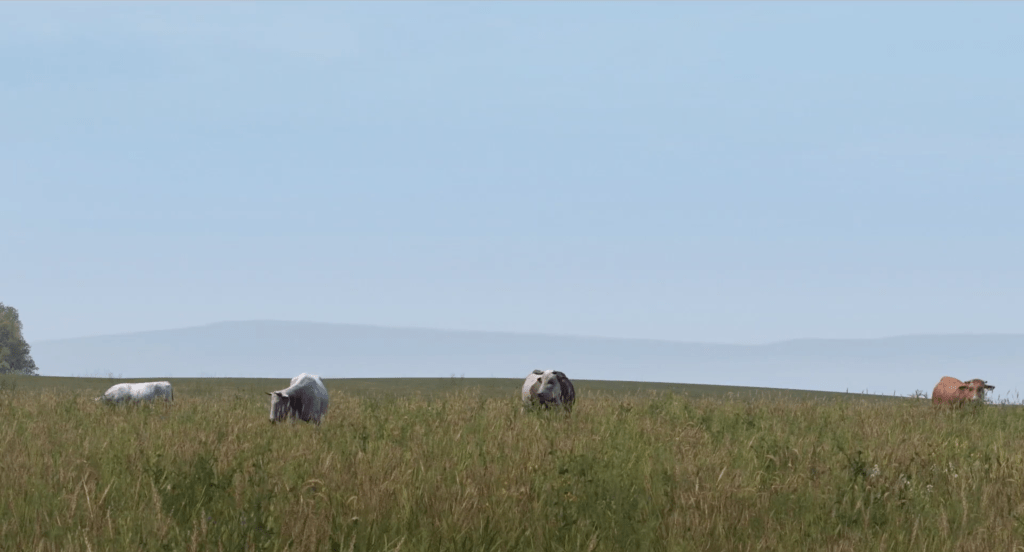
Knit’s Island drops a group of French filmmakers into this world. They seek out the players on the same server (for non-players: imagine this as a self-contained version of the world running on one computer) as them and approach them in a non-threatening manner, telling them what they are doing: making a film about the community of players in this apocalypse. Sometimes they’re met with the expected violence – what better way to get resources than in a one-sided fight against some dudes with French accents who won’t even defend themselves? Sometimes, however, they get lucky and the players they run into are as curious about them as the documentarians are about the people who have spent a long time in DayZ.
Here’s what people who don’t play games, or at least not multiplayer games, may be unaware of: while you find the expected lone wolf-style types in online gaming, there are many others who seek community (sometimes called clans or guilds, depending on the game). Sometimes they do so in order to be better at killing, and indeed, the first group we see the filmmakers interact with isn’t too dissimilar from the psychotic raiders of a Mad Max movie, both in their behaviour and outfits. They find both enjoyment and companionship in hanging out together in order to better terrorise other players regardless of whether they’re a threat, killing for fun rather than defending themselves. They enact something between a power fantasy and nihilistic anarchist cosplay. If the game gives you guns, what else are they supposed to be for than shooting people?

Other groups, though, are more companionable: these, too, are generally armed to the teeth, but they spend their time planting pumpkins and mushrooms to feed their group, or they join pacifist communities or hang out in churches where they listen to what the more roleplay-oriented players have to say. One of these is the Reverend Stone, a player from Finland who preaches the word of Dagon and who seems to be the friendliest person in Chernarus. The filmmakers also encounter a friendly couple that are romantically involved in real life, who hang out in Chernarus together while sitting side by side at their computers, and a Canadian playing from his home on Table Mountain in South Africa. Many of these know each other from playing DayZ for years, and at some point the game becomes as much about hanging out with each other as it does about killing infected and players to survive in the post-apocalypse.
And then, halfway through the making of Knit’s Island, the COVID pandemic hits – and for many of the people we’ve been hanging out with, DayZ is no longer just something to do in the evenings for fun: it’s pretty much the only place they can safely meet and socialise and interact with others. Before, real life and virtual life already intersected to some extent, but the overlap now becomes more pronounced. The makers of Knit’s Island don’t verbalise this as a central thesis: instead, they ask open questions, in heavily-accented English (so they are sometimes misunderstood) and then let the subjects of their film talk. The effects of the pandemic are felt around the edges of the conversations. It is in the scenes where the denizens of this place meet and hang out, shoot the breeze, go on virtual hikes into the unknown and beyond the edges of the map, that Knit’s Island is most fascinating. We’re used to stories about virtual realms being about isolation, and some of the characters we meet seem like their private lives mostly revolve around DayZ, but even for non-gamers it is clear that relationships in a game such as this one have a reality to them, in particular at a time when social contact in the real world is reduced to a minimum.
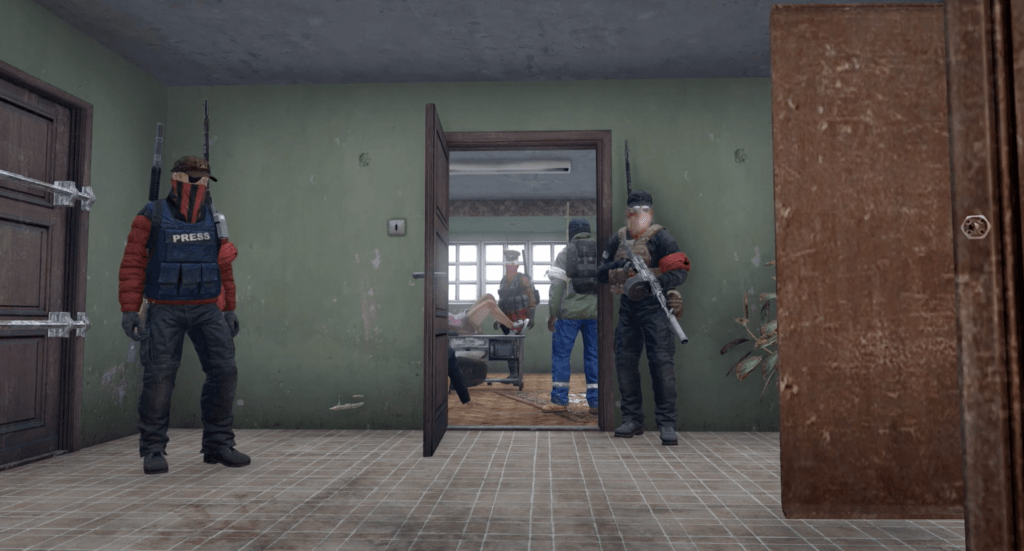
While DayZ does sport a realistic aesthetic, it is a game that, at the time Knit’s Island was made, had been out for years. It is often janky and buggy. More than that, game systems are always an abstraction from the real world, allowing for a small set of formalised interactions. As a result, there is an uncanny valley effect to life in Chernarus, where things look reasonably real on the surface but are strange when you look at them more closely: cucumbers grow in a matter of minutes, deadly wounds can be treated with bandages, there are holes in the ground that take you underneath the map into a psychedelic realm (that is, in effect, just the graphics engine showing its limitations).
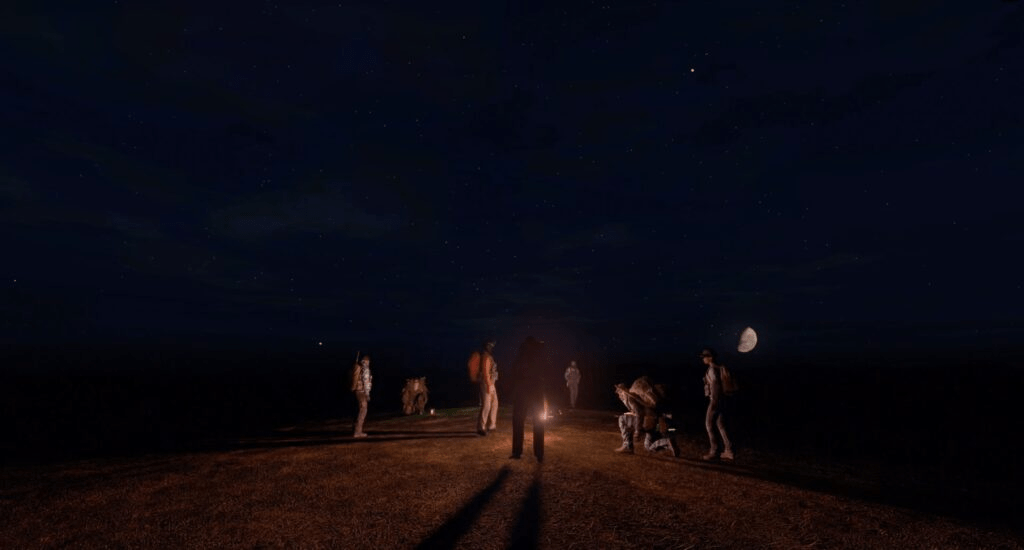
However, these uncanny deviations from reality don’t make this ethnographic expedition into a virtual world feel less real: on the contrary, they serve to highlight the ways in which socialising is socialising, whether it’s in a pub, a club or a DayZ server. A scene late in the film shows this beautifully, needing no editorial comment: the player characters we’ve spent the last hour or so with meet up after a longer hiatus, not to kill infected or grow vegetables. They just sit around a campfire, listen to music, chat, and sometimes they’re just quiet together. One of them, the Reverend Stone, falls asleep in front of his computer – and likewise, the character sits slumped in his deckchair while the other player characters around him whisper, in order not to wake him up. Other than all of them being decked out as survivalists, the scene is one that is familiar from every other late-night student party.
There is a bumbling shapelessness to Knit’s Island that can be frustrating at times: its makers, the documentarians Ekiem Barbier, Guilhem Causse and Quentin L’Helgouac’h, are curious, and their curiosity isn’t altogether directed. They just want to know about these people, so they immerse themselves in the world of DayZ for almost 1000 hours to find out what makes these people tick. Basically, they hang out with them and become part of the group. Sometimes, things happen, sometimes they don’t, making for virtual reality TV that is, however, much less scripted than actual reality TV. The apparent lack of direction can occasionally raise the question: where is this going? But, over time, it becomes one of Knit’s Island‘s great strengths: it doesn’t have a particular point to make about online gaming or virtual communities, about isolation or the pandemic’s effect on people’s social lives. It is set in a virtual world, but over time what we see gains the immediacy of reality. The guilelessness of the filmmakers, their lack of a thesis as they go into this experiment, allows stories and themes to form of their own. We get to know these people, we see them at a time when real-world human contact is reduced drastically, and we recognise how they seek out each other to do what people do: form social bonds, express themselves, feel less lonely. The structures of the game lend an almost Brechtian quality to this at times, but the virtual strangeness makes us recognise the familiar in these characters, as they try to survive in a world that can be indifferent, even antagonistic, but that also gives them a quietly beautiful stage to try out a different version of themselves – one that, in the end, is perhaps not that different from the version that’s sitting in front of a screen, playing DayZ.
 A Damn Fine Cup of Culture