Remember those last few seasons of Game of Thrones, and especially the finale? How a series that started strong took a dive once it moved past the plot written by its original author, George R. R. Martin, and, to many of its critics, became not just mediocre but outright bad in its home stretch, turning complex, nuanced characters into caricatures of themselves?
I enjoyed Game of Thrones in its first few seasons yet also found its last third disappointing, but for me, that disappointment was rather abstract. I didn’t take the series’ nosedive personally. Sure, I would have preferred for it to remain good, but I didn’t end up hate-watching the final few seasons, I just disengaged and got what fun there was to be had out of the spectacle and the nonsensical plot developments, at arms’ length.
Sadly, this didn’t work for me with The Handmaid’s Tale.

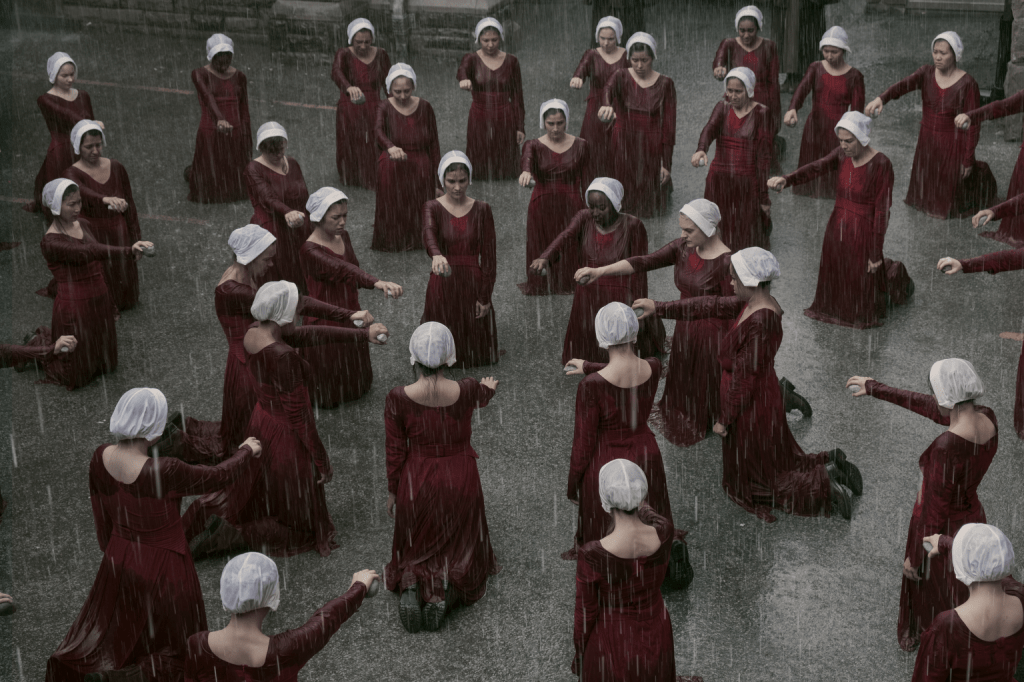
Mind you, the setup is quite similar: The Handmaid’s Tale started off in 2017 with what I’d consider a pretty much pitch-perfect adaptation of Margaret Atwood’s prescient novel. The cast was strong, led by Elizabeth Moss as the titular Handmaid Offred/June, and ideally supplemented by the likes of Joseph Fiennes and Yvonne Strahovski as Commander Fred Waterford and his wife Serena Joy, two perfectly hateful exemplars of capital-C Conservatives with a reactionary Christian slant, as well as actors such as Ann Dowd, Madeline Brewer, Samira Brugel and many others. This series gets what Atwood is doing, I thought at the time, it understands how this story and its characters work, and what’s more, it highlights the many ways in which the 1985 novel has only become more timely. (It is sadly fitting that Hulu’s adaptation started and ended during Trump presidencies.)
Sure, I was surprised that the series creator Bruce Miller talked of having outlined a story that would require six seasons to tell, going well beyond the original material, but at least in the first season I gave him and his team the benefit of the doubt. They understood the material, obviously, so surely they knew what they were doing, right? The second season didn’t immediately give me cause for alarm: it was still good, just not great, if perhaps less thematically on-point. Its main problem was an over-reliance on plotting; Atwood’s novel has a plot, but it is more focused on themes and on the characters’ lives in the hellhole that is Gilead, the horrific offspring of a United States of America having slid headlong into misogynist theocracy, with plot serving theme rather than the other way around. Oh, and yes, it started to suffer from an over-reliance on putting Moss’s Handmaid at the centre of things, not as a lens through which we experience Atwood’s darkly satirical social critique but as a hero. The hero, in fact. But Moss is nothing if not a good actor, so it was understandable that they’d have her carry much of the weight of the story. Right?

As the series continued and it began to use the title character differently, Moss and her character became more and more foregrounded. Sure, the title already indicates that this is the Handmaid’s Tale – but in the novel, the protagonist stands in for an entire society of women enslaved and made into broodmares for a theocracy claiming to act in the name of God. The novel is not a hero’s journey. The series changed this: over time, June becomes a Spartacus-like character, a figurehead for the resistance against Gilead and even an action hero that drives this resistance. And as June becomes more central to everything, the characters around her are sidelined more and more. Increasingly, she feels the tragedy of Gilead more than anyone else, she determines the course of the story more than anyone else, and Moss gets more and more of the juicy scenes and badass slow-motion closeups, to a point where it could serve as an especially potent drinking game: slo-mo close-up of Moss? Do a shot.
Over time, and especially in the final season, the series did try to address June’s more ambivalent aspects and her flaws, but overall The Handmaid’s Tale does little more than pay lip service to these elements of the character. Those closest to her, especially her husband Luke (O-T Fagbenle) and her best friend Moira (Samira Wiley), who is first held as a Handmaid and later made into a ‘Jezebel’, a sex slave to be used for pleasure by the hypocritical leaders of Gilead, get to criticise June, but only in order to forgive her and defer to her, because she is the title character, she is the hero, and any criticism must come second to that – at best. As The Handmaid’s Tale moved into its later seasons, empowering women meant empowering June first and foremost, and making Moss and her performance the absolute centre around which everything else must circle. (While I doubt that it was a conscious choice, it is even more unfortunate that many of these characters and actors orbiting the June sun are people of colour: the series’ version of female empowerment is white first and everything else is subservient to this.)
While the series’ increasing, and in the end practically absolute, centring on June, and on Elizabeth Moss as the Handmaid-turned-Glorious Leader (something that, based on her writing, Margaret Atwood might have a sharply ironic thought or two about), is grating, it may be a less fundamental issue. What truly sinks the series for me is how it ended up warping one of the central themes of The Handmaid’s Tale: motherhood. In Atwood’s novel, Gilead’s toxic fetishisation of motherhood is perhaps its fundamental evil: this is a world in which the Handmaids only matter because they are fertile, they are biologically able to bear children. They are revered for this, but only as bodies, and the actual women whose bodies these are, well, they are nothing. They have no rights, no freedom, no role other than to conceive, be pregnant and finally give birth, rinse and repeat. As bodies, they are protected from all harm; as people, they barely exist in the eyes of Gilead. At best they are sullied, flawed females, redeemed by serving as broodmares. And then there are the Commanders’ wives, who take part in the ritualised rapes of the Handmaids: they are symbolic mothers, they take on the children born of systematic rape as their own, in the eyes of Gilead they are the real mothers of these children. There are a handful of other roles women are permitted in Gilead: the Marthas are unmarried or infertile women who have been assigned the role of domestic servants, while the Jezebels are forced into prostitution, existing solely to satisfy the carnal urges of the Commanders, and the Aunts are the sadistic disciplinarians, often believers in a fundamentalist strain of Christianity, who indoctrinate the Handmaids.

The only women who matter in Gilead, in one sense or another, are mothers: actual, biological mothers and the Commanders’ wives who usurp the role of mother. The novel’s point of focus (whose real name may or may not be June in Atwood’s original story) was already a mother before the rise of Gilead, but she was other things beside this and a wife. Gilead can only conceive of them being one thing: functioning wombs to conceive and bear the Commanders’ children. The Handmaids are mothers, and then they are not even that, while the wives are mothers-in-waiting or the mothers of children stolen from their biological mothers. There is a hierarchy in this – the wives are privileged, the Handmaids are enslaved -, but each only exists to become, and then be, a mother. In Hulu’s adaptation, the female characters have identities outside motherhood. We learn about June’s work as a book editor for a publishing house, others were waitresses or teachers or judges or writers. But as the series went on, it developed a fetishisation of motherhood of its own: sure, it seemed to say, these women had all kinds of jobs, they were free to be whatever they wished to be – but motherhood trumps them all. So many of the characters at the centre of the story are defined by whether they are mothers or not. And again, June’s motherhood takes precedence. So much of the later seasons turns around June’s need to find and free Hannah – and this is not only her own motivation, and that of her husband Luke, it comes to drive the overall plot, up to key military actions by the remaining military forces (in exile) of the United States. What allows June to become the determining force in the fight against Gilead and the actions by the resistance is her motherhood: the prime purpose is that Hannah must be freed. Most of the other present and former Handmaids who have key roles in the story are also mothers first and foremost. Moira isn’t, and while she is given the screen time of a key supporting character, there finally is little to her beyond being June’s sidekick and occasional voice of conscience (though Samira Wiley’s acting makes Moira stand out more than the writing, which barely develops her in the latter half of the series). Margaret Atwood’s novel was about women in a misogynist system that only gives women meaning in one form or another of motherhood; the TV adaptation ended up giving women their main meaning in motherhood.
This motherhood fetish takes the plot on some wild detours that only serve to undermine the series’ beginning. Serena Joy, Commander Fred Waterford’s wife and willing accomplice in the enslavement and repeated rape of Offred, becomes pregnant later in the series, something that is seen as akin to a biological miracle, and The Handmaid’s Tale uses this in order to redeem the character. Admittedly, this particular plot development isn’t without ambivalence, but it still serves to show that while Commander Waterford gets his well-deserved grisly end at the hands of former Handmaids, Serena Joy, who not only was entirely complicit in June’s repeated ritualised rape but indeed is a sort of ‘mother’ to the idea of Gilead, becomes worthy of some sort of redemption due to becoming a biological mother herself.
In all of this, it is ironic that June’s continued endeavours to get her daughter back (after she’s been stolen and indoctrinated as the child of a Commander and his wife) become a major focal point of the last few seasons, for June as an individual as much as for the resistance against Gilead, but the logic of TV production make it so that this plot strand cannot be resolved or even moved much: back in 2019, Hulu bought the rights to The Testaments, Atwood’s sequel to The Handmaid’s Tale, in which Hannah, still living in Gilead, is set to be a main character. For all of the stylisation of June into symbol, leader, icon of biological and therefore, for the series, good maternity, her agency is sadly restricted by the necessities of sequelisation; and perhaps this means that, once Hulu’s The Testaments begins, we’ll get more chances to see Elizabeth Moss as the Mother Of Them All, striding into battle against Gilead in slow motion, while her entourage gets to cheer and support her in the background. After all, this is pretty much what those supposedly necessary six seasons have made out of the character and the actor. Oh Mother.
 A Damn Fine Cup of Culture