It would be futile to assign a genre to Evil Does Not Exist, beyond the most generic catch-all there is. Yes, the film is a drama, but what does that mean? To be honest, the more I think about Ryusuke Hamaguchi’s follow-up to the award-winning Drive My Car (2021), the less I can shake the impression that it is a horror film.
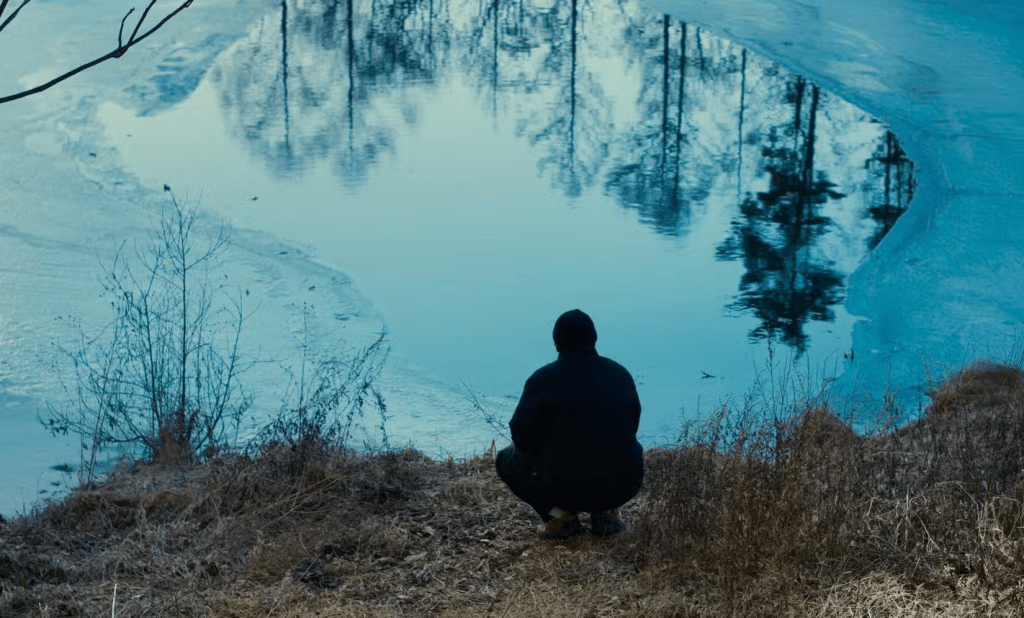
To be clear: this doesn’t mean that Evil Does Not Exist belongs in the category of J-horror, with films such as Ring, Pulse or Audition. A little girl features prominently in the film, but she does not clamber out of wells or TV sets, and there are no ghost, demons or curses… at least not in a traditional sense. But by the end of Hamaguchi’s film, I couldn’t shake a sense of almost cosmic horror, of mankind having brought upon itself the anger of a world that will return on us whatever we visit on it – though the ones who get to suffer its wrath aren’t necessarily the ones who deserve it most.
On paper, Evil Does Not Exist wouldn’t seem to be this kind of film, at least to begin with. It is set in Mizubiki, a peaceful mountain village, where a company is hoping to develop a glamping site, a sort of glamorous camping resort where guests get to enjoy the beauty of nature without any of its inconveniences. When Takahashi (Ryuji Kosaka) and Mayuzumi (Ayaka Shibutani), the representatives of the company, come to introduce the project, they do not expect the extent to which the village’s inhabitants are opposed to the project. The locals pick apart apart the glib, superficial PR concessions to nature that the two present to the community members, showing these concessions to be little more than greenwashing. Where it matters, profit comes before sustainability.

Also at the meeting is Takumi (Hitoshi Omika), who describes himself as an “odd-job man”. He is obviously smart and perceptive, understanding the needs of the locals and the environment they inhabit. Takahashi and Mayuzumi try to latch on to him, half in the hope of placating and winning over the locals, half in a genuine desire to bring the project more in tune with the environment. Takumi, who lives in the woods with his eight-year-old daughter Hana (Ryo Nishikawa), is quietly forceful in his convictions and his understanding of what it means to cohabit with nature – and this authenticity makes a convert of Takahashi who, after spending barely a day with Takumi wishes to leave behind his job and his big-city life with their cynicism and jadedness. What Takahashi does not understand, though, is that his idealised perception of Takumi and his rugged life in tune with the environment is naive. In a way, his view of the local man is no different from the hoped-for tourists that would come and pay to spend time at the planned glamping site: what he sees is a romantic image of an authentic co-existence with nature. What he does not see is the sacrifice this existence requires, something that Takumi is keenly, fatalistically aware of.

Horror cinema tells the story of man vs nature in many variations. In those films, there are often clear protagonists and antagonists, though the roles are not always distributed the same way: in Jaws, the shark is clearly the villain, and it is defeated by our hero, Chief Brody, while in Swamp Thing, Alec Holland becomes the embodiment of nature, while man is very clearly the bad guy. Evil Does Not Exist makes it clear in its title, which is to be taken at its word, that this is not a story of heroes and villains: Takahashi and Mayuzumi, the representatives of the company hoping to exploit nature (while not being seen to be doing so too obviously), aren’t antagonists, nor is Takumi the hero of the tale. It isn’t even the case that nature is clearly, unambiguously good, defending itself against the evil of being abused in the name of profit. It is this absence of a moral framework that finally evokes a sense of dread, because while Evil Does Not Exist portrays the world as one governed by the principle of cause and effect, there is a blindness to this principle. When man disrespects nature, nature hits back – but it isn’t the company putting a septic tank where its sewage will leak into the groundwater that will be made to drink the polluted water. It isn’t the hunter who has gut-shot a deer that is attacked by that deer. It isn’t punishment, it isn’t personal: it is simply cause and effect. Takumi understands this: water runs downhill. The ones who feel the effect are rarely the ones that have caused it. Takumi accepts this with a composure that is chilling: he even lets himself be made the instrument of this inexorable rule that gives the conclusion of Evil Does Not Exist its sense of dread, because humanity as a whole hasn’t yet understood this simple, pitiless rule. Water runs downhill. Whoever is downhill may very well drown.

P.S.: So why is this not a regular Criterion Corner post? It’s because while the film was released by Criterion, it is not a part of the regular collection with its numbered entries; it is released under the Criterion Premieres series, a selection of new films recently released at the theatre that is brought to physical media in association with the Criterion Channel. The selection of films is idiosyncratic and interesting, though the releases are more barebones than the usual Criterion standard. Will “(This is not a) Criterion Corner” become its own series of posts? Probably not, though I do have at least two other such releases waiting to be watched, Bertrand Bonello’s The Beast and the Ryuichi Sakamoto concert film Opus by Neo Sora.

 A Damn Fine Cup of Culture