Welcome to Six Damn Fine Degrees. These instalments will be inspired by the idea of six degrees of separation in the loosest sense. The only rule: it connects – in some way – to the previous instalment. So come join us on our weekly foray into interconnectedness!

“You can’t defeat people’s expecations.” ~John Boorman
It was as early as 1969, when John Boorman hoped to be able to film the Arthurian legends: Arthur and the Grail cycle had been a lifelong passion of his. However, at the time, the project was deemed too costly by United Artists, and so he was offered The Lord of the Rings instead, about which he even corresponded with J.R.R. Tolkien himself (already 77 by that point). But that venture, too, was deemed too expensive. It wasn’t until 1980 when he could finally start filming his big saga. In the intervening years he had made films such as the rather confounding Zardoz (1974) and the iconic Deliverance (1972), the latter of which received an Academy Awards nomination. His big fantasy film, which would put the pic back in epic, would turn out not to be Tolkien’s magnum opus, but Excalibur (1981), a loose adaptation of Le Morte D’Arthur by Malory (1485). The story should be familiar, although it differs from the more prevalent T.H. White adaptations (The Once and Future King was first published in 1958, and is also based loosely on Malory), such as the highly entertaining Disney animation The Sword in the Stone from 1963. In Boorman’s version, sorcerer Merlin (Nicol Williamson) acquires the magical sword Excalibur from the Lady of the Lake, and sets in motion a series of prophecies and schemes to make the (as yet unborn) Arthur Pendragon king. Baby Arthur’s dying father Uther Pendragon (Gabriel Byrne) rams the sword Excalibur into a rock, and only the true king will be able to extract it. And so Arthur (Nigel Terry) eventually becomes king, and recruits to his side the famous knights of the round table, such as Gawaine (Liam Neeson), Lancelot (Nicholas Clay), Leondegrance (Patrick Stewart), Perceval (Paul Geoffrey), and so on. Thus the land is healed for a while, until the iniquities of man (and Morgan le Fay) again pull it asunder.
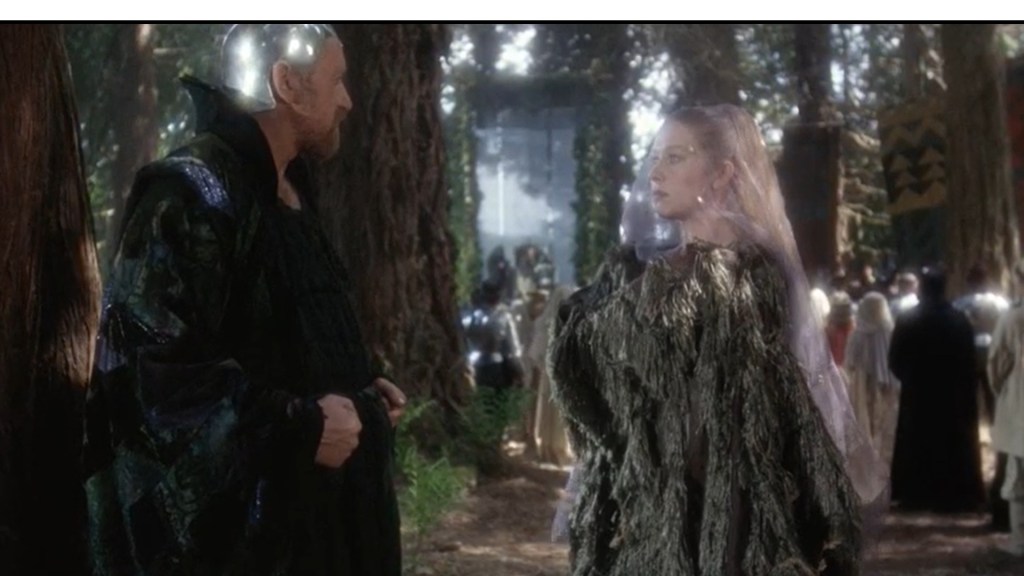
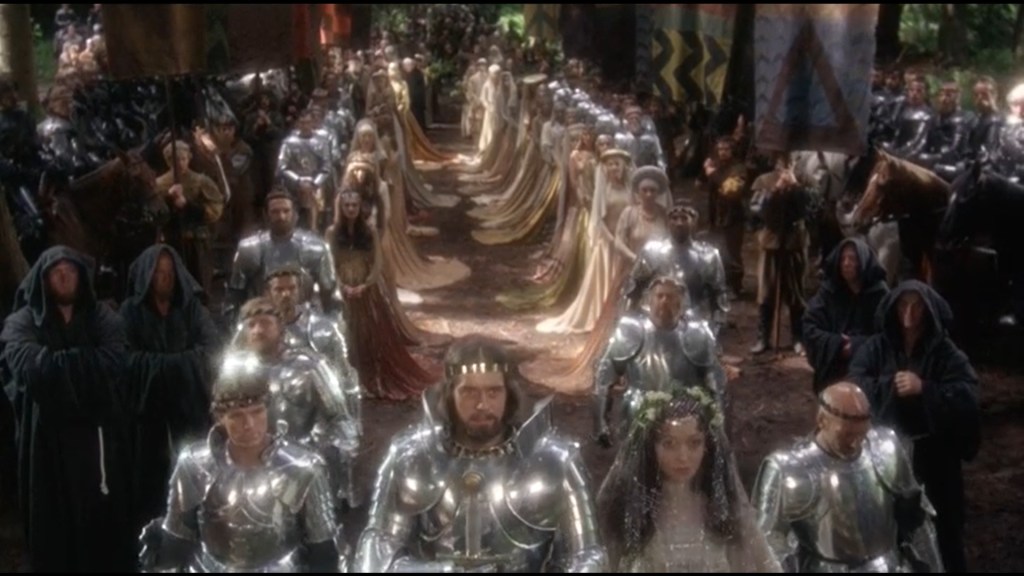
The film is replete with epic battles. As all the effects are in camera, the armour the actors are wearing is actual armour made by an actual armourer: the unparalleled Terry English. There are horses and battleaxes, plagues and privations, with some questing thrown in for good measure. Visually it is an absolutely stunning film, made moreso by the realisation that all of what you see on screen is quite real. No CGI, no greenscreens, and as much natural light as they could capture. It was shot in Ireland (counties Wicklow, Kerry and Tipperary as well as at Cahir Castle), where – according to a short documentary on the making of the film – it rained constantly. The camerapeople had to wait for the light, relight scenes to replicate the light and so on. A truly daunting enterprise. Boorman recruited, for his cast, relative unknowns. Mainly stage actors, as they were then, who are now recognizable stars of stage and screen. It started the film careers of Helen Mirren, Liam Neeson and Gabriel Byrne, to name only a few.
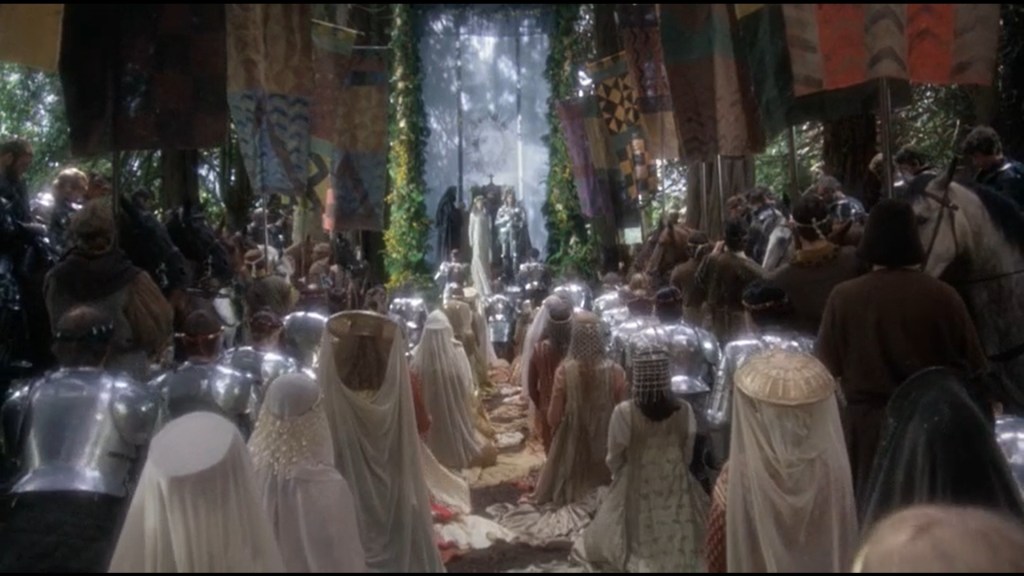
In that sense, much of the interest the film elicits comes from how it was all done. The story itself is not only thoroughly well worn, but it makes it seem like its characters are on rails. There is no logic to their choices, there is no agency. Fate will have its course, and when Guinevere’s adultery with Lancelot splits the knights into factions, the adulterous act itself is so wildly random as to be nearly preposterous, were it not for what we’ve all come to expect should happen. It is a sacrifice that is prescribed, with no discernible purpose. Thus Arthur’s realm rises and falls, decays and is reborn, without much rhyme or reason. Mainly, it appears, as a side-effect of the rivalry between two mighty sorcerers (Nicol Williamsons’ extraordinary Merlin, and Helen Mirren’s equally exceptional Morgan le Fay), who appear to simply crush the realm between them, through sheer intransigence.
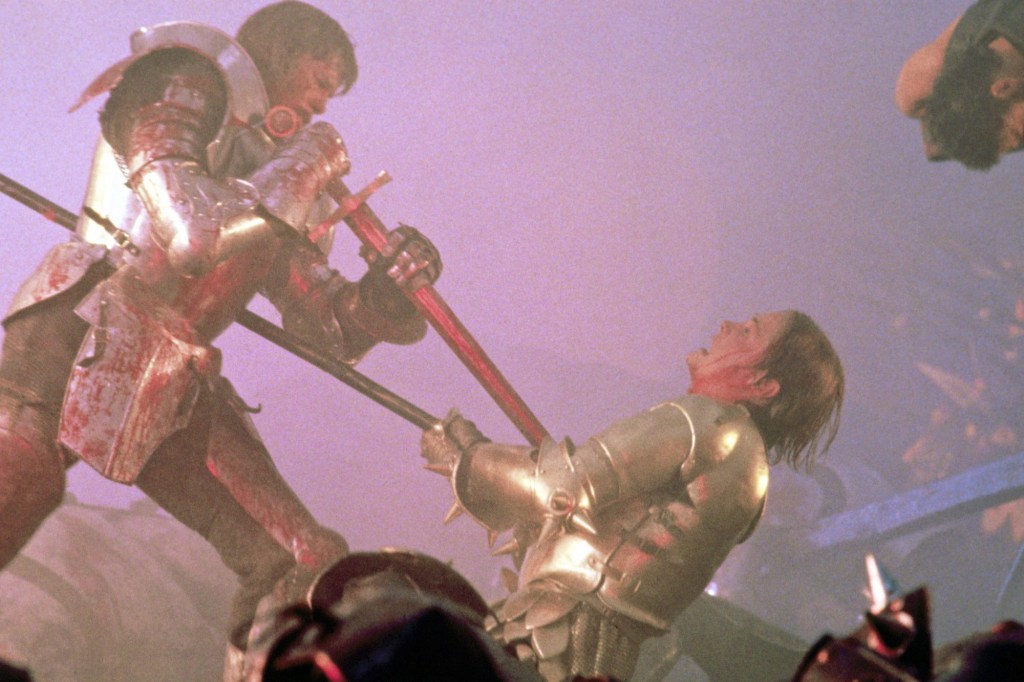
Which is rather a circuitous way of saying that for all its undeniable artistry, visual splendour and grandeur the film is a bit of a mess. It is also, by necessity, rather humourless. Most of the quips come from Williamsons’ Merlin, who displays a wry sense of humour. Otherwise everyone takes the film quite as seriously as it takes itself. Be that as it may, it is unquestionably imposing. No matter, if you can’t quite tell the knights apart, through a sheer lack of organization in the choreography of the battle scenes. No matter the perpetual fog, the mud and the murk, the clutter and the blood. These are armoured men bashing at each other with great big clangs and that, for its faults, remains thoroughly impressive.
All screen captures © Warner Brothers Entertainment Inc.
 A Damn Fine Cup of Culture