Welcome to Six Damn Fine Degrees. These instalments will be inspired by the idea of six degrees of separation in the loosest sense. The only rule: it connects – in some way – to the previous instalment. So come join us on our weekly foray into interconnectedness!
I didn’t like Oppenheimer. That’s largely because I didn’t understand the second half of the movie, wherein, somehow, Oppenheimer gets the upper hand over Strauss. I didn’t understand what was there for the getting, nor did I understand what the bone of contention was. To the very small extent that I got the situation between them, I didn’t much care. As I understood it, it took a smallish statement by the Rami Malek character during the hearing to push Strauss off his pedestal. And that was it. What had just happened?

To be fair, it’s the only Christopher Nolan movie from which I came away feeling that I had just seen a good but not great movie. My judgement was thrown into relief by very good production and cinematography, by an inspired cast and a sense of impending doom pervading the whole story. Yes, I love seeing Cillian Murphy, Robert Downey Jr, Emily Blunt, and I have a soft spot for Louise Lombard, a criminally underused British actress, who has so few scenes, and short ones at that, that I longed for her to turn up again and take centre stage.
There is the aspect of the story laid out clearly in a movie like this, because it must be, to some extent, a bio-pic: the scientific work, the theoretical framework for the development of the atomic bomb, its manufacture, its detonation. It’s all there, and it’s very well done, in the usual Nolan style that we have all come to like and admire. I also liked the sparring between Oppenheimer and the army, where you never know who is the cat and who is the mouse. I was horrified that Oppenheimer, with all his genius, was also some sort of half-baked womanizer who didn’t quite know how to go about womanizing.
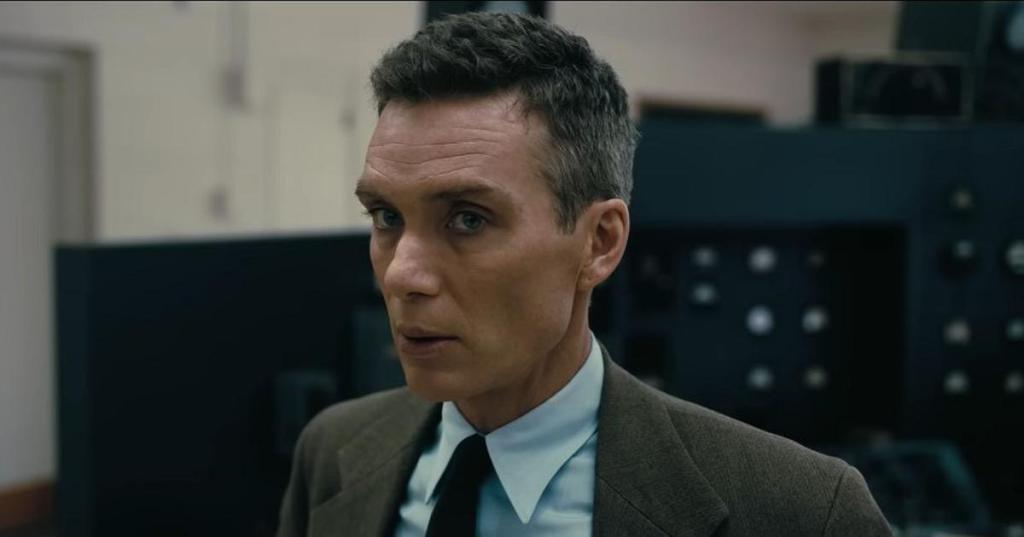
And then the movie veered off and concentrated on that political duel between Oppenheimer and his former mentor Strauss, and I utterly lost the plot. Or the plot lost me. I watched the movie twice and came away the second time not knowing anything more than after the first viewing. As a general rule, I don’t like movies that deal in political intrigue, although there are notable exceptions. Michael Mann’s The Insider (1999) comes to mind, or George Clooney’s Good Night, and Good Luck (2005).
Maybe the solution is that, by keeping still and telling the people in the hearing everything they wanted to hear in the manner they could understand and accept, Oppenheimer won. In most of the movie, he is a master negotiator, working towards the bomb, compromising, negotiating, pacifying, explaining and interpreting. But for the life of me, I don’t know how he managed to throw Strauss out of his political post by essentially doing nothing much. I am thinking about watching the movie a third time, but I need to see Barbie again before that.
 A Damn Fine Cup of Culture