Welcome to Six Damn Fine Degrees. These instalments will be inspired by the idea of six degrees of separation in the loosest sense. The only rule: it connects – in some way – to the previous instalment. So come join us on our weekly foray into interconnectedness!
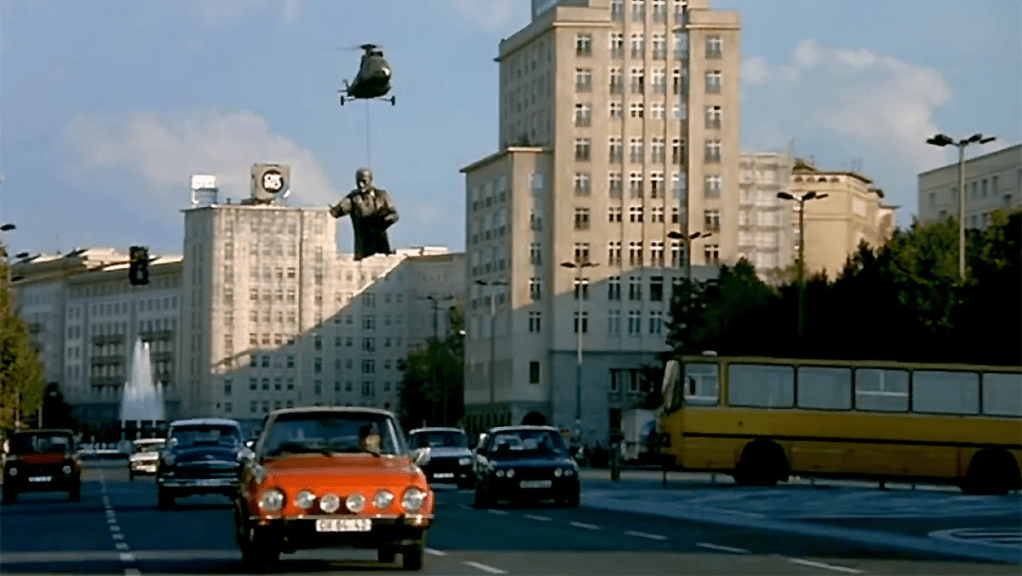
At first glance, Berlin hasn’t quite been as cinematic a city as, let’s say, romantic Paris, foggy London, cosmopolitan New York or sunny L.A. However, its tumultuous history during the first 100 years of cinema has made it an ideal space for movies that used it as more than just a postcard background. Arguably, the number of times Berlin’s cityscape felt like an active participant in the plot has to be significantly higher than the myriad establishing shots of the Eiffel Tower, Big Ben or the downtown zoom shot of the Hollywood sign used elsewhere.
Julie’s piece on Lola Rennt reminded me, for instance, of how fundamental Berlin’s vast distances (eight times the size of Paris, after all) are to Lola’s quest of endlessly running to never quite reach her goal. Throughout the scarred history of Berlin in the 20th century and beyond, our imaginings of this at times unimaginable city have been transformed greatly: from a bustling metropolis of the time between the World Wars to the rubbled maze of the post-war era, and from divided Cold War decades to liberation and renewal since the 1990s. Certain films either made during or depicting these major phases in the city’s development make for a fascinating mosaic of Berlin imagined on film. The following, to my mind, are the essential ones.
Berlin before and after the World Wars
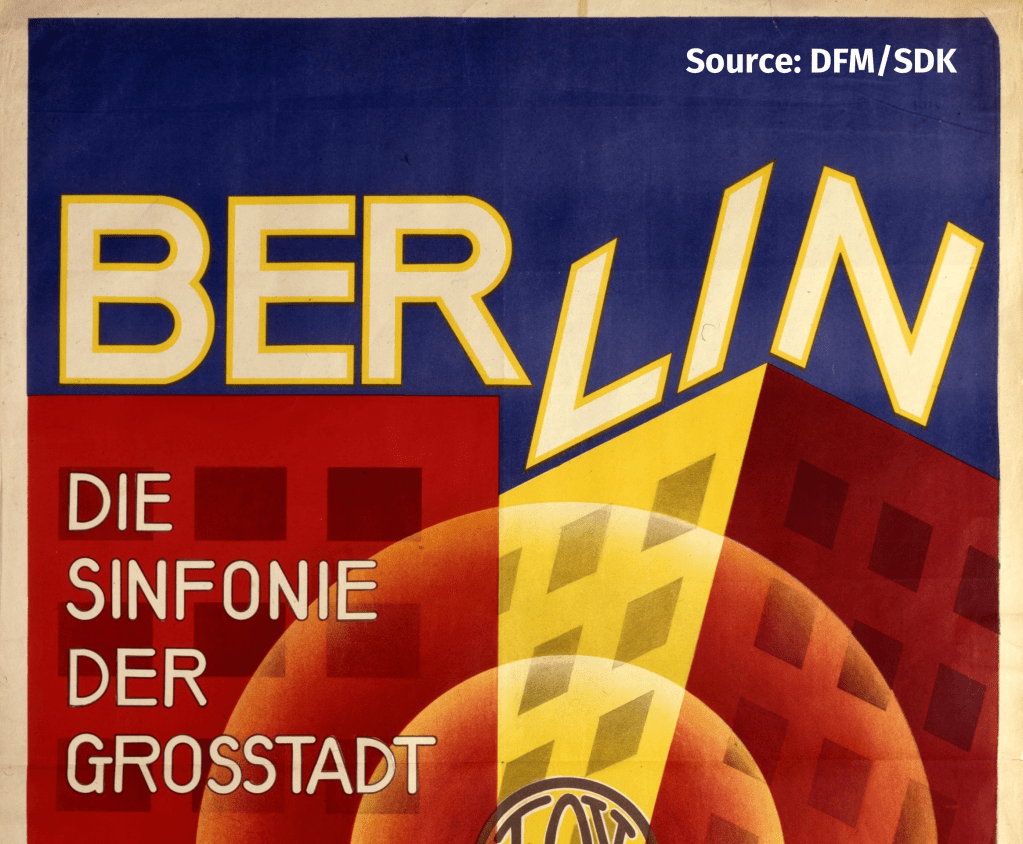
No era in Berlin’s history held as much promise as its rise to an ever more sprawling metropolis between the late 19th and early 20th century. Filmmaking was an integral part to its cultural role far beyond the German Empire. After the unaccepted defeat and the massive consequences of the Paris peace treaties, Berlin became the epicenter of the short-lived Roaring Twenties, and Weimar-era cinema was the essential art form. Berlin: Die Sinfonie der Grossstadt (1927, by Walther Ruttmann) documents as a hustling and bustling urban work of art, but there is darkness underneath: Fritz Lang’s thriller M – Eine Stadt sucht einen Mörder (1931) feels like an ominous warning of both urban evils and mass hysteria to come.
Two years later, the Nazis’ rise to power was complete, as well as their takeover of German culture including cinema. A twelve-year period of frantic propaganda followed (recently talked about in one episode of our most recent summer series) and the image of Berlin featured prominently in, for example, Olympia (1936, by the infamous Leni Riefenstahl) or Grossstadtmelodie (1943, by Wolfgang Liebeneiner), one of the last depictions of the city before utmost destruction and the end of the war. When the film came out, none of the happy Nazi screwball cheerfulness existed anymore. It was time for a reckoning.
One of the most honest films to come out of this before German Heimatfilme became all the rage and cinemagoers wanted to forget what had just happened was Die Mörder sind unter uns (1946, by Wolfgang Staudte), in which a former concentration camp survivor (a young Hildegard Knef) encounters perpetrators and other survivors in war-destroyed Berlin. Later eras have also found powerful stories within the shifting tides of the war and eventual Nazi defeat, especially Oliver Hirschbiegel’s Downfall (2004), unearthing Hitler’s final weeks in the Reichskanzlei bunker, as well as Christian Petzold’s Phoenix (2014), a Hitchcockian thriller of lost identities in the post-war era.
Behind and between the Iron Curtain
It almost seemed at first that Cold War Berlin – at least before the wall went up in 1961 – was a place where comedies of errors now had a place. Billy Wilder’s One Two Three (1961) shows protagonists James Cagney, Horst Buchholz and Lilo Pulver madly driving back and forth through the still open Brandenburg Gate. The mood soon darkened significantly, even if Hitchcock tried to have it both ways with his romantic spy thriller Torn Curtain (1965). Paul Newman’s mysterious escape between the Iron Curtain and his wife Julie Andrews’ search for the truth were clearly filmed on Universal soundstages that managed to look so shoddy that Wes Anderson later parodied them in his Grand Budapest Hotel (2014). However, once the adaptation of John Le Carré’s The Spy Who Came In From the Cold (1965, by Martin Ritt) arrived in cinemas, the threat to individualism and Western liberty from the East became frighteningly clear, and the Wall became a place of tragedy and flight.
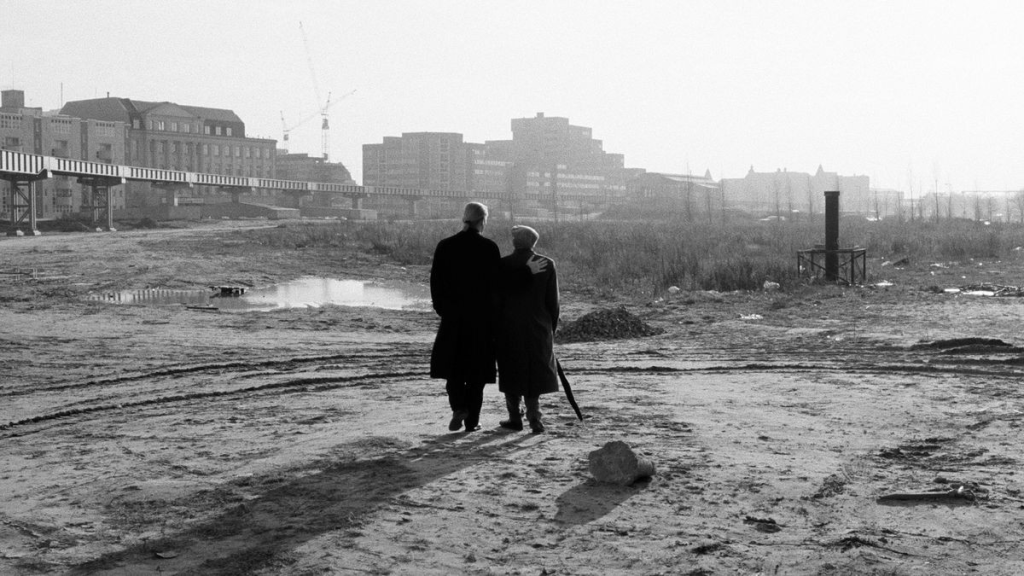
The most interesting films portraying Berlin in the following decades were neither spy thrillers (James Bond briefly made it to Checkpoint Charlie in 1983’s Octopussy) or action thrillers (Night Crossing dramatized an escape by Eastern Germans in a hot-air balloon in 1984) but rather the ones that used the bleak reality of a separated city to moving effect: Christiane F. (1981, by Uli Edel) adapted the bestseller of the same name to show the devastation of West Berlin’s drug scene around Bahnhof Zoo, while Wim Wenders’ Der Himmel über Berlin (1987) created iconic images of angels hovering over the city’s death zone wastelands just before Reagan uttered his famous “Mr Gorbachev, tear down this wall” in front of the Brandenburg Gate.
To me, the most fascinating example, however, came from the last Eastern German film released before the Cold War ended: a gay love story called Coming Out (1989). It was literally the film that opened in Berlin cinemas on 9 November, the night the Wall came down. DEFA, the GDR’s state film production company, had been enormously productive at making both blatant propaganda and widely popular fairy tales and fantasies, but Heiner Carlow’s film is soberingly realistic in its depiction of a young teacher in search of asserting his sexuality – an incredibly brave film, but also a clear sign that things were about to change drastically.
German cinema took a moment to come to terms with the enthusiasm of reunification and a more balanced view of life in the now disappeared East. There was a sometimes questionable period of ‘Ostalgie’ (nostalgia for the East), when hits like Sonnenallee (1999, by Leander Haussmann) and particularly Goodbye Lenin (2002, by Wolfgang Becker) seemed indecisive in their stance on how difficult or desirable life in the GDR had been. They both resonated tremendously with audiences, who started to revive the style and products of East Germany as if the vanished country had been no more than a brocante fantasy. Goodbye Lenin, however, still holds up really well as a document of these shifting attitudes, and, because it is at its heart a fantasy itself, showing the life of a young man and his idealistic mother, whose loyalty to communism and the state he misinterprets – still a really worthwhile watch for its recreation of Berlin before, during and after the fall of the Berlin Wall.
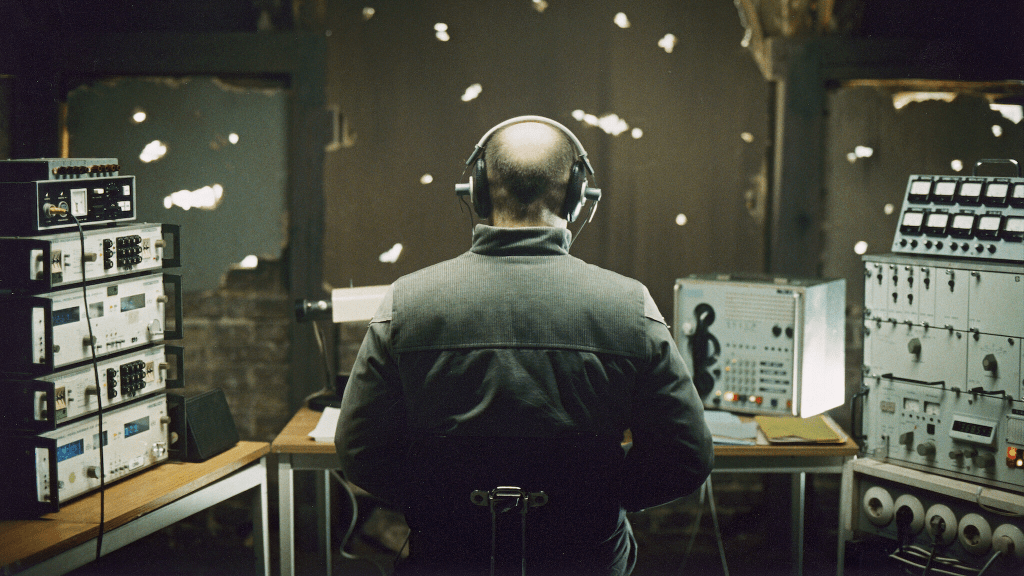
The sobering blow came with Oscar-winning Das Leben der Anderen (2006, by Florian Henckel von Donnersmarck) putting the East German spy system, the Stasi, at the heart of its quietly devastating drama: An author (Sebastian Koch) and his actress girlfriend (Martina Gedeck) are being surveilled day and night by a seemingly loyal Stasi agent (Ulrich Mühe) in their own apartment building. Berlin as a city mostly appears in grim night shots and interrogation room interiors, and the film became a highly acclaimed testament to the scars German totalitarianism had left on generations of families. It’s certainly the more realistic-seeming attempt to recreate Cold War Berlin on film than later highly stylized espionage thrillers like Bridge of Spies (2015, by Steven Spielberg), Atomic Blonde (2017, by David Leitch) or Man From U.N.C.L.E. (2015, by Guy Ritchie), which digitally recreated the city (badly) or fooled people into believing Budapest architecture looks like Berlin’s.
Post-Cold War Berlin: a limitless city?
Berlin had been forced to reinvent itself many times before, but the unification of the city and the melding of East and West became a particularly interesting and creative period in its history. Night life exploded into the former industrial halls and communist venues of the East (Café Moskau, an elite’s fancy hangout-turned-nightclub became one of my favourites when I started to explore the city in the early 2000s). 2008’s Berlin Calling (by Hannes Stöhr) captured the excess of the 1990s techno scene and its victims extremely well, but it was probably Lola Rennt (1998) that had set the tone for what Berlin was now becoming on screen: a vast, cold, anonymous cityscape for survival. The second instalment in the Jason Bourne series, The Bourne Supremacy (2004, by Paul Greengrass) used the same effect of a protagonist on the run (Matt Damon) to chilling effect. Berlin seemed the perfect place to expose him to a (now American) surveillance system from above and below.
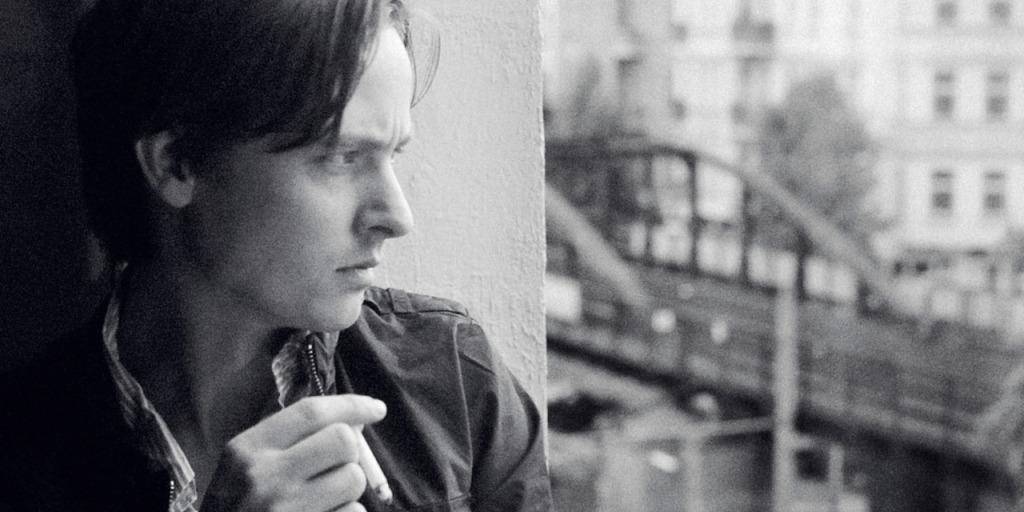
Two of my favourite more recent Berlin films took yet two different approaches to filming the city: Oh Boy! (2012, by Jan-Ole Gerster) gave it a Woody Allenesque black-and-white veneer when following ne’er-do-well Niko Fischer (Tom Schilling) for an entire day of finding peace over a cup of coffee. Berlin at times seems an unforgiving place (now gentrified with hip coffee shops and overpriced restaurants), but Niko eventually finds solace at a bar, reminiscing with an old man over Berlin’s troubled past. Finally, Victoria (2015, by Sebastian Schipper) took the most audacious filmic approach by starting his camera on young Spanish woman Victoria dancing in a nightclub and then following her through two and a half hours of incredible excitement and danger – all in one take! The sense of the city you get from just one camera’s perspective still makes up for an incredibly realistic experience of what such a night can be like. It is maybe one of the best time capsules filmed in the heart of Berlin.
So maybe after all, Berlin is the perfect cinematic city, a constantly reshuffled set of buildings and rubble, a vast filling and emptying canvas with seemingly endless spaces for filmmakers’ imagination and projections.
 A Damn Fine Cup of Culture