Welcome to Six Damn Fine Degrees. These instalments will be inspired by the idea of six degrees of separation in the loosest sense. The only rule: it connects – in some way – to the previous instalment. So come join us on our weekly foray into interconnectedness!
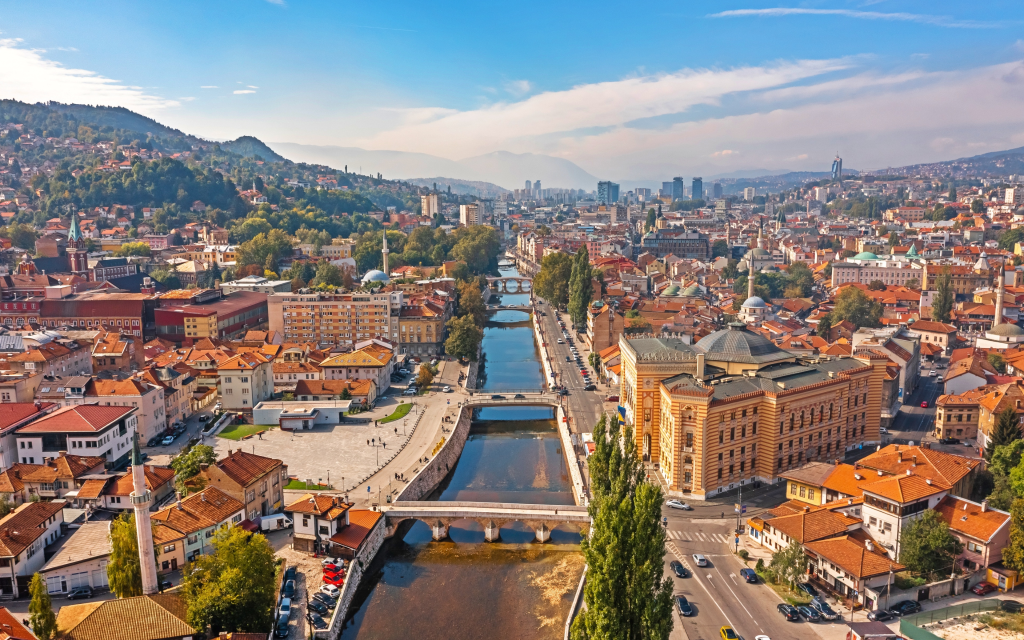
It’s one of those cinematic moments in history classes that high school students almost get to know by heart: on the morning of 28 June, 1914, Archduke Franz Ferdinand wakes up to meet with officials at the Sarajevo city hall on a tour to convince the sceptical Bosniaks that being freshly annexed by Austria-Hungary is actually a good thing. 28 June happens to be a doubly important date for both the next-door Serbs, who commemorate the defeat against the Ottoman Empire in 1389, and for the Archduke, heir to the throne, who celebrates his wedding anniversary with wife Sophie, who has joined him on the trip to Bosnia.
As the saying goes, the rest is history: Franz Ferdinand’s trip downtown is accompanied by the ready assassins of Serbian nationalist organisation The Black Hand. An early bombing attack fails: it is only by pure coincidence that the motorcade of the Archduke turns into a small side street at Latinsky Most, and the remaining assassin, young high school student Gavrilo Princip, gets another chance to make history, killing both Franz Ferdinand and Sophie at close range. It is the “shot heard around the world” and the “trigger of the First World War” – at least that’s what some historians argue, while others (like Christopher Clark in Sleepwalkers, discussed in last week’s post) would argue differently.
On my first trip to Sarajevo in 2014, I stood on that exact corner and was taken by how such a small unassuming spot could carry that much history. The Latinsky Most (Latin Bridge) carried Gavrilo Princip’s name for most of the 20th century but then reverted to its original name in the course of the Bosnian War of the 1990s. Two wars have imperfectly framed the international image of this city: whereas Sarajevo only served as the final straw in the build-up to the war among the great powers in 1914, it became the infamous centre of the most brutal siege in post-World War history: For 1425 days, the Serbian Bosnian army, apparently with the assistance of international snipers (as was recently revealed), was shooting down at civilians and UN peacekeepers without mercy between 1992 and 1995. The National Archives, where Franz Ferdinand had visited the city government in 1914, were utterly destroyed by the ensuing fire.
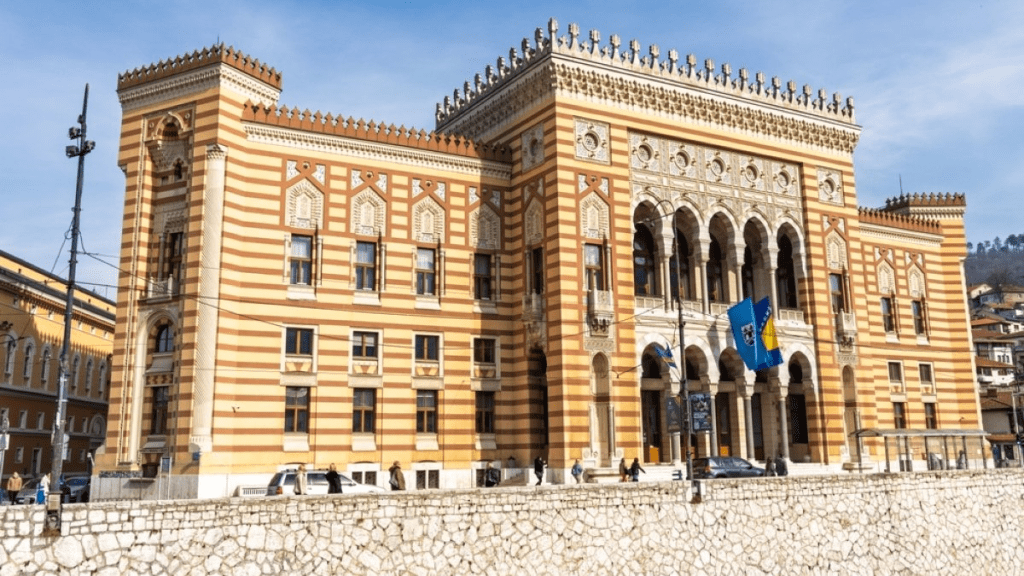
Yet when I visited in 2014, there was not only that sense of the burden of history and the scars of the past to be felt: the former city hall ravaged by fire had just recently opened its doors again, the perfectly unified Ottoman and Habsburg architecture on full display. I was utterly taken in by that deep-seated mixture of cultures and influences all over the city and how a walk along the city’s river Miljacka is a literal walk down its historical timeline.
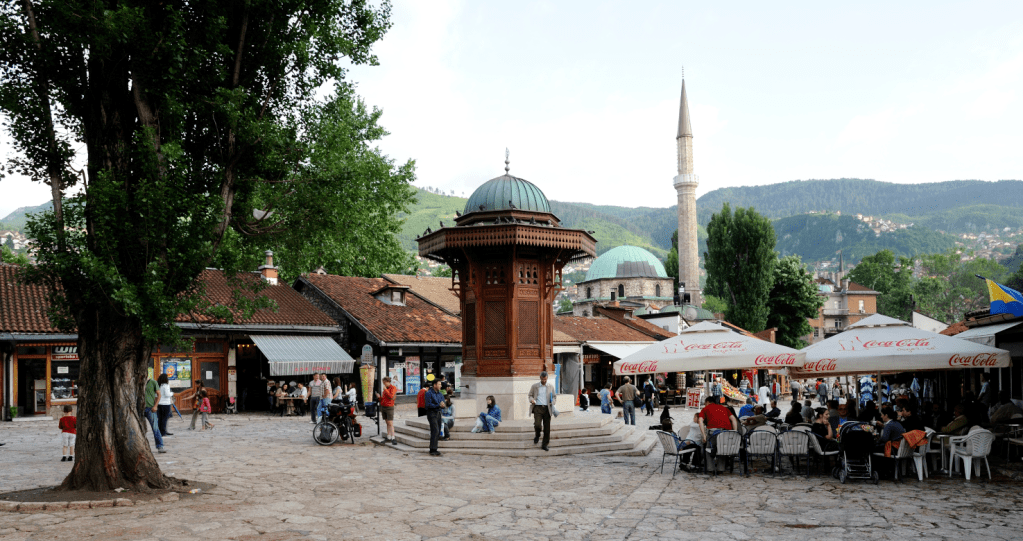
At the centre, and just a stone’s throw away from the Latin bridge and the former city hall, is the Bascarsija, the Ottoman-influenced old town and market streets featuring most mosques, Turkish café houses, countless Ćevapčići grills and other historical remains of Islam leaving religion, culture, food and trade at the city’s doorstep. One of the most charming places to visit is the caravanserai, now a courtyard with historic rooms all around and coffee shops and restaurants downstairs. This is where Ottoman traders would stop their caravans for a while and relax among trees over tea. Close by, there are also some of my favourite restaurants in the city: Pod Lipom (judging by the photos on the wall, one of the Clintons’ favourite hangout since the ’90s) and Inat Kutca (literally the “Stubborn House”), a small place across the Miljacka refusing to be razed or moved over centuries.
Just outside this central hub, you walk straight into Habsburg’s 19th century influences, a massive push to modernise and partly assimiliate the city into its influential infrastructure and style: the tram lines were built, the elegant main post opened its doors, schools (including the First Gymnasium that Gavrilo Princip attended) received students and fancy hotels accommodated guests from afar. One of them, the Hotel Europe, still serves some of the city’s best Sachertorte in its elegant café. Such influences clearly benefited the city’s development on the one hand, but the presence of an unwanted occupier only cemented the nationalist movements in Bosnia and neighbouring Serbia that culminated in the aforementioned assassination.
In between the influences of empires, other cultures and religions found their spaces, too: Serbian-Orthodox churches and Jewish synagogues are testament to Sarajevo’s relative co-existence of religions and cultures throughout its history, mostly tolerated during the 19th century, and then again backgrounded during the next massive changes during and after the World Wars. Their impact cannot be overstated and their legacy can be seen all over the city in the form of monuments and memorials. This is mainly due to what happened at the end of World War II: Sarajevo became part of communist Yugoslavia II under its leader Tito, who had famously fought among the anti-Fascist Partisans and now turned into a quasi father figure who helped to unify the various religions, nationalities and cultures under a new common ideology. The commemoration of the world wars, especially the anti-fascist stance, became a core piece of the new identity.
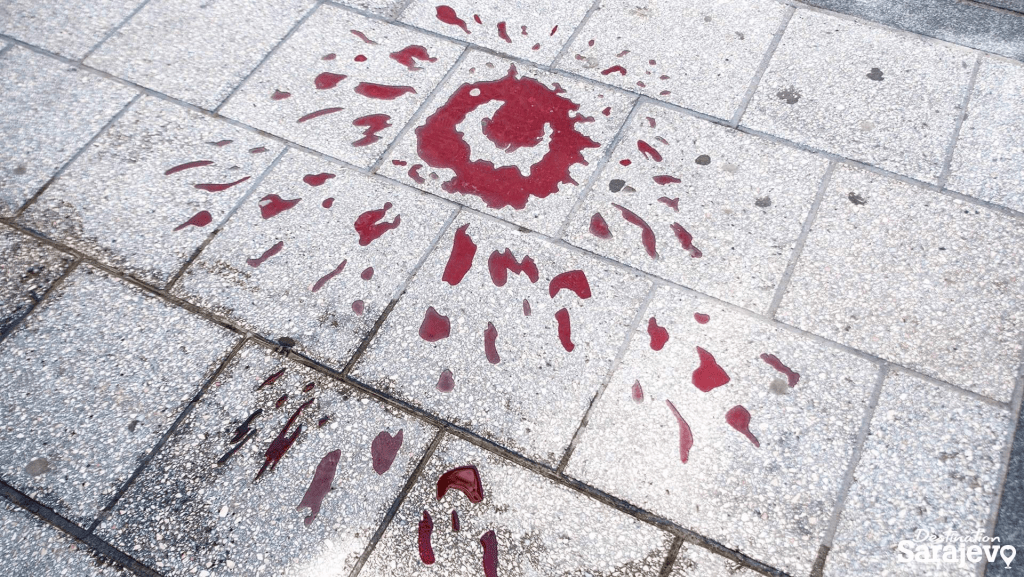
The traces of communism are manifold in the city, from the strangly reverent Café Tito by the historical museum and the memorials partly hidden in the hills above the city (among them the abandoned site of the 1984 Winter Olympics, which attracts myriads of dark tourism), to the infamous Holiday Inn hotel, from where snipers were shooting at people in the city in the 1990s civil war. The marks of this conflict, at least in 2014 and during my returns in 2016 and 2017, were still the most present reminders of what the city had gone through: After years of turmoil, takeovers and communist (and implicitly Serbian) dominance, nationalist liberation seemed near for Bosnia-Herzegovina as well. Looking down while walking, the famous “Roses of Sarajevo” are also constant reminders of the heartbreak and bloodshed endured.
By 1991, the Slovenes had already split within ten days from Yugoslavia, and the Croats were just fighting a war to do the same. However, it was the Bosnian War that captured a mortified world when the Siege of Sarajevo started and images of sniper victims, masses of refugees and a distraught city went around the world. Only in 1995, and after the horrific genocide of Srebrenica was revealed, did an uneasy peace – the Dayton Agreement – allow for the dust to slowly settle. Bosnia was now divided between a Bosnian Serb Republic, a Croatian enclave and Bosnia-Herzegovina itself. The Swiss-inspired cantons introduced did not help paint over the fact that the political system has remained as divided between parties representing Bosniaks, Bosnian Serbs and Bosnian Croats to this day and the EU’s High Commissioner is presiding over a country unable to overcome its economic weakness and political differences to become an active member of the European Union.
Lately, Sarajevo has been in the headlines as a intermediary stop of many refugees on their hopeful journey from the Middle East into the EU. As a non-member, cities like Sarajevo with its multicultural history have often been more welcoming an accessible to outsiders, maybe because of so many families with relatives abroad who had to flee the horrors of war themselves. Outside players like Russia, Qatar or Saudi Arabia have also disovered the potential of a mostly Muslim country such as Bosnia in the middle of Southeast Europe.
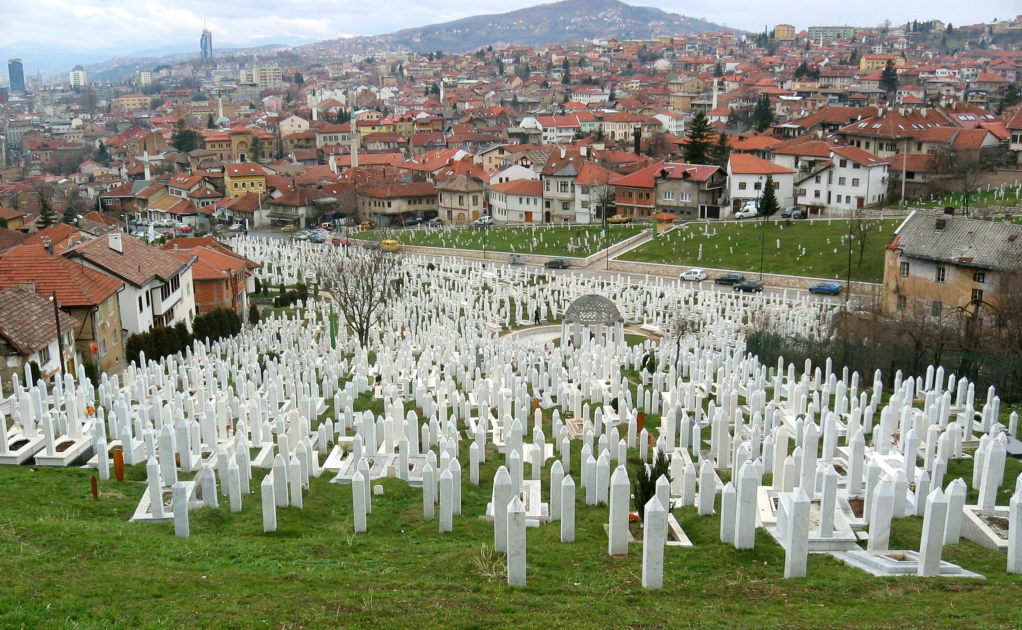
Still, the city for me is far beyond only history and politics: it was strangely moving to see its scars and beauty live side by side, a place so openly displaying its contrasts and imperfections yet being so open and welcoming. At one point, we were standing above the city with about the same view as the photograph on top. We were surrounded by graves and nearby, the Bosnian Serbs had shot down at the city from their tanks with citizens finding refuge and water in a local brewery below. Someone was reading from Miljenko Jergović‘s story Sarajevo Marlboro and the local wild dogs were roaming nearby.
It’s hard to overstate the intense love I felt for the place below from such a historic vantage point.
 A Damn Fine Cup of Culture