One of the things that video games can do magnificently is create worlds. These posts are an occasional exploration of games that I love because of where they take me.
Virtual Reality is one of those technologies that sound tremendously cool – on paper. No longer are you just looking at a 2D representation of whatever world a game creates: you can be fully immersed in a real world! Except it’s not that easy. For one thing, not everyone has the necessary space at their disposal, so you can actually walk around in the virtual world. For another, not a few people simply get nauseous in VR. And then there’s the challenge of tactility: not just seeing but feeling and touching whatever you’re interacting in the virtual world. There is a not inconsiderable gap between the idea of VR and the actual practice – a gap that can be reduced by means of clever game design, but this kind of design doesn’t necessarily lend itself to what people expect from VR gaming.
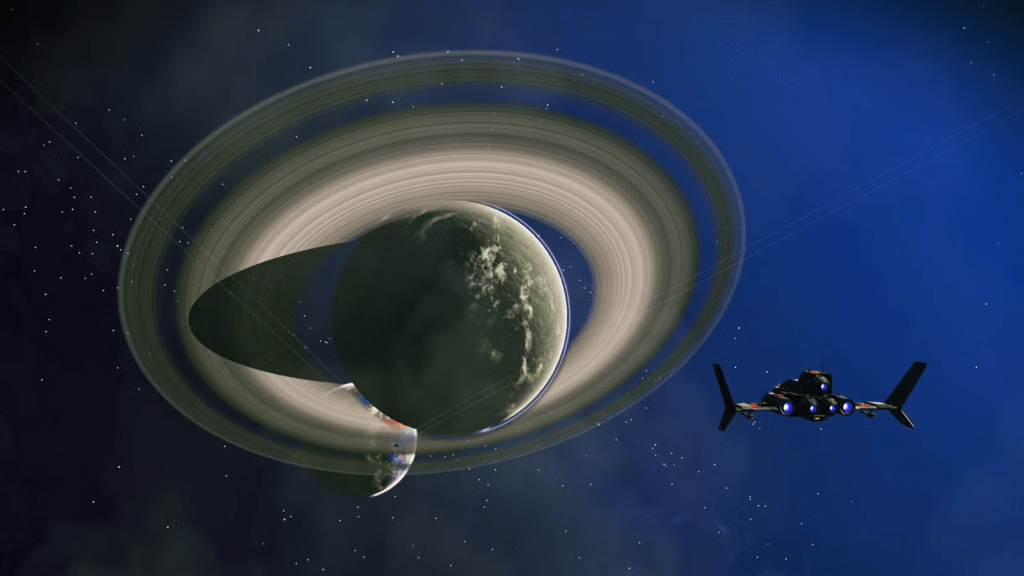
Ten years after the release of Oculus Rift, VR isn’t the runaway success that some breathless PR people predicted, and as a result, less and less money is being put into the development of VR experiences and games. If your audience is relatively small, you can’t really afford to develop VR fare that has the kind of AAA production values you get in normal video games. And this generally means that big games, with large worlds, the kind of thing you find regularly in non-VR gaming, are a rarity when it comes to Virtual Reality. A lot of games developed for the tech are much smaller in scope, somewhere in between an escape room and a theme park ride, and they are generally as on-rails as the latter. With a modest budget, you may still be able to put together a handful of interconnected rooms that are reasonably detailed and nice to look at; a whole world, though, is an entirely different matter.
A whole universe? Now you’re talking
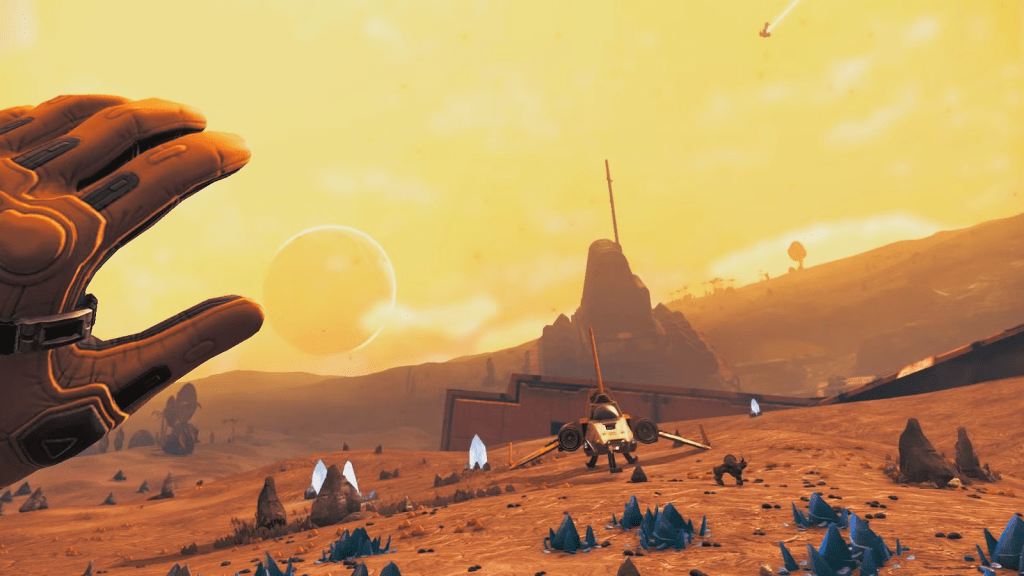
No Man’s Sky made a big splash when it was announced, and something more like a thud when it came out. Its developers, wide-eyed and ambitious, made promises that got gamers and gaming journalists excited: a universe of over 18 quintillion planets, unique worlds that no one else had ever stepped on, an aesthetic inspired by 1980s sci-fi. People came to expect the kind of game gamers dream of, rich and vast and endlessly varied – and, accordingly, the disappointment was great when No Man’s Sky at its release in 2016 was a buggy mess offering something that seemed to be more of a caricature of the kind of epic space adventure people had been imagining. For a while, mocking YouTube videos and memes were everywhere, eclipsing the game itself. The narrative seemed set: No Man’s Sky is a joke and its developers were either failures or liars.
But then, over the following years, No Man’s Sky turned from a poster child of over-ambition into one of the greatest redemption stories in the medium. Hello Games, the UK-based studio, kept working at the game, first fixing the plethora of bugs and then adding better graphics, new systems, all sorts of bells and whistles. There have been over 30 major updates adding more story, game modes, creatures, vehicles. And, most importantly for this post: in 2019 they added Virtual Reality support.
Over the last couple of months, I’ve been playing a few hours of No Man’s Sky each week, over the weekend and in the evenings before going to bed. You could even say that I’ve been nursing a bit of an addiction. The thing is, though: I’m not sure I would have played more than a few hours of the game if I wasn’t playing in VR. Sure, there is an admirable breadth to No Man’s Sky: you can explore hundreds of thousands of solar systems, land on planets, check out a wide range of flora, fauna and minerals, from drab little rocks to floating fractal constructs. You can hunt pirates, explore strange alien architecture, catch fish. You can manage settlements, direct fleets and send them on missions, you can make friends with alien races and learn their languages – or you can behave clumsily or be outright hostile, offend them and risk making enemies of them. But this breadth comes at a cost: many of the systems of No Man’s Sky are not very deep. There isn’t all that much challenge to playing the game or following its storylines. More than skill, the games takes patience: you spend a lot of time mining and harvesting resources, which you’ll need to build bases and upgrade your tools, including your spaceship, to extend your reach to other solar systems – where you’ll end up doing many of the same things. Sure, the creatures on the planets in those new systems look different, but over time I’ve come to see much of this as little more than different coats of paint.
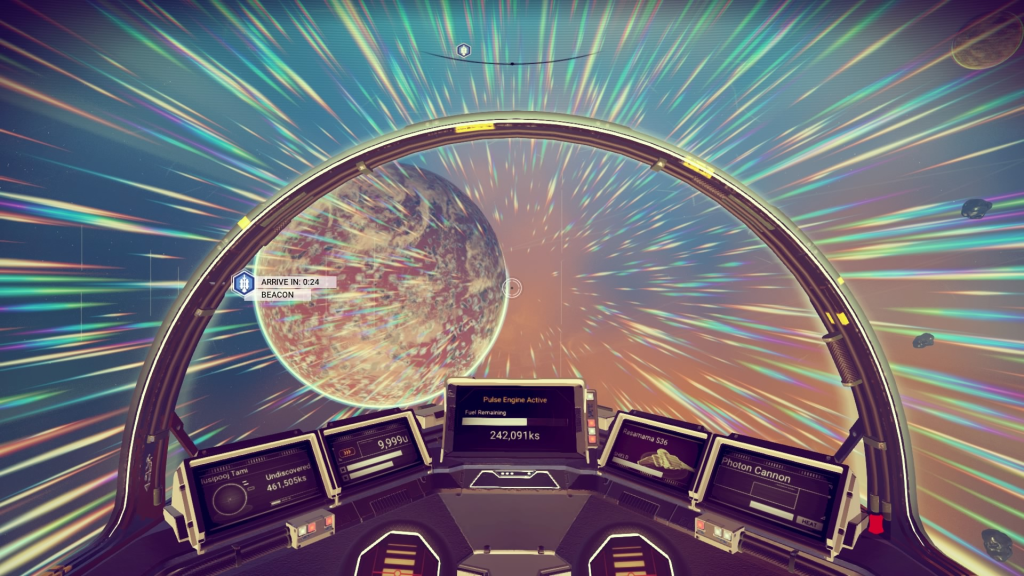
But, in VR? Sure, this universe may be somewhat shallow – but it is big, and it is seamless. And all of this is many times more effective in Virtual Reality. As I’ve mentioned: many of the worlds I’ve explored in VR over the years amounted to little more than a set of interconnected rooms – or if the worlds were bigger, they were also much more sparse and spartan. The worlds of No Man’s Sky? It’s like immersing yourself in vintage sci-fi book covers: alien landscapes, emerald vistas, crystalline structures, odd creatures flapping across the sky, gigantic worms burrowing into the ground and emerging just metres away from you, making you feel like you’re in a more neon version of the Dune universe. Hop in your spaceship and grab the throttle with one hand, the stick with the other, and take off. You accelerate through the cloud cover over a landscape where, seconds earlier, you’d been walking on the ground. The sky fades from whatever colour the atmosphere lends it to black: you’re in space. Flick on the Pulse Engine and zip across the solar system you’re in, past fleets of corvettes and freighters, asteroid fields, and arrive at the system’s space station, where you can buy upgrades, sell resources you’ve harvested from the planet you were just on, haggle with aliens over the price of their ships.
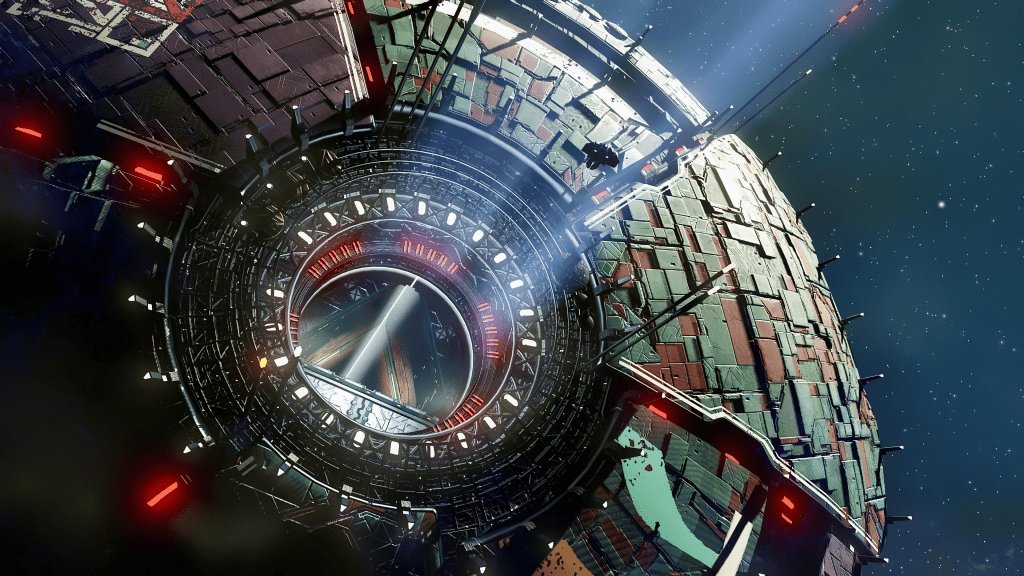
And, once again, there’s something to VR that makes the experience so much more concrete. Take verticality: if you’ve collected enough resources and purchased all the necessary blueprints, you can build your modest starter base into something both grander and bigger, stacking habitat modules on top of one another. Playing on a screen, you move the mouse a little and you’re looking at the top of your base. In VR, you crane your neck back, so your body feels the scale of what you have built. Or you’re exploring the depths of a body of water on one of the gazillion planets just a hyperjump away: looking down and barely seeing the bottom of the lake? or ocean? you’re exploring is different from the much more abstract method of moving what’s visible on the screen by moving a mouse an inch or two.
Truth to tell, it doesn’t take long before you start to understand the variables that went into creating the worlds you visit: a planet can be more or less craggy, the ground can be covered with grass or shrubs or nothing at all, the animals can have two or four or more legs, the minerals can be crystalline or more rock-shaped, but it’s all variations on a theme. But valleys feel deeper, mountains feel higher, prairie planes feel more endless when you’re exploring them in VR. Just knowing that you could walk off into the distance for hours, without encountering a wall stopping your progress, makes an enormous difference.
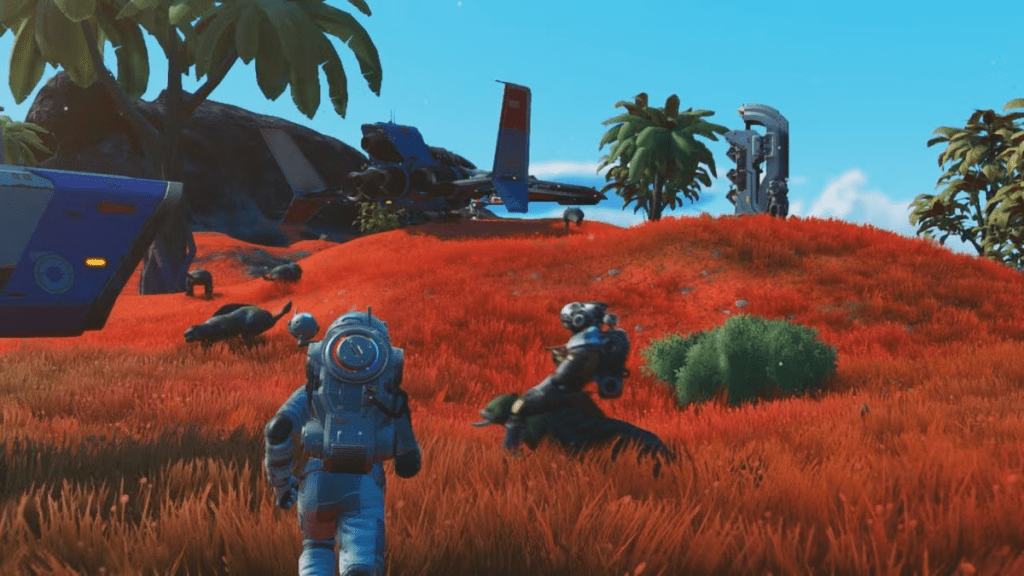
While I’ve been loving my 20+ hours in No Man’s Sky so far, I know there’s a risk inherent to so many games that offer breadth rather than depth: it is easy to become obsessed only to OD and burn out on them, souring the experience. For now, I’ve decided to focus on the main storyline that the game offers. My base will always be waiting for me if I just want to build some more rooms, or go on missions for the base staff I’ve recruited, or if I want to go on a few side missions and take photos of a volcanic planet or scan some minerals for some alien. Make more money. Buy another ship. Add another freighter to my fleet, which I then send off on missions of their own. Come across alien ruins. Anger some cybernetic guard dogs protecting said ruins, blast some of them into smithereens, then hop into my ship and zip off before reinforcements arrive, hoping to do it all over again in the next solar system, on the next planet. Because, even if No Man’s Sky is a bit shallow, it is pretty damn close to what I would have wanted from Virtual Reality as a kid growing up with big, cheesy, wonderful sci-fi. You can find whole worlds in that headset of yours – and lose yourself in them.
 A Damn Fine Cup of Culture