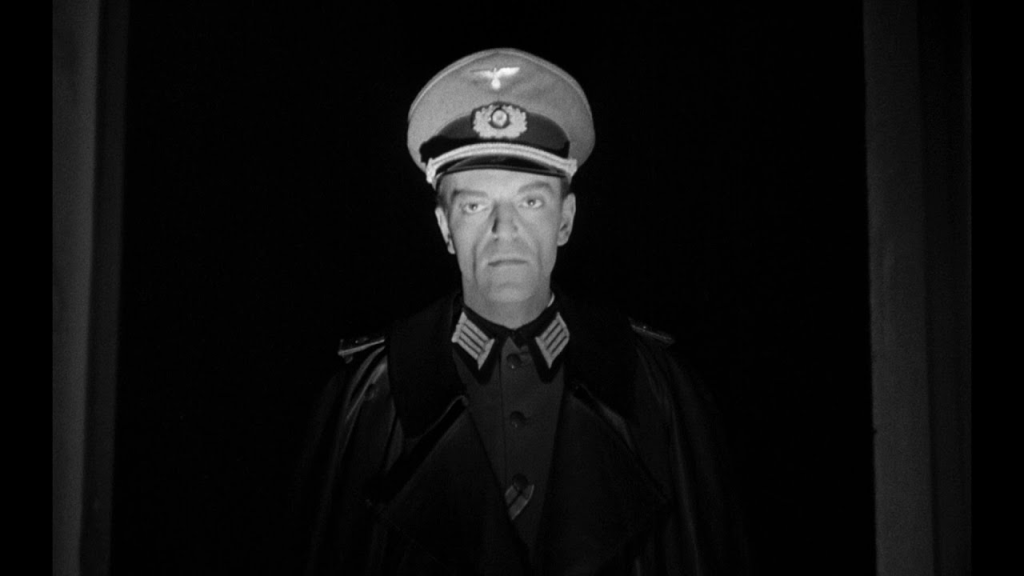
There are many kinds of resistance. The one that’s perhaps most familiar to us – more so from the cinema screen than from personal experience, most likely – is that of taking up arms against the oppressor. The French filmmaker Jean-Pierre Melville made a number of films in which the French Résistance and its fight against the occupying German army featured, most famously perhaps Army of Shadows (which may come up more prominently in a future post), and as one might expect, the film depicts a heroic (if bleak) armed struggle.
While the setting is a similar one – the Second World War, occupied France -, the resistance of Le silence de la mer (The Silence of the Sea) is of a very different kind; as is, arguably, the characters’ struggle with each other and with themselves.
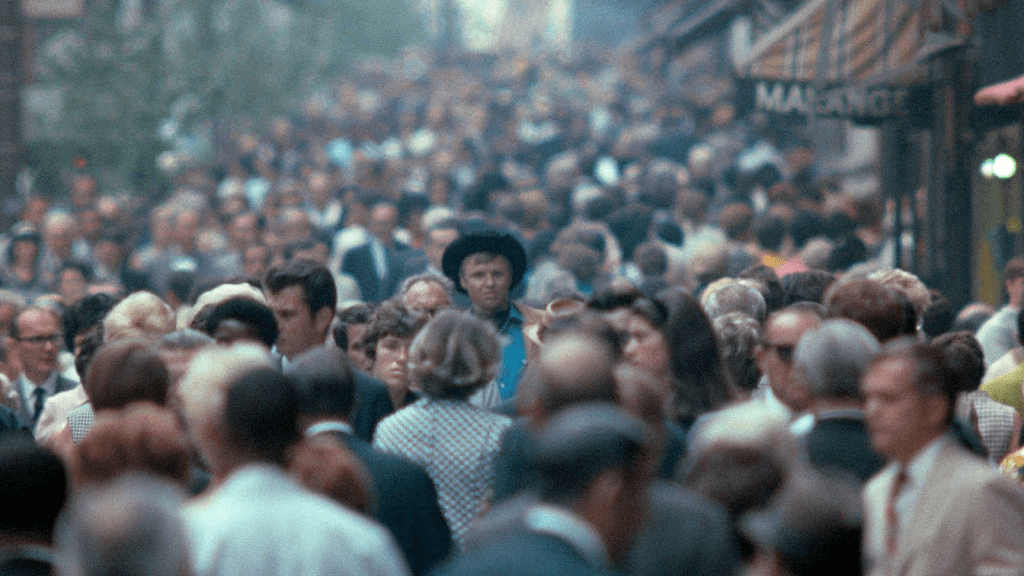
In my head, John Schlesinger’s 1969 classic Midnight Cowboy is intertwined with Miloš Forman’s 1979 adaptation of Hair for some reason, to such an extent that I tend to mix up Jon Voight and John Savage. I have no convincing explanation why this is the case, but I suspect it may be that I watched at least the beginning of Midnight Cowboy at an age when I was too young to really take in what the film was about, so all that stuck with me was a young hick from one of the more rural states taking a bus ride to New York to begin a new life and, once there, falling in with a very different crowd than what he was previously used to. Perhaps Harry Nilsson’s melancholy hit “Everybody’s Talkin'”, playing over the Greyhound ride Joe Buck (played by Voight) takes to the Big Apple, added to that mostly inaccurate memory.
Those similarities are there, but they’re entirely superficial. Where Hair‘s Claude Hooper Bukowski goes to New York City after being drafted into the Army to go to Vietnam, Joe Buck has drafted himself into a very different kind of service: he wants to put his carnal talents, and his cowboy outfit, to good use to make the women and men of New York happy. And there’s no idealised, singing hippie tribe waiting to take Joe under their wings, but a fidgety, coughing con man named Rico “Ratso” Rizzo (Dustin Hoffman), who at first is eager to trick the naive Texas hick out of twenty dollars – but then, for a while, becomes the midnight cowboy’s only friend and companion.
Perhaps my experience of watching Jules Dassin’s Rififi for the first time would have been different, or at least more smooth, if I’d remembered its original French title: Du rififi chez les hommes. The English title, especially if you (like me) don’t know what the word ‘rififi’ means. The film is kind enough to provide something of an explanation, in the form of a song performed in a nightclub to an audience of gangsters, hoodlums and molls: rififi is brouhaha, trouble, especially the kind that goes on between gangsters over money, women, the size of their guns. But without that knowledge, the title Rififi sounded like a cocktail, a musical style that makes you snap your fingers, or a Mediterranean resort town. This together with the film often being described as the quintessential heist movie made me expect something jazzy, breezy, stylish. Something fun.
So when fifteen minutes into Rififi the main character makes his former girlfriend strip and then brutally beats her with a belt because she’d gone off with another man while he was serving five years in prison, I was taken aback – especially when the film in the scenes following the violence seemed to shrug and go, “Well, that’s what men are like, that’s what women are like, and that’s how everyone likes it.” I was ready to press STOP, eject the disk from the Blu-ray player, put it away and never think of Rififi again.
What is it I look for in a Criterion release? Why do I not just get every single film released by the Criterion Collection? It would certainly save me some time – upfront, at least, though not necessarily afterwards, when I actually have to watch these films. Not that it’s a chore, but my various media backlogs and the increasing unlikelihood that I’ll actually get to finish all the films, series, books, games etc. that I’ve amassed in my life to date are already making me more anxious than I like. (#firstworldproblemsamirite?)
So, what is it that makes me buy a Criterion release? Obviously, the first reason is that they release a film that I already like, or the work of filmmakers and actors that I already enjoy. Next, sometimes it’s a film that I’ve heard a lot about, one of those stone-cold classics that I’ve never got around to watching on TV, and what better way to first see a classic than a good remaster with interesting extras included on the disc? (Okay, the correct answer to this is often: at the cinema. But while I’m very happy with our local cinema releases of classics, they will never cover everything I’m interested in.) Sometimes it’s simply that I’ve never heard of a certain Criterion release, or perhaps only snippets and a still here and there, but what I read makes it sound intriguing, strange or fascinating in some other way. I mean, if it’s Criterion, it’s gotta be good, right?
The final type of Criterion purchases I make comes from me feeling somewhat guilty that I’m not more broadly interested in the history of cinema. Obviously I am interested, but then I look at Julie or Alan, our two resident movie historians, and I see their fascinating with and breadth of knowledge on classic Hollywood, whether we’re talking about the classics of silent movies or pre-Code Hollywood, and there’s a part of my movie-fan ego that feels vaguely inadequate.
For a while, I’d catch all new Pixar releases at the cinema. I missed out on Toy Story, their first feature film, when it originally came out, but I remember enjoying A Bug’s Life and Toy Story 2, and I loved The Incredibles when it came out (though I have to confess that I never enjoyed Finding Nemo as much as most people did). At the time these were something we’d not seen before, not in this quality. Obviously Pixar’s artistry was amazing, in a genre that, when the first few Pixar films were released, was still fairly new – and with each film, the company would introduce new innovations. The fur in Monsters, Inc. (apparently there were over two million hairs on Sulley that needed to be animated), water and the way it was lit in Finding Nemo, the way musculature behaved on human beings in The Incredibles: Pixar were technological innovators as much as they were artists, but above all, they were storytellers. Their movies were technological marvels from the first, but most people aren’t wowed by textures or shaders alone: if these aren’t used to tell interesting, engaging stories, the films that use them won’t be remembered. I mean, how many people still talk about Final Fantasy: The Spirits Within?
Three young, smart, attractive people – Gilda, a commercial artist, the painter George and the playwright Thomas – meet on a train to Paris. Their initial conversations may not be entirely friendly, but the sparks that fly as they exchange zingers make it clear that the men are attracted to Gilda, and vice versa – and how could they not be? They’re witty, they’re attractive, and they’re in Paris. Soon they fall: both of the men for Gilda, and Gilda for, well, both of them. She can’t choose, and she won’t choose – so Gilda, George and Tom come up with a plan: they live together as Gilda is a friend, a muse and a critic to both men. They make a gentlemen’s agreement to make sure that this will work: no sex.
I can’t remember which of the two films I watched first: Memories of Murder (2003) by Bong Joon-ho or David Fincher’s 2007 film Zodiac. The two films share a lot of similarities. Both are about serial murders that actually happened: the series of killings Bong’s film is about took place between 1986 and 1991, while Fincher’s film is focused on the manhunt for the Zodiac Killer, who was active in the Bay Area in the late 1960s and early 1970s. Both are more interested in the investigation than in the killer, and in the individuals conducting the investigation (the protagonists of Bong’s film are the three police officers hunting for a rapist and murderer of women, while Fincher splits the difference between the San Francisco detectives, the journalist Paul Avery and the cartoonist Robert Graysmith). And, importantly, both films present the audience with very likely suspects to then withhold from us a confirmation that it is really this man, or that guy, who committed these murders. Much like the protagonists, we are left with a sense of frustration and unease.
This isn’t how crime thrillers are supposed to work. If we don’t know whodunnit at the end, what was the point?
And that, exactly, is the point.
Warning: The following contains spoilers for Bong Joon-ho’s Memories of Murder. If you’ve yet to see the film, don’t read this post but go and watch Memories of Murder. Without wanting to put down my own posts: the film is much, much better.
It took a while for me to warm to Wes Anderson and his films. It’s not that I didn’t see his talent for mise-en-scène; that has always been obvious. It’s that I found his characters and their quirks grating rather than charming. I did not enjoy spending time with the Tenenbaum family, I didn’t want to hang out with Steve Zissou and his crew. And when the films veered towards tragedy, I found them too affected to care, too smugly self-conscious and twee.
It was only with The Fantastic Mr Fox that I learnt to enjoy a Wes Anderson film, not for individual parts but as a work in its entirety – and oddly, it took the more sustained artifice of latter Anderson for me to connect to the underlying emotion as something real. It was therefore with some trepidation that I approached Rushmore, Anderson’s second feature film, which I expected to be closer to the films that would follow it, The Royal Tenenbaums and The Life Aquatic, in style and tone. And it is – though it has some interesting quirks of its own, among them an awareness of the limitations and annoyances of The Life Andersonian.
I admit: sometimes I find them intimidating. The classics, the cinema icons, the films that everyone says you should watch because they are just that good and the directors who made those films. What if I watch one of those films and I don’t like them – or, worse, they don’t do anything for me and barely evince any reaction whatsoever? (Somehow it’s easier to dislike an iconic film than to be indifferent to a supposed masterpiece of the art form.) Which may go some way towards explaining the big pile of Criterion films I’ve bought but haven’t watched yet. Of course I want to watch them, I will watch them – but not just yet. I’ll get around to them. Eventually. Perhaps there’s a part of me that doesn’t want to watch them so much as it wants to have watched them.
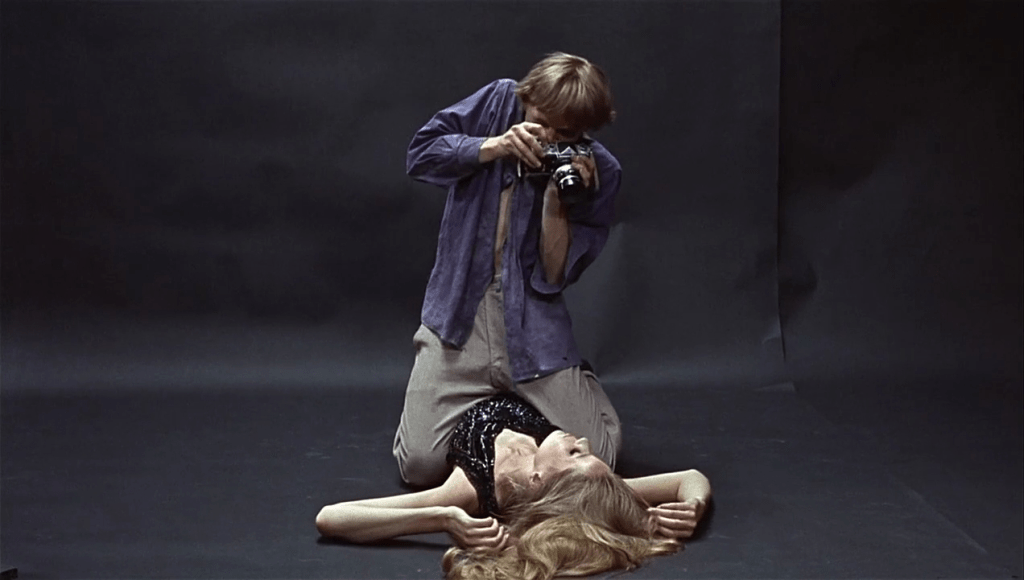
Michelangelo Antonioni’s Blow-Up was one of those films for a long time – but then my kindly co-baristas here at A Damn Fine Cup of Culture went and did a podcast episode about seeing our cities, the places we live (or have lived) in, on film, and Alan chose to talk about the London of Blow-Up. And at that point I couldn’t really not watch it, could I? (Mind you, it still took me more than seven months, but I think that this year has given me enough of an excuse for that sort of delay.)
Humphrey Bogart is a strange leading man: while charismatic, he is not exactly handsome, and as he got older, the contrast between his charisma and his lack of conventionally good looks got bigger. He wasn’t afraid to play characters that were unpleasant, though interestingly so, and he didn’t shy away from his characters’ dark sides, their cowardice, neediness, pettiness and egotism. Look at Fred C. Dobbs, his character in The Treasure of the Sierra Madre: he’s not a Disney villain, he is not an evil mastermind, he is a small, pitiful man, really, who meets a pitiful end. How many Hollywood leading men at the time were happy to play such roles?



 A Damn Fine Cup of Culture