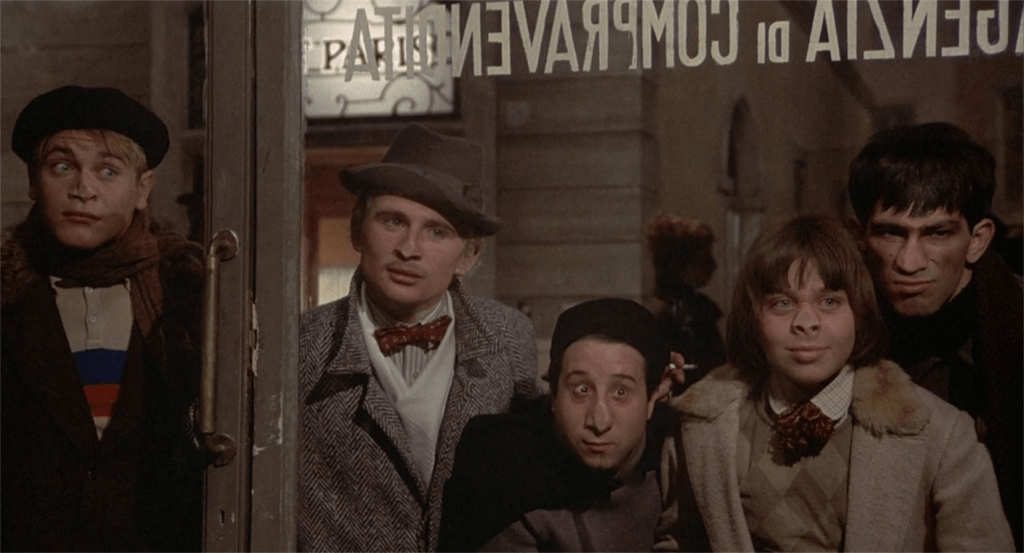
Fellini Finale: Ginger and Fred (1986)

Over the last two years, I’ve been making my way through Criterion’s Essential Fellini box set. Starting with Variety Lights (1950 or 1951, depending on where you check) and ending with Intervista (1987), this beautiful set included most of Fellini’s films – though not all, skipping for instance the acerbic English-language Fellini’s Casanova (1976), in which a bewigged, increasingly ridiculous Donald Sutherland fornicates his way across Europe, getting further and further away from anything approaching happiness, or even pleasure, in the process.

Continue reading

Forever Fellini: Intervista (1987)

And there we are: the final film on Criterion’s Essential Fellini box set, Intervista. It’s not Fellini’s final film: the director would go on to make The Voice of the Moon, released in 1990 and starring Marmitey Italian comedian Roberto Benigni, but even if the decision not to include that one was down to rights issues, Intervista feels like the right end point, seeing how it is about filmmaking, memory and finding that decades have passed and all of a sudden you’re an old man.

Also, quite literally and more than any other film by the director, Intervista is about the man himself: Federico Fellini.

Continue reading

Forever Fellini: And the Ship Sails On (1983)

It’s a conundrum: this late in Criterion’s Essential Fellini box set, I didn’t expect to find a film I’d like as much as And the Ship Sails On – but at the same time, I ended up finding it more frustrating than many of the films I liked considerably less. There is a lot I love about And the Ship Sails On – but it feels like by the time Fellini made it, he had mellowed with age, and in this case I wish he hadn’t. The film is too loving and mild as satire, when the themes it addresses would have required a sharper sensitivity, one that isn’t averse to drawing blood… and this shortcoming is much more obvious in 2025 than in 1983.

Continue reading

Forever Fellini: Fellini’s Casanova (1976)

Giacomo Casanova: a man of many talents (allegedly). Check out his Wikipedia entry – which he would have probably loved doing! – and you’ll find that he “was, by vocation and avocation, a lawyer, clergyman, military officer, violinist, con man, pimp, gourmand, dancer, businessman, diplomat, spy, politician, medic, mathematician, social philosopher, cabalist, playwright, and writer”. (Wikipedia’s “citation needed” never seemed more apt.)

Yet, ask anyone what they know about Casanova, and they’ll tell you one thing: he was the lady’s man, a playboy extraordinaire, a big hit between the sheets. No one remembers the diplomacy, the philosophy, the writing. He might as well have been little more than a walking phallus, a sex toy with aristocratic aspirations.

Continue reading

Forever Fellini: Amarcord (1973)

It seems that Fellini’s Amarcord, a semi-autobiographical film inspired by the director’s childhood in and around Rimini, is a tremendously easy film to like. Critic Vincent Canby called it “Fellini’s most marvelous film” and “extravagantly funny”, while Roger Ebert described it as “a movie made entirely out of nostalgia and joy”.

Me, though? More than halfway into Amarcord, I would have said that I’m not a fan at all. I didn’t find it funny or joyous. One of the tropes I’m more than a little tired of is: boys will be boys – and as a result I would’ve gladly thrown all of these guys below under a car.

Continue reading

Forever Fellini: Roma (1972)

Is Roma a sort of stealth sequel to Fellini’s previous film, Satyricon? It can certainly be seen as such: like the film Fellini made three years earlier, it is a sprawling tapestry that is focused less on telling a coherent plot than on moving from episode to episode and from setpiece to setpiece. Where Satyricon depicted, and satirised, ancient Rome, the city’s story is taken into the more recent past and even the present in Roma, making the two films a sort of History of Rome, Parts I & II. But where the earlier film was based on the writings of Petronius, Roma‘s angle is decidedly subjective.

Continue reading

Forever Fellini: Satyricon (1969)

Welcome to ancient Rome, filtered through Federico Fellini’s sensitivities – which may as well be saying: unfiltered. But this isn’t your parents’ ancient Rome, or perhaps it is exactly your parents’ ancient Rome: one that is filled with corruption, debauchery and cruelty. Expect images, scenes and ideas that go far beyond the strangeness and excess of earlier Fellini films: here’s a beautiful young woman who won’t put out to just anyone, so an old sorcerer curses her so that fire comes out of her vagina (which the villagers use to light their kindling), and there’s a dead poet whose last will was that his belongings go to those who will eat his remains, so they begin to tuck in.

Continue reading

Forever Fellini: Juliet of the Spirits (1965)

We’re back, several months after 8 1/2 (sorry!), with a film that I find frustrating and confounding – and yet I’m difficult to shake it off: Juliet of the Spirits. Two years after Fellini’s last film, and after two movies in which Marcello Mastroianni played variants (albeit more overtly attractive ones) of the director himself, Fellini cast his wife Giulietta Massina, for the first time in eight years (he’d last directed her in Nights of Cabiria) – and, in a twist on what he’d done with Mastroianni, Masina plays a character not dissimilar from herself: Giulietta Boldrini is an upper-class housewife, married to a philandering, self-centred husband, and while the details are vague but specific enough to show that the Boldrinis aren’t literally Fellini and Masina, the constellation of their marriage isn’t a hundred miles from that of the famous film-making couple.

Continue reading

Forever Fellini: 8 1/2 (1963)

Watching Fellini’s 8 1/2 for the first time in 2024 is a strange experience: it is so clear that this film has inspired many directors who’d go on to make films of their own that are very much inspired by Fellini’s. From Bob Fosse’s All that Jazz via Tom Di Cillo’s Living in Oblivion to Charlie Kaufman’s Synecdoche, New York and Paolo Sorrentino’s Youth – and that’s just some of the movies that, like 8 1/2, focus specifically on artists in a protracted state of crisis, trying to produce a work that, to all extents and purposes, is the film we’re watching.

Continue reading

Forever Fellini: La Dolce Vita (1960)

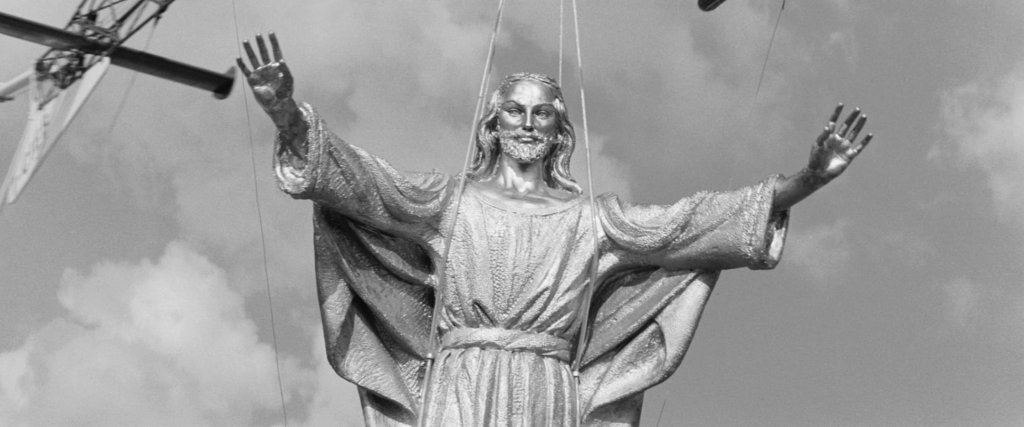
We all know the iconic images: the statue of Christ flying through Rome, transported by a helicopter; wild nighttime parties in the Baths of Caracalla; believers carrying the sick on stretchers, tabloid journalists and TV people crowding two small children that claim to have seen the Madonna; and, always and especially, Anita Ekberg in the Fontana di Trevi.

Continue reading